ace214
- 28
- 0
In Figure P4.30, m1 = 9.5 kg and m2 = 3.5 kg. The coefficient of static friction between m1 and the horizontal surface is 0.60 while the coefficient of kinetic friction is 0.30.
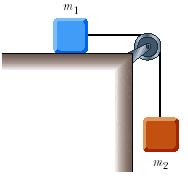 (Why can't I post this image in the message?)
In case you don't feel like looking at the picture, there are two masses connected by a frictionless pulley- m1 is on the table, m2 is hanging off the table.
(a) If the system is released from rest, what will its acceleration be?
(b) If the system is set in motion with m2 moving downward, what will be the acceleration of the system?
=========================================
I assume that the basic equation is the same for both parts just with different coefficients of friction. (Is this correct?) So I start with
m1a1 = T - forceFriction
m2a1 = T - m2g
Then I plug in -a1 for a2 in the second problem giving me -m2a1 = T - m2g => m2a1 = -T +m2g
Then add these two equations together, canceling out the tension.
m1a1 + m2a1 = m2g - Ff => a1(m1 + m2) = m2g - Ff
Then I solve for a using +9.8 for g in all cases. I eventually get -1.66 but this is not the answer. WebAssign says it differs by order of magnitude...
==========================================
I think something may be wrong with my signs in one way or another but I have tried multiple ways. Thanks for any help.
In case you don't feel like looking at the picture, there are two masses connected by a frictionless pulley- m1 is on the table, m2 is hanging off the table.
(a) If the system is released from rest, what will its acceleration be?
(b) If the system is set in motion with m2 moving downward, what will be the acceleration of the system?
=========================================
I assume that the basic equation is the same for both parts just with different coefficients of friction. (Is this correct?) So I start with
m1a1 = T - forceFriction
m2a1 = T - m2g
Then I plug in -a1 for a2 in the second problem giving me -m2a1 = T - m2g => m2a1 = -T +m2g
Then add these two equations together, canceling out the tension.
m1a1 + m2a1 = m2g - Ff => a1(m1 + m2) = m2g - Ff
Then I solve for a using +9.8 for g in all cases. I eventually get -1.66 but this is not the answer. WebAssign says it differs by order of magnitude...
==========================================
I think something may be wrong with my signs in one way or another but I have tried multiple ways. Thanks for any help.
