| Thread Closed |
resistor in parallel/series |
Share Thread | Thread Tools |
| Sep14-08, 12:40 AM | #1 |
|
|
resistor in parallel/series
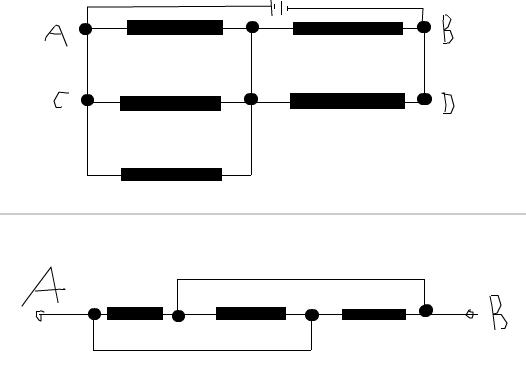
How can i determine resistors are connected in parallel or in series?
By current or potential.difference? The following are some complicated example..
|
| Sep14-08, 12:42 AM | #2 |
|
|
Resistors are in parallel when they share the same nodes. They are in series when the same current flows through each.
|
| Sep14-08, 12:45 AM | #3 |
|
|
Hey thanks! What's the meaning of nodes?
|
| Sep14-08, 12:46 AM | #4 |
|
|
resistor in parallel/series
its a branching point
|
| Sep14-08, 12:51 AM | #5 |
|
|
A node is where two or more circuit elements meet, so the voltage at every point in a node will be the same.
Ive taken this image from wikipedia, but its a pretty good image for describing what nodes are: Basically, each of the three colours form a node each. In your first image, can you see how there are three nodes? Each resistor is connected to two nodes, one at each terminal. If two resistors are in parallel, then they are both connected to the same two nodes. |
| Sep14-08, 01:15 AM | #6 |
|
|
![]() In the picture above R3 & R4 are in parallel R1 & R2 are in series When resistor are not in parallel, Are they must be in series? Thanks so much! |
| Sep14-08, 01:22 AM | #7 |
|
|
If resistors are not in parallel, it does not necessarily mean they must be in series. R1 and R2 are not in series. If there was a current coming out of the left of R2, it would split up at that junction, so not all of the current through R2 would go through R1, some would go through the voltage source. |
| Sep14-08, 01:54 AM | #8 |
|
|
Or the voltage of RED and BLUE nodes are the same? ![]() Secondly,In picture above, it seem current would split up in Junction X and Y however the answer is two resistor in series.Why? |
| Sep14-08, 03:04 AM | #9 |
|
|
The red and blue nodes are at different voltages.
Have you drawn the diagram correctly? I wouldnt have thought there were any in series. |
| Sep14-08, 05:24 AM | #10 |
|
Recognitions:
|
He meant to say there the problem may be reduced to 2 equivalent resistors in series, which is correct. For the second one, I suggest you denote one node by VA and the other by VB. Then trace out all the possible paths between VB and VA. You'll find that it reduces to a single configuration.
EDIT: danago, I think you're looking at the wrong circuit. He was referring to his, not the Wikipedia one. |
| Thread Closed |
| Tags |
| parallel, resistor, series |
| Thread Tools | |
Similar Threads for: resistor in parallel/series
|
||||
| Thread | Forum | Replies | ||
| Resistances in Series, Parallel, and Series-Parallel Combinations | Advanced Physics Homework | 1 | ||
| Series and Parallel Resistor | Electrical Engineering | 1 | ||
| Parallel Resistor | Introductory Physics Homework | 3 | ||
| How to calculate current of a resistor "inside" of another parallel resistor? | Introductory Physics Homework | 2 | ||
| 2 series resistorss are in parallel with another resistor.. | Introductory Physics Homework | 12 | ||