Bystander said:
---annddd --- have the emissivities and concentration data necessary for the integration.
The calculation I refer to is of the radiative forcing from changes in atmospheric composition. It uses emissivities for the various gases you might include, and you can also add here that it uses profiles of pressure, concentration and temperature; all up and down the atmospheric column. The change from CO
2 concentrations depends also on the concentrations of other gases in the atmosphere.
That "whole pile of assumptions" is where there is a whole lot of room for discussion --- and, given the guidelines for Earth sciences posting, can be regarded as "speculative."
That's a bad misuse of the term "speculative". It's flatly wrong to speak of "speculative" when what you really mean are bounded uncertainities based on measurement uncertainties of the quantities involved. Furthermore, as we are calculating a forcing, many uncertainities have only a small impact. The result of doubled CO
2 concentrations is a forcing, or a change of about 3.7 W/m
2 in the energy balance, and that holds over a range of atmospheric composition, temperature and pressure profiles.
The net energy flux can differ quite a lot, while the change in flux from change in CO
2 may remain about the same or vary only slightly.
Calculation of a radiative forcing
Concentrations of gases and changes in pressure and in temperature up and down the atmosphere are not "speculative". They are measured, and they have uncertainties, and that constrains the accuracy of results.
The emissivity of gases is not "speculative". It's based thoroughly on theory and observation. This calculation requires you to look in very fine detail at the absorption spectrum of a gas, and at line broadening effects with pressure and temperature, and there are well established tools for doing this.
The consequent implications for radiative balance are not "speculative". They are grounded solidly in measurement and basic physics, and the results are definite. Like any complex measurement in science they have an associated error term. From this you can get as basic data that a doubling of CO
2 levels will lead to about 3.7 W/m
2 change in the energy balance of the Earth. The relation is approximately logarithmic, which is why it is given in terms of doublings. Increase by a factor of 1.414 and you get half the effect. The word "about" is needed partly from measurement errors, but more importantly because of natural variations in conditions that impact the calculation, of cloud and temperature and so on. The number has an accuracy of about 10%.
Reference: Myhre, G, Highwood, EJ, Shine, KP. "New estimates of radiative forcing due to well mixed greenhouse gases", in Geophysical Research Letters, Vol 25, No 14, pp2715-2718. July 15 1998.
This reference gives the result in natural logarithms rather than log base 2. The forcing is 5.35 W/m
2 per natural log CO
2. This is a basic reference for the calculation. There are other calculations since, giving about the same numbers, but this is the key reference for the subject.
This is only a matter of "discussion", in the usual sense for a forum like this. There's lots of scope for useful educational discussion against a background of science that all of us are trying to learn about, for clarifying details, learning more about it, and understanding it better.
It is not a matter for debate over whether temperature or pressure or emissivity unknowns might invalidate the whole result – because physicsforums is not intended to be dealing with fringe or crank science. The unknowns in temperature, pressure and emissivity are all already a part of the calculation I refer to, and they show up as part of the 10% uncertainty on the number 5.35 W/m
2 per Ln(CO
2).
Emissivity and transmittance spectra
If you want know more of the fine details, there is an excellent on-line tool used by researchers involved in radiative transfer calculations for gases. See:
Spectral Calculator, an on-line tool supplied for use by researchers and other interested parties. This is a very heavy duty calculation and full use requires a subscription, but there's a lot a visitor can do for free. It's making available the
http://www.gats-inc.com/linepak.htm suite of algorithms for spectra in a whole range of cases, from an atmosphere to gas cells in a laboratory. This is a basic tool for a working scientist.
To give you an idea of why you really want a supercomputer for this, here is a bit of a spectrum. It's taken from the on-line calculator, using N
2O in a gas cell 1 meter long, held at 1 atm pressure and 296K temperature, and it corresponds to a small part of the whole spectrum, from wavenumber 2300 cm
-1 to 2400 cm
-1.
Note the fine details of the absorption lines in the spectrum. They will broaden with pressure and temperature. Unfortunately I gen't get a graph for the full spectrum, but it is full of bumps and dips; this graph zooms in and shows the fine details at higher spectral resolution.
The full calculation of radiative forcing integrates over the whole spectrum, line by line, and over the whole atmospheric column, at least up into the levels where the remainder is optically thin. It uses all the various gases, and a profile of temperature and pressure. And it repeats this for different latitudes and times of day. Then you do it all again, but with a change in the CO
2 level. Repeat as required with different temperature and pressure profiles, to get a mean impact for a given change in CO
2 concentration.
If that sounds arduous… it is. But it is not speculative. The result has an associated uncertainty, of course. It's about 10%. If you think the radiative forcing for doubled CO
2 might be 2.5 W/m
2, or 5 W/m
2, then you are in basic conflict with fairly fundamental physics.
The "debate"
Bottom line. There are lots of people out there who, for whatever reason, don't accept that CO
2 has a strong impact on climate and temperature, and who apparently think that the widespread acceptance of this impact in the scientific literature is because of some hoax, or because of a bias by scientific publishers as to what they'll accept, or because the critic simply has no idea of what actually appears in the literature and thinks there's still some big scientific debate over the matter.
There is certainly lots of real scientific debate going on. The impact of a forcing on temperature, for example, is not nearly so well known as the radiative forcing number for doubled CO
2.
But you are flatly incorrect to think that the point I raise here, on the calculation of CO
2 radiative forcing, is "speculative". It's basic physics.
The real debate is over the climate response in temperature to forcings, over regional variations in forcings and temperatures, and most especially over the forcings for other factors – like aerosols, for example – where we don't have nearly so good an idea of the numbers. Globally, however, greenhouse effects stand out as the major forcing for global climate changes over recent decades.
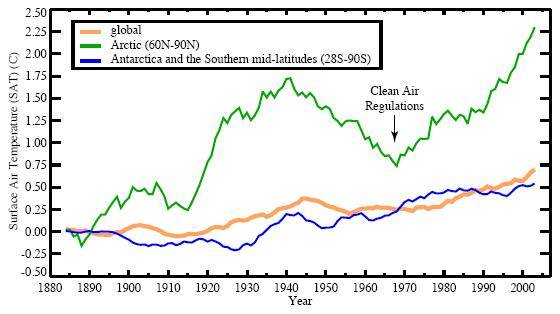
Shindell and Faluvegi
The paper by Shindell and Faluvegi is solid science, all in the context of the above data. Indeed, these guys are particularly expert in the kinds of atmospheric modeling that is required for the calculations I'm talking about above.
Their paper is talking about the
difference between the Arctic and other latitudes. Over recent decades, the Arctic has been warming at about 1.5C/decade, where the global trend is more like 0.2C/decade. A crude back of the envelope calculation indicates that the effects of increasing CO
2 is in the ball park of the global trend, but not the Arctic trend. That calculation relies upon the numbers I've quoted above, and sensitivity numbers such as Shindell and Faluvegi use in their paper (which are pretty bog-standard magnitudes).
Taking other greenhouse gases into effect doesn't change things all that much. So it makes good sense to me that the rate of warming in the Arctic cannot possibly be explained as a direct greenhouse effect. The global warming trend is mainly a greenhouse effect, but on top of that there's something else going on in the Arctic. Shindell and Faluvegi make a persuasive case that aerosols and black carbon may be the major contributor to the 1.5C/decade Arctic temperature trend.
Cheers -- Sylas