Thread Closed

need help to build long range IR transmitter

 
Share Thread
Aug11-09, 12:46 AM   #1
 

need help to build long range IR transmitter


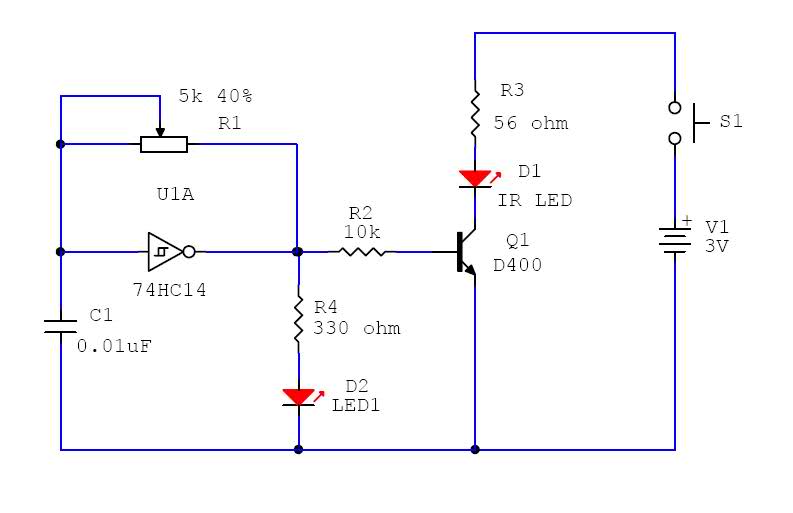
hey guys I'm trying to build a 38khz transmitter that works about 5m(at least) but its unsuccessful.currently I'm using this circuit. but it cant use more than 50cm. i have no idea how to increase rage.


equation is f=1/(0.8*R1*C1)
I have some NE555 and a 9V battery some transistors and couple of 0.1uf,0.01uf caps.can some one give me a circuit with higher range (at least 5m).
i know i have to give large current to IR led but i cant figure out a way to do that.

and i want some thing that will not eat 9v battery.
thanks
PhysOrg.com engineering news on PhysOrg.com

>> Four microphones, computer algorithm enough to produce 3-D model of simple, convex room
>> Faster, more precise airstrikes within reach
>> How smart technology could change public transit
Aug11-09, 12:55 AM   #2
 
Mentor
Where to start?

The HC14 circuit you show will oscillate about mid-rail, not shutting off the NPN well, I would think. The voltage source you show is not 9V, and the rest of the power connections are not shown (are they shared and switched by the same pushbutton as well?

If you want to put full power into the base drive of the main drive NPN (or Darlington), you would not steal current for a status LED from that base drive.

And what optical magnifiers have you added to your link? IR focusing elements would help your overall gain a lot, if they can be applied.

finally, are you planning on modulating this link with data, once you get the range part figured out?
Aug11-09, 01:00 AM   #3
 
Mentor
You should be putting many 10s or 100mA through your xmit IR LED to get some range. What are you targeting?

And what does your IR receiver look like? That is a big part of your range budget too, right?
Aug11-09, 01:01 AM   #4
 

need help to build long range IR transmitter


Quote by berkeman View Post
Where to start?

The HC14 circuit you show will oscillate about mid-rail, not shuting off the NPN well, I would think. The voltage source you show is not 9V, and the rest of the power connections are not shown (are they shared and switched by the same pushbutton as well?

If you want to put full power into the base drive of the main drive NPN (or Darlington), you would not steal current for a status LED from that base drive.

And what optical magnifiers have you added to your link? IR focusing elements would help your overall gain a lot, if they can be applied.

finally, are you planning on modulating this link with data, once you get the range part figured out?
well i use 3V with this circuit.but i have 9v battery if i have make 555 circuit.
no magnifired use.and i don't send data.i just want to make on off switch.
thanks
Aug11-09, 01:03 AM   #5
 
Quote by berkeman View Post
You should be putting many 10s or 100mA through your xmit IR LED to get some range. What are you targeting?

And what does your IR receiver look like? That is a big part of your range budget too, right?
i have HRM3800 and vs1838 (similar to tsop1738 i guess) ir reciever
Aug11-09, 01:07 AM   #6
 
Mentor
Quote by aruna1 View Post
well i use 3V with this circuit.but i have 9v battery if i have make 555 circuit.
no magnifired use.and i don't send data.i just want to make on off switch.
thanks
Don't regulate 9V down to 3V. Use all 9V straight with several series-matched LEDs. Or better yet for battery life, use a buck DC-DC converter to convert 9V down to a lower voltage to drive the LEDs (so that you don't waste much power across current-limiting resistors).

Hammer the TX LED with as much current as it's rated for, and parallel up multiple LEDs if that works. Drive the status LED separately from the TX LED(s) to focus your power.

Can you post your receiver circuit? And you definitely should look into IR optics for a point-to-point IR link...
Aug11-09, 01:31 AM   #7
 
Quote by berkeman View Post
Don't regulate 9V down to 3V. Use all 9V straight with several series-matched LEDs. Or better yet for battery life, use a buck DC-DC converter to convert 9V down to a lower voltage to drive the LEDs (so that you don't waste much power across current-limiting resistors).

Hammer the TX LED with as much current as it's rated for, and parallel up multiple LEDs if that works. Drive the status LED separately from the TX LED(s) to focus your power.

Can you post your receiver circuit? And you definitely should look into IR optics for a point-to-point IR link...
no no i have 3v supply (2 AA batteries)

hammering is the problem.i dont know how to do it.

reciver
Aug11-09, 02:14 AM   #8
 
Recognitions:
Science Advisor Science Advisor
You might like to have a look at the following. It gives some information about Radio Amateurs in Australia communicating over 145 km (about 90 miles) with red light LEDs.

They used the fresnel lenses that are used in overhead projectors.

http://www.bluehaze.com.au/modlight/

http://www.bluehaze.com.au/modlight/...IEDfresnel.gif

It may give you some idea of what is needed. Please accept that I haven't even read all the links so I take no responsibility for the contents.
Aug11-09, 02:43 AM   #9
 
Quote by vk6kro View Post
You might like to have a look at the following. It gives some information about Radio Amateurs in Australia communicating over 145 km (about 90 miles) with red light LEDs.

They used the fresnel lenses that are used in overhead projectors.

http://www.bluehaze.com.au/modlight/

http://www.bluehaze.com.au/modlight/...IEDfresnel.gif

It may give you some idea of what is needed. Please accept that I haven't even read all the links so I take no responsibility for the contents.
thanks
Aug11-09, 01:58 PM   #10
 
I'm a bit surprised that you're not getting some kind of range out of this. Even though there are places it can be improved a bit.

Putting 9 volts across the 74HC14 isn't going to work - It won't like anything over 6. But if you choose to go over 6, you might try the CD40106. It's basically the same type of part, though the output drive has about 100-200 series equivalent output impedance.

In the mean time, every other remote uses 3 volts. That's handy, because AA cells give you a great energy density / $.

I'd start by increasing the LED drive. Most any LED can take 25ma average, and the large ones used for remote controls can usually take 100ma. Even for a 25ma part, you can apply 50ma for a rapid 50% duty cycle, so I'd design to that.

I don't know the voltage drop of youre LED, but as a guess, 1.8 volts is typical for an IR type. You'll also have a voltage drop across the transistor. Say .2 volts if it were well driven to sturation (which it's not, but we'll return to this).

So, you have 3V - 1.8V - .2V = 1V across your resistor.
For 50ma, R = V / I => R=20 ohms.

Now, your transistor is sinking about 50 ma, so it needs adequate base drive. I'm not sure what a D400 is (a 2SD400?), so I'm gonna guess it has an hfe on the low side, say 40. To saturate the transistor, drive it with about twice as much as it will ever need in the linear range.

Ib = 2 x (Ic / hfe) => Ib = 2x ( 50ma / 40) => 2.5ma

(Vhi - Vbe) / Rb = ib => Rb = (Vhi - Vbe)/ib => Rb = (3 - .65)/.0025 = 940

Vhi will be lower than 3V because of the internal on resistance of the 74HC14's PFET, but the HC series has pretty low output impedance, so it's not likely to be 50 ohms or less. I'd stick with a 910 ohm resistor for Rb.

I guess the only other thing I can think of is that you got a really poor output LED. That happens as the efficeiny of the things varies 100's to one. If you can scrap one from a remote, those are great.

Best Luck,

- Mike
Aug11-09, 07:51 PM   #11
 
Quote by Mike_In_Plano View Post
I'm a bit surprised that you're not getting some kind of range out of this. Even though there are places it can be improved a bit.

Putting 9 volts across the 74HC14 isn't going to work - It won't like anything over 6. But if you choose to go over 6, you might try the CD40106. It's basically the same type of part, though the output drive has about 100-200 series equivalent output impedance.

In the mean time, every other remote uses 3 volts. That's handy, because AA cells give you a great energy density / $.

I'd start by increasing the LED drive. Most any LED can take 25ma average, and the large ones used for remote controls can usually take 100ma. Even for a 25ma part, you can apply 50ma for a rapid 50% duty cycle, so I'd design to that.

I don't know the voltage drop of youre LED, but as a guess, 1.8 volts is typical for an IR type. You'll also have a voltage drop across the transistor. Say .2 volts if it were well driven to sturation (which it's not, but we'll return to this).

So, you have 3V - 1.8V - .2V = 1V across your resistor.
For 50ma, R = V / I => R=20 ohms.

Now, your transistor is sinking about 50 ma, so it needs adequate base drive. I'm not sure what a D400 is (a 2SD400?), so I'm gonna guess it has an hfe on the low side, say 40. To saturate the transistor, drive it with about twice as much as it will ever need in the linear range.

Ib = 2 x (Ic / hfe) => Ib = 2x ( 50ma / 40) => 2.5ma

(Vhi - Vbe) / Rb = ib => Rb = (Vhi - Vbe)/ib => Rb = (3 - .65)/.0025 = 940

Vhi will be lower than 3V because of the internal on resistance of the 74HC14's PFET, but the HC series has pretty low output impedance, so it's not likely to be 50 ohms or less. I'd stick with a 910 ohm resistor for Rb.

I guess the only other thing I can think of is that you got a really poor output LED. That happens as the efficeiny of the things varies 100's to one. If you can scrap one from a remote, those are great.

Best Luck,

- Mike
ok that is a great answer,completely described,thanks.
in sri lanka we cant buy IR LEDs by part number or type. we can only buy just IR LEDs
Aug13-09, 02:15 AM   #12
 
Recognitions:
Science Advisor Science Advisor
I misread your query as 5 miles. Oops! From Sri Lanka, you probably mean meters.

5 meters should be no problem, but I see you are using a TSOP 1738 receiver which is a 38 KHz carrier device. You would need to be sure your IR diode is being pulsed very close to 38 KHz. I don't see any reference to this in your posts.

According to the formula in the datasheet, R1 should be about 3289 ohms to get 38 kHz, but this will depend on the devices a bit. Go really close and adjust R1 for best response and then back off and try again.

If you have access to a digital camera, you can observe the IR diode in the viewfinder to check that it is actually working and how directional it is.

IR receivers usually have a lens on the front of them so they are quite directional.

Also, some compact fluorescent lights operate at about 38 KHz and these will produce bright pulses of Infra Red light at this frequency and may stop the IR receiver receiving your signal.

Try a TV remote control and see what sort of range you get with your receiver with that. That might tell you if there is a problem in the receiver.

Others may have mentioned it, but your 10 K is a bit big. Maybe 2.2 K. Remove the 330 ohms and LED.
Aug13-09, 02:35 AM   #13
 
WELL I FINISHED IT,
Remote fan regulator
http://aruna1.web44.net/electronics
Thread Closed

Similar discussions for: need help to build long range IR transmitter
Thread Forum Replies
long range distance sensor Electrical Engineering 4
ultra long range projectile problem Introductory Physics Homework 12
Long range effect of Nuclear Power plants. Academic Guidance 0
ow long does it take for the charge to build up to 9.0 µC? RC circuits Introductory Physics Homework 7
article about long range artillery Introductory Physics Homework 12