Calculating average speeds when distance is unknown

  • Context: High School 
  • Thread starter Thread starter BogMonkey
  • Start date Start date
  • Tags Tags
    Average
Click For Summary
SUMMARY

The discussion centers on calculating average speeds when the total distance is unknown, specifically using the formula v = d/t. Users are directed to the website SolvePhysics.com, which provides physics questions and solutions, including a specific kinematics problem. The solution involves rearranging the formula to t = d/v and substituting known values for a portion of the journey to derive the average speed. This method effectively addresses the challenge of working with incomplete distance information.

PREREQUISITES
  • Understanding of basic physics concepts, particularly kinematics.
  • Familiarity with the formula v = d/t (velocity equals distance divided by time).
  • Ability to manipulate algebraic equations to solve for unknown variables.
  • Basic knowledge of fractions and their application in real-world problems.
NEXT STEPS
  • Explore additional kinematics problems on SolvePhysics.com to reinforce understanding.
  • Learn about the implications of average speed versus instantaneous speed in physics.
  • Study the concept of distance-time graphs and their relevance to speed calculations.
  • Investigate real-world applications of kinematics in various fields such as engineering and sports science.
USEFUL FOR

Students studying physics, educators teaching kinematics, and anyone interested in solving real-world problems involving speed and distance calculations.

BogMonkey
Messages
76
Reaction score
0
I found a brilliant website with physics questions + solutions here
http://www.solvephysics.com/problems_kinematics.shtml
the question I'm on they only tell you the speed traveled in fractions of the total distance but don't tell you the total distance. I looked at the solution but couldn't make much sense of where they got this from
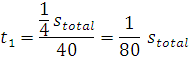
kinematics_problem86_clip_image008.gif

heres the solution page
http://www.solvephysics.com/kinematics_problem86.shtml
 
Last edited by a moderator:
Physics news on Phys.org
You know [itex]v = d/t[/itex], right? That can be rearranged to [itex]t = d/v[/itex]. Then just plug in values for that quarter of the journey.
 

Similar threads

  • · Replies 9 ·
Replies
9
Views
2K
  • · Replies 16 ·
Replies
16
Views
6K
  • · Replies 7 ·
Replies
7
Views
5K
Replies
5
Views
2K
  • · Replies 6 ·
Replies
6
Views
2K
  • · Replies 5 ·
Replies
5
Views
3K
  • · Replies 5 ·
Replies
5
Views
10K
  • · Replies 5 ·
Replies
5
Views
4K
  • · Replies 8 ·
Replies
8
Views
2K
  • · Replies 26 ·
Replies
26
Views
15K