Thread Closed

Moment Inertia of a cube

 
Share Thread
Jan12-10, 08:22 AM   #1
 

Moment Inertia of a cube


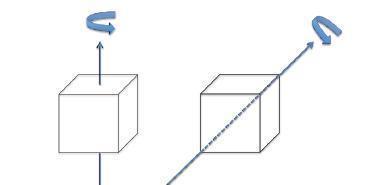
To which of the two cubes has a larger moment of inertia?
Click image for larger version

Name:	untitled.JPG
Views:	35
Size:	5.3 KB
ID:	23012
I think it's the right one, is it correct?
How can I explain that without using the parallel axis theorem?
PhysOrg.com science news on PhysOrg.com

>> City-life changes blackbird personalities, study shows
>> Origins of 'The Hoff' crab revealed (w/ Video)
>> Older males make better fathers: Mature male beetles work harder, care less about female infidelity
Jan12-10, 12:10 PM   #2
 
Mentor
Quote by Cosmossos View Post
To which of the two cubes has a larger moment of inertia?
Attachment 23012
I think it's the right one, is it correct?
How can I explain that without using the parallel axis theorem?
Why do you say the right one? Are you familiar with the relevant equation for calculating the moment of inertia?
Jan12-10, 01:01 PM   #3
 
what relevant equation?

I think it's the right one because We know that the minimal moment of inertia is throw the principal axes that goes throw the center of mass. in the right one , the rotation isn't throw the principal axes . there is also the following theorem :

The moment of inertia about an arbitrary axis is equal to the
moment of inertia about a parallel axis passing through the
center of mass plus the moment of inertia of the body about
the arbitrary axis, taken as if all of the mass M of the body
were at the center of mass.

Am I wrong?
Jan12-10, 04:05 PM   #4
 
Mentor

Moment Inertia of a cube


Quote by Cosmossos View Post
what relevant equation?

I think it's the right one because We know that the minimal moment of inertia is throw the principal axes that goes throw the center of mass. in the right one , the rotation isn't throw the principal axes . there is also the following theorem :

The moment of inertia about an arbitrary axis is equal to the
moment of inertia about a parallel axis passing through the
center of mass plus the moment of inertia of the body about
the arbitrary axis, taken as if all of the mass M of the body
were at the center of mass.

Am I wrong?
There may be a shortcut way to tell which has a higher moment of inertia, but for me, I'd need to calculate it. I'd use the standard definition of the Mmoment of inertia, and evaluate thge integral for the diagonal case. I don't think you can use the parallel axis theorm, since the two axes are not parallel.

I'd do the 2-D case first, to see if it offered some intuition. That is, the moment of inertia for a flat rectangular sheet, with the axes going straight versus diagonal.
Jan12-10, 04:58 PM   #5
 
Recognitions:
Gold Membership Gold Member
Homework Helper Homework Help
Science Advisor Science Advisor
Retired Staff Staff Emeritus
I think they'll turn out to be equal. Try computing the moment of inertia tensor.
Thread Closed

Similar discussions for: Moment Inertia of a cube
Thread Forum Replies
Area moment of inertia and second moment of inertia Mechanical Engineering 1
hollow cube - moment of inertia Introductory Physics Homework 15
what tis hte difference betweeen mass moment of inertia and inertia Classical Physics 11
Second Moment of Inertia - Area Moment of Inertia Classical Physics 1
What are moment of inertia, mass moment of inertia, and radius of gyration? Introductory Physics Homework 1