Designing a Safe Beam Support for an Exhaust Pipe

  • Thread starter Thread starter hughfrancis89
  • Start date Start date
  • Tags Tags
    Beam Support
Click For Summary

Discussion Overview

The discussion revolves around the design of a beam support for an exhaust pipe, focusing on safety factors, load calculations, and modeling approaches. Participants explore theoretical aspects of structural engineering relevant to this application.

Discussion Character

  • Technical explanation
  • Debate/contested
  • Mathematical reasoning

Main Points Raised

  • Hugh seeks guidance on ensuring a safety factor against yielding in the beam support design and questions how to calculate the load from the pipe on each support.
  • One participant suggests assuming a simply-supported beam for safety in design, rather than a fixed-end beam, due to uncertainty about the beam's fixity.
  • Another participant emphasizes the importance of considering fatigue in the design, particularly if cyclic loading is anticipated in the exhaust system.
  • There is a discussion about whether to model the load from the pipe as a distributed load or as point loads, with differing opinions on the appropriate approach.
  • Hugh confirms that modeling the pipe as a distributed load is correct for solving for the hanger point loads, as indicated by another participant.

Areas of Agreement / Disagreement

Participants express differing views on how to model the load from the pipe, with some advocating for a distributed load approach and others suggesting point loads. The discussion remains unresolved regarding the best modeling technique.

Contextual Notes

Participants have not provided specific numerical values or detailed assumptions regarding the load distribution or material properties, which may affect the design calculations.

hughfrancis89
Messages
2
Reaction score
0
Hi there! I have recently taken on an engineering job and have been tasked with designing a simple beam support for an exhaust pipe.

Because I'm still studying and I want to make sure I do this properly, I have decided to consult Physics Forums, as reading others posts have helped me so much in the past.

I have attached a picture of the design to this post. Basically I've just got to make sure there is a significant safety factor against yielding with the setup.
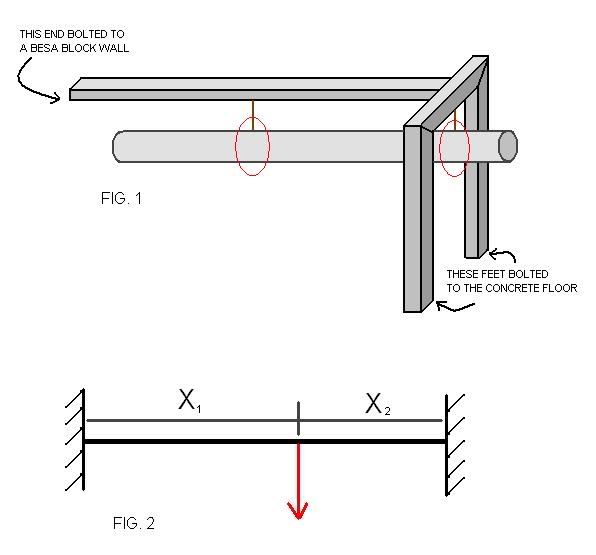
GeneratorFrame.jpg


I don't have any numbers to work with currently, I'm just getting the theory down pat first.

I assume I need to find the yield stress of the material, and compare that to the bending stress currently caused by the load from the pipe. Also, how would I calculate the load caused by the pipe on each support? Would it just be the weight of the pipe divided by two (due to the two supports) or would it be more complicated than that, because the supports arent evenly spaced?

Also I assume to model the top beam I would just use a fixed end beam as in FIG 2.

Thanks for the advice, apologies for the simple question!

Hugh
 
Engineering news on Phys.org
hughfrancis89: We don't really know the fixity of your top beam. Therefore, it might be safer for designing the midspan of the top beam if you assume a simply-supported beam for the top beam, instead of a fixed-end beam.

Draw a free-body diagram of the pipe and hanger supports. Use static equilibrium equations (summation of forces, and summation of moments) to solve for the tensile force in each hanger.

If you want a safety factor against yielding of, e.g., 1.50, then the applied bending stress on your beam should not exceed the beam material tensile yield strength divided by 1.50.
 
Important thing to remember:

Yield strength is typically a single cycle load application. In your exhaust system, do you anticipate any vibration or cyclic loadings? In so, then you need to also look at fatigue.
 
Thanks for the replies! I should model the pipe as a distributed load, right?
 
Looks like two point loads to me. Why would you think of it as a distributed load?
 
hughfrancis89 said:
I should model the pipe as a distributed load, right?
hughfrancis89: Yes, that is correct, if you are referring to paragraph 2 of post 2, to solve for the hanger point loads.
 

Similar threads

  • · Replies 6 ·
Replies
6
Views
2K
  • · Replies 7 ·
Replies
7
Views
3K
  • · Replies 1 ·
Replies
1
Views
2K
  • · Replies 2 ·
Replies
2
Views
4K
Replies
3
Views
2K
  • · Replies 4 ·
Replies
4
Views
17K
  • · Replies 1 ·
Replies
1
Views
3K
  • · Replies 2 ·
Replies
2
Views
3K
  • · Replies 6 ·
Replies
6
Views
6K
  • · Replies 8 ·
Replies
8
Views
3K