Thread Closed

*Quick question: When is VENUS visable in the sky in this period ?

 
Share Thread Thread Tools
Oct7-10, 12:02 AM   #1
 
Recognitions:
Gold Membership Gold Member

*Quick question: When is VENUS visable in the sky in this period ?


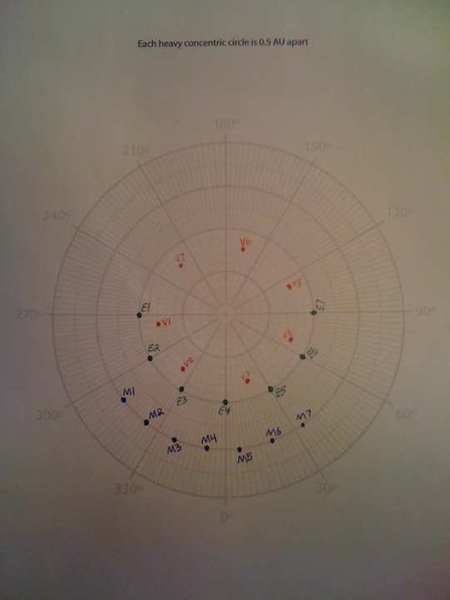
Given the following: Its a polar graph.

I am trying to figure out when is VENUS visable in the sky during this period (dawn, dusk, noon, midnight) ?

How do you figure that out? Also, Venus is red, earth is green on the chart.

Thanks!

 
PhysOrg.com
PhysOrg
astronomy news on PhysOrg.com

>> Galaxy's Ring of Fire
>> South Africa's new radio telescope reveals giant outbursts from binary star system
>> Researchers find winds on Uranus and Neptune confined to thin atmosphere layer
Oct7-10, 02:23 AM   #2
 
Admin
Is it at all possible that Venus is visible at midnight?
 
Oct7-10, 07:22 AM   #3
 
Also, remember that the Earth rotates in the same direction that it revolves around the sun (counter-clockwise in your graph). This should help you figure out when it is visible in the morning, and when in the evening. Try drawing the Earth as a larger circle, instead of a dot, and draw on which part of the Earth it is day and which it is night.
 
Oct7-10, 08:14 AM   #4
 
Recognitions:
Gold Membership Gold Member

*Quick question: When is VENUS visable in the sky in this period ?


am I right to assume that venus is visable from earth in the evening and morning ?

I need some help here
 
Oct7-10, 08:34 AM   #5
 
Admin
Morning and evening - yes.
 
Oct7-10, 08:35 AM   #6
 
Recognitions:
Gold Membership Gold Member
Quote by Borek View Post
Morning and evening - yes.
Great, can u possible tell me how, since I have to answer the same questoion for mars, which are the blue points
 
Oct7-10, 08:38 AM   #7
 
Without doing your homework for you, chronologically the Earth at E1 corresponds to the position of Venus at V1, and so forth. Since the Earth turns on its axis so that planetfall brings the Sun into view in the east, then E spins counterclockwise in your diagram. So V1 will come into view first for E1 and then the Sun at the center of your diagram will come into view. Thus, Venus comes into view in the early morning (before sunrise) for the Earth at E1.
 
Oct7-10, 08:42 AM   #8
 
Recognitions:
Gold Membership Gold Member
Quote by Arch2008 View Post
Without doing your homework for you, chronologically the Earth at E1 corresponds to the position of Venus at V1, and so forth. Since the Earth turns on its axis so that planetfall brings the Sun into view in the east, then E spins counterclockwise in your diagram. So V1 will come into view first for E1 and then the Sun at the center of your diagram will come into view. Thus, Venus comes into view in the early morning (before sunrise) for the Earth at E1.
Oh ok great. So, its not visable at night then based on those points?

How about mars?
 
Oct7-10, 08:50 AM   #9
 
V5 looks like it would be visible for some time from E5 before sunrise.

A point on E1 is/has been facing away from the Sun when M1 is in view, so night viewing.
 
Oct7-10, 08:56 AM   #10
 
Quote by nukeman View Post
Great, can u possible tell me how, since I have to answer the same questoion for mars, which are the blue points

E1 through E7 represent points in Earth's year; each one is a few weeks apart. At any given one of them, Earth is spinning on its axis like a top - these are its days.

Imagining yourself standing on that dot that is Earth, you are spinning counterclockwise, round and round. No, forget imagining - draw it. Draw a dot on the Earth's dot that represents you, standing on the Earth.

From your point of view, a little dot on the bigger dot, which is rotating counterclockwsie, the sun will move past you from left to right. It will rise on your left and set on your right. When the Earth dot rotates so that the you-dot is directly away from the Sun, that is midnight to you, when the you-dot is pointed directly at the sun, that is noon to you.

This is key. Understanding this CCW rotation is the key to knowing the day-night cycle of Earth, particularly when it is sunrise and when its sunset.

Now, as the you-dot observes the sun rise on its left and set on its right, where is Mars? Is Mars ever visible in you-dot's sky at the same time as the Sun? As you-dot rotates, does Mars become visible before the Sun becomes visible? Does Mars stay visible after the Sun sets?
 
Oct7-10, 09:15 AM   #11
 
Admin
As you were suggested several times - replace dots with small circles, and put a dot - which will be observer - on the planet surface. When observer is close to the Sun - what time is it? When observer is on the other side of the circle - what time is it? Is it possible to see Venus when you are on the side opposite to Sun?
 
Oct7-10, 11:28 AM   #12
 
Quote by nukeman View Post
am I right to assume that venus is visable from earth in the evening and morning ?

I need some help here
Note that it is sometimes visible in the morning and sometimes in the evening, but never visible in both the morning and the evening.
 
Oct7-10, 01:20 PM   #13
 
Admin
Quote by phyzguy View Post
Note that it is sometimes visible in the morning and sometimes in the evening, but never visible in both the morning and the evening.
That's not quite true. It depends on where you are and on the night length.
 
Oct7-10, 03:21 PM   #14
 
Quote by Borek View Post
That's not quite true. It depends on where you are and on the night length.
There are some edge conditions in real life, yes.

But in this scenario we are not provided with data to account for seasonal changes. You can say nothing at all about day/night length when providing answers.
 
Oct7-10, 05:15 PM   #15
 
Admin
Sure. Just the statement was a little bit too strong to my liking. Especially after not seeing nights for two weeks far North this Summer.
 
Thread Closed
Thread Tools


Similar Threads for: *Quick question: When is VENUS visable in the sky in this period ?
Thread Forum Replies
A quick question on the twin paradox (quick I promise!) Special & General Relativity 7
visable light Introductory Physics Homework 5
Venus Synodic Period Astrophysics 1
venus transit question Astrophysics 7
seeing outside of the visable spectrum General Physics 3