New Reply

Contortion tensor

 
Share Thread
Dec13-10, 06:18 AM   #1
 

Contortion tensor


I have been reading papers on teleparallel gravity as well as the recent modified gravity called f(T) (see e.g. astro-ph/1005.3039v2).

I am confused about the contortion tensor, which is defined as the difference between the teleparallel connection and the usual GR connection. In the paper above, as well as say, equation 7 of gr-qc/1001.3407 and equation 6 of gr-qc/0607138v1, it is given by:


However, page 254 of Nakahara "Geometry, Topology and Physics" as well as some papers such as this (which quoted Nakahara), give


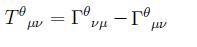
I am confused why there's discrepancies in the extra minus signs. Granted that the torsion tensor in the teleparallel papers seem to differ from Nakahara's text and differential geometry texts by an extra minus sign, i.e.
instead of
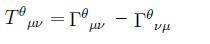
shouldn't the contortion then differ by an *overall* minus sign instead of having only one of the terms differ in sign?
PhysOrg.com science news on PhysOrg.com

>> Leading 3-D printer firms to merge in $403M deal (Update)
>> LA to give every student an iPad; $30M order
>> CIA faulted for choosing Amazon over IBM on cloud contract
Dec14-10, 01:39 AM   #2
 
Did you take into account the fact that [itex]T^\lambda_{\mu\nu}[/itex] is antisymmetric in [itex]\mu,\nu[/itex] whichever way it is defined?
Dec14-10, 05:04 AM   #3
 
Quote by arkajad View Post
Did you take into account the fact that [itex]T^\lambda_{\mu\nu}[/itex] is antisymmetric in [itex]\mu,\nu[/itex] whichever way it is defined?
Yes, as far as I can tell, well, maybe there are mistakes in my calculations somewhere...
Dec14-10, 06:13 AM   #4
 

Contortion tensor


One possible reason for discrepancies may be due to the fact that in gr-qc/0607138v1 they have index [itex]\theta[/itex] which refers to an orthonormal tetrad. They can mean something else by the connection coefficients. It is not clear. This needs to be checked. Nakhara based formulas for the coordinate frame are certainly correct.
Dec14-10, 07:20 AM   #5
 
Quote by arkajad View Post
One possible reason for discrepancies may be due to the fact that in gr-qc/0607138v1 they have index [itex]\theta[/itex] which refers to an orthonormal tetrad. They can mean something else by the connection coefficients. It is not clear. This needs to be checked. Nakhara based formulas for the coordinate frame are certainly correct.
OK. I will look into that. Thanks :-)
Dec14-10, 12:33 PM   #6
 
Blog Entries: 9
Recognitions:
Homework Helper Homework Help
Science Advisor Science Advisor
I have checked Nakahara's calculations and they are correct. He uses the convention for covariant differentiation different than here: http://en.wikipedia.org/wiki/Covariant_derivative. Specifically, Nakahara uses

[tex] \nabla_{\mu}g_{\nu\lambda}:=\partial_{\mu}g_{\nu\lambda}-\Gamma^{\kappa}{}_{\mu\nu}g_{\kappa\lambda}-\Gamma^{\kappa}{}_{\mu\lambda}g_{\nu\kappa} =0 [/tex]

by the metricity condition imposed to the linear connection. If you compare this formula with the Wikipedia definition (semicolon notation), you can see the difference. The Wiki formula for the (0,2) tensor is wrong, it is not a consequence of the (0,1) tensor written there, but from a formula for the (0,1) tensor written with the lower indices of the connection backwards.

Checking the Wiki comment page, I see that somenone noticed this error, too:

Quote by Wiki
light incoherent Christoffel symbols index position
The article does not assume a symetric (torsion-free) connection, so it is not necessarily true that

Γkij = Γkji.
For example, in the section "coordinate description" the definition of the covariant derivative uses the "derivative index" of the Christoffel symbol to be the first lower index. The expression for the covariant derivative of a vector field is coherent with the definition used. On the other hand, the expressions for the covariant derivative of a dual field and for a general tensor field use the second lower index of the Christoffel symbol as the "derivative index".

My suggestion is to choose one convention and use it coherently. Personally, I'd rather use the second lower index of the Christoffel symbol as the "derivative index" because it maintains some coherence with the position of the index added by the semi-colon notation, but I have seen different texts using both of these conventions.

Marcelo Roberto Jimenez 15:19, 15 July 2010 (UTC)
Dec15-10, 01:28 PM   #7
 
Blog Entries: 9
Recognitions:
Homework Helper Homework Help
Science Advisor Science Advisor
Quote by yenchin View Post
I have been reading papers on teleparallel gravity as well as the recent modified gravity called f(T) (see e.g. astro-ph/1005.3039v2).

I am confused about the contortion tensor, which is defined as the difference between the teleparallel connection and the usual GR connection. In the paper above, as well as say, equation 7 of gr-qc/1001.3407 and equation 6 of gr-qc/0607138v1, it is given by:


However, page 254 of Nakahara "Geometry, Topology and Physics" as well as some papers such as this (which quoted Nakahara), give


I am confused why there's discrepancies in the extra minus signs. Granted that the torsion tensor in the teleparallel papers seem to differ from Nakahara's text and differential geometry texts by an extra minus sign, i.e.

instead of

shouldn't the contortion then differ by an *overall* minus sign instead of having only one of the terms differ in sign?
Adding to my post above, I'm telling you that there are basically 2 different conventions and definitions used throughout the literature. Nakahara used the above-mentioned convention/definition for the covariant derivative of a (0,2) tensor AND the following definition of the torsion tensor:

[tex] T^{\lambda}{}_{\mu\nu}:= \Gamma^{\lambda}{}_{\mu\nu}-\Gamma^{\lambda}{}_{\nu\mu} [/tex]

,while Aldrovandi & Pereira (quoted by 2 of the article you mention oposing Nakahara) use the following conventions/definitions:

[tex] \nabla_{\mu}g_{\nu\lambda}:=\partial_{\mu}g_{\nu\lambda}-\Gamma^{\kappa}{}_{\nu\mu}g_{\kappa\lambda}-\Gamma^{\kappa}{}_{\lambda\mu}g_{\nu\kappa} [/tex]

AND

[tex] T^{\lambda}{}_{\mu\nu}:= \Gamma^{\lambda}{}_{\nu\mu}-\Gamma^{\lambda}{}_{\mu\nu} [/tex].

Both approaches are correct. The authors follow the conventions they choose with precision, so that a confusion as the one pointed on the Wiki page does not exist.

The conventions of Aldrovandi and Pereira are probably more common in physics articles/books than the ones used by Nakahara (I remember the literature on the PGT), but, nonetheless, both are equally correct.
Dec15-10, 01:55 PM   #8
 
I suggest you check this paper by Pereira, where the explicit relation between Weitzenböck connection coefficients (used by Aldrovandi et al) and Christoffel symbols of the Levi-Civita connection is given. The rest should be an easy calculation.
Dec16-10, 12:50 AM   #9
 
Thanks to all the help guys. Really appreciated!
New Reply

Similar discussions for: Contortion tensor
Thread Forum Replies
Physics and science of contortion/flexibility/magic tricks General Physics 18
Riemann Curvature Tensor and working out independent components of a tensor generally Calculus & Beyond Homework 2
[Special relativity - Mathematical background] Tensor and pseudo-tensor Special & General Relativity 2
Rank 3 tensor created by taking the derivative of electromagnetic field tensor Advanced Physics Homework 1
I can't see how stress-energy tensor meets the minumum tensor requirement Special & General Relativity 4

