Darlo770
- 2
- 0
Hi, I'm a newbie here, i joined just now purely to ask this question that's been on my mind recently. Now i apologise if this question is fundamentally wrong (which it probably is), but I'm only the average person with an amateur interest in physics :P So don't laugh.
Firstly, as you know, we can visual the 'canvas' of space-time as a grid, such as here: (ignore the planet for now)
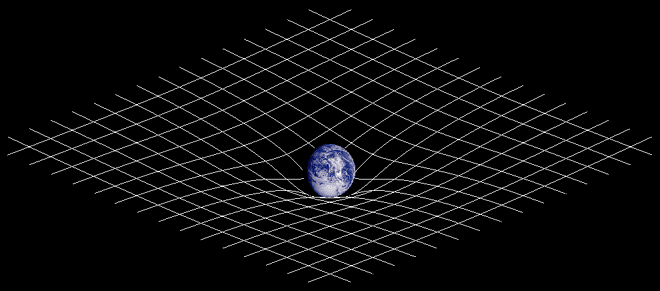 However, the above image is just a 2d 'slice'. It's obviously missing the 3rd dimension, because when we introduce the 3rd dimension, we can visualise space time like a 3d grid:
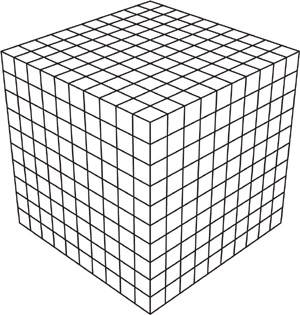
Don't miss my point, the first image sort of is 3D, but what i mean is; it's only ONE of those flat 2D 'planes/slices' from the 3D grid/cube.Now, this is my question. If the first image is only a 2D representation of the distortion on ONE of those planes/slices, what would it look like in 3D? Immersed inside the 3D grid. A kind of 3D spherical distortion.I can imagine the first image in 3D, a sort of gentle outward 'expansion', 'bubble', 'warp', etc.. in space time. The space-time sort of curving around the sides of the body.
However, the extent of the distortion in the black hole's image makes it (for me at least) very hard to comprehend/visualise it in 3D: (if you get what I'm saying)
The distortion is too great for it fit within it's own bounds, if you get what i mean. Does that makes sense? I'm sorry this is very hard to describe.
 Thanks, and again i apologise if there's something I've missed/don't understand properly.
Firstly, as you know, we can visual the 'canvas' of space-time as a grid, such as here: (ignore the planet for now)
Don't miss my point, the first image sort of is 3D, but what i mean is; it's only ONE of those flat 2D 'planes/slices' from the 3D grid/cube.Now, this is my question. If the first image is only a 2D representation of the distortion on ONE of those planes/slices, what would it look like in 3D? Immersed inside the 3D grid. A kind of 3D spherical distortion.I can imagine the first image in 3D, a sort of gentle outward 'expansion', 'bubble', 'warp', etc.. in space time. The space-time sort of curving around the sides of the body.
However, the extent of the distortion in the black hole's image makes it (for me at least) very hard to comprehend/visualise it in 3D: (if you get what I'm saying)
The distortion is too great for it fit within it's own bounds, if you get what i mean. Does that makes sense? I'm sorry this is very hard to describe.
Last edited by a moderator: