| New Reply |
Wouldn't The Time Being Relative Be A Product Of Space Curvature Near Mass |
Share Thread | Thread Tools |
| Feb16-12, 08:58 PM | #1 |
|
|
Wouldn't The Time Being Relative Be A Product Of Space Curvature Near Mass
Now, I know that tittle is messy, so I'm going to explain it as clearly I can. One of the proofs to the fact that time is relative is, as I've heard. Putting one clock on the ground, and another a few feets above it. When these clocks measure time, the one above the ground will do it faster, because, as Einstein says, mass slows time and all that stuff.
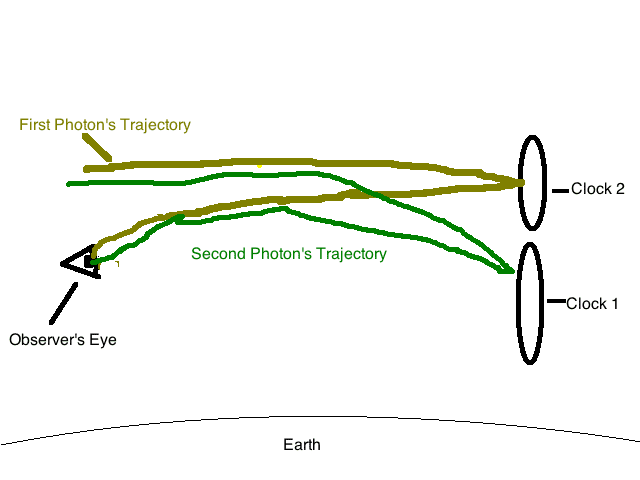
But, one day I thought of something that bugged me. I made an awful picture to depict it. ![]() So, as depicted in the picture, a guy observes two clocks, one above the ground more than the other. But what happens to these photons as they get closer to the Earth, is they are pulled with more force towards it. Therefore the one reaching the upper clock will have less gravitational pull applied to him, and will be more unrestrained, with his trajectory shorter than in the other case. The observer gets this photon faster than the second photon, which hit the clock lower to the ground, which was more pulled by the gravitation, which elongated its road, delaying the time it hit the observer's eye, even if both of the photons hit the clock at the same time. Wouldn't this delay we see between the clocks be simply the effect gravity has on photons, curving their path and making it get to our eyes shortly after the photon from the higher clock hits it. Oh, and if I'm terribly wrong at something, please don't hate on me. This was just a random thought that popped into my mind once. I also want to make it clear that this isn't a "theory" of mine that I've come here to discuss. I've already got a warning for discussing my theories on here, even if it was a misunderstanding. |
| Feb16-12, 09:15 PM | #2 |
|
Blog Entries: 6
|
Hi Sarcastic :) Time dilation equations predicts what happens after signal travel times have been taken into account. For example we could start with both clocks at ground level and then move clock 2 up to height X and leave it there for a while and then move clock 2 back to ground level and compare the clocks again when they are both alongside each other. This way delays due to light travel times is insignificant and GR predicts that the clock that remained at ground level will show the least elapsed time. You might argue that because clock 2 has moved and clock 1 has not, that the time differences may be due to the differences in motion. This argument can be eliminated by repeating the experiment with both clocks initially at height X and lowering one to ground level and then raising it back up again. Alternatively you send one clock down to ground level and after a long delay send the second clock to ground level. In all cases the clock that spends the most time nearest the massive body shows the least elapsed time and it is nothing to do with light signal travel times.
Also, trivially in your experiment the light paths from the two clocks could be made equal by careful positioning of the observer and the clocks would still tick at the predicted different rates. |
| Feb17-12, 12:24 AM | #3 |
|
|
For instance in the case of gravitational time dilation, it is actually the reduced/increased travel time of light that we consider. For instance an observer far away from a black hole will see the clock of a stationary observer close to the event horizon as standing still, some scientist called it "ancient light" e.g. light that took 'forever' to reach the outside observer due to the gravitational differential and opposite we see that the remote clock from the perspective of the stationary observer near the event horizon seems to go faster. |
| Feb17-12, 08:20 AM | #4 |
|
Blog Entries: 6
|
Wouldn't The Time Being Relative Be A Product Of Space Curvature Near Mass<EDIT> I just thought of a better example. Let us say we had a convoy of Ferraris with cruising at 180 mph and a convoy of heavily laden trucks cruising at 18 mph down the same highway. When they pass point A the Ferraris and the trucks are seen to pass at a rate of once per second. One hundred miles further down the highway at point B we see that the Ferraris pass a second observer at a rate of once per second and the same is true for the trucks. While it is true that the trucks arrive long after the the Ferraris, the frequency of arrival is unchanged by the speed of the vehicles or in the case of gravitational time dilation, by the speed of light signals. |
| Feb17-12, 10:03 AM | #5 |
|
|
|
| Feb17-12, 04:58 PM | #6 |
|
Blog Entries: 6
|
|
| Feb17-12, 05:16 PM | #7 |
|
|
An stationary observer A far away from a black hole will observe the clock from a stationary observer B close to the event horizon as going slow while B sees observer's A clock going fast. If you take the difference in light travel time between A to B and B to A then there is a direct correspondence with the clock differential. |
| Feb17-12, 05:47 PM | #8 |
|
Blog Entries: 6
|
It is however true that light slows down lower in a gravitational field (in coordinate terms) but local observers are not aware of this due to the gravitational time dilation of their clocks. It is interesting to analyse what happens to a light signal as it climbs out of a gravitational well. Let us say that B sends a signal from lower down with a frequency of F and wavelength of W as measured by B. A will measure the signal he detects as having a longer wavelength and a lower frequency by a factor of 10. However in coordinate terms, the frequency of the light remains constant as the photon climbs and they conclude that the frequency changes because of differences in their local clock rates. The wavelength really does increase in coordinate terms. This is unusual because we are used to wavelength increasing as an reciprocal of frequency so an increase in wavelength is inconsistent with a constant frequency because normally the speed of light is a constant, but the coordinate speed of light in a gravitational field is not constant. The gravitational time dilation of the two clocks will cause them to measure all intervals between non local events as different. For example if they both observe a distant super nova event and A says the interval of peek brightness lasted 100 seconds, then B lower down will say the interval lasted only 10 seconds because B's clock is running 10 times slower. We cannot explain differences in the clock rates of A and B in terms of the light travel time from the super nova. I am really confused about what you are claiming. Are you claiming that it can not be proved that clocks lower down do not actually run slower and that all "apparent gravitational time dilation" can be explained or accounted for simply in terms of light travel times? |
| Feb17-12, 06:10 PM | #9 |
|
|
Also when we have A and B start at the same point and later come together than in addition to gravitational time dilation we also need to take into account dynamical time dilation, e.g. the SR kind. |
| New Reply |
| Thread Tools | |
Similar Threads for: Wouldn't The Time Being Relative Be A Product Of Space Curvature Near Mass
|
||||
| Thread | Forum | Replies | ||
| space-time curvature | Special & General Relativity | 16 | ||
| motion in space due to space-time curvature | Special & General Relativity | 14 | ||
| Are space-time curvature 3D | Special & General Relativity | 2 | ||
| Relativistic mass and space-time curvature | Special & General Relativity | 10 | ||
| Space time curvature | Special & General Relativity | 2 | ||