jerusalem
- 13
- 0
hi,
is it misleading to write omega = 1.0000... for the ideally flat space?
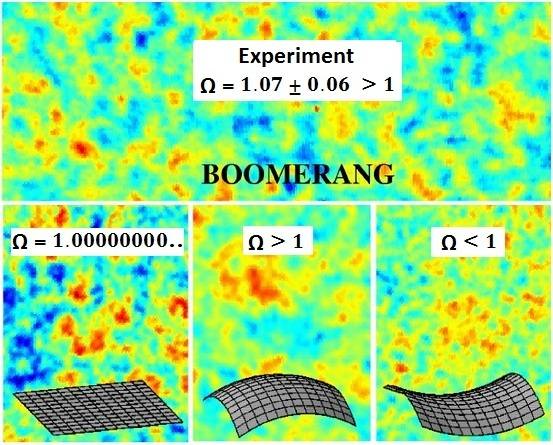
is it misleading to write omega = 1.0000... for the ideally flat space?
Chalnoth said:I wouldn't say that. The Boomerang confidence interval was fully consistent with the current value today. We can just do better today, with many other observations.
cepheid said:I don't think that the OP is questioning the veracity of the result from the BOOMERANG data (in the top panel).
It seems like the OP is asking if the Ω = 1.00000000.. statement in the lower left panel is misleading. My answer would be no, and I wonder why you think it might be. Ω is supposed to be exactly 1 for the flat case, given that you are talking the total density parameter.
marcus said:I'm glad you know what the interval was. Could you give a link and say what it was? This would save me having to dig it up.
The graphic which Jerusalem gave us says their estimate was [1.01, 1.13].
Is that right? Did Boomerang actually say [1.01, 1.13]?
Is that what you mean by fully consistent with the current value today, which I'm taking from WMAP7 to be [0.9916, 1.0133]?
jerusalem said:...I need to convince him that the statement in the lower left panel has nothing to do with the results of the experiment. it just states that Ω is supposed to be exactly 1 for the ideally flat space.
...
The inflation was so enormous, in fact, that the balloon seems flat in our vicinity, a fact that has been experimentally verified by the WMAP satellite. In the same way that the Earth appears flat to us because we are so small compared to the radius of Earth, the universe appears flat only because it is curved on a much larger scale.
books.google.ca/books?id=6rCw34JCLnsC&pg=PA13#v=onepage&q&f=false
The universe looks pretty flat: it doesn’t deviate by more than 2% from being flat. But, the possibility exists that the universe is still curved on much larger scales. It’s just like the fact that the Earth looks flat locally, over small scales, but is curved on the whole. The universe could be closed into a sphere, but on a much larger scale than what we can see.
physics.ucsd.edu/~tmurphy/phys10/universe.pdf
So when we say "WMAP provides strong evidence that the universe is flat", we really mean "WMAP provides strong evidence that the observable universe is flat".
curious.astro.cornell.edu/question.php?number=171
Actually, I don't remember the specific parameters off the top of my head. I was, in part, going by the numbers posted earlier in this thread. I know, however, that no experiment to date has detected a statistically-significant deviation of spatial curvature from zero.marcus said:I'm glad you know what the interval was. Could you give a link and say what it was? This would save me having to dig it up.
The graphic which Jerusalem gave us says their estimate was [1.01, 1.13].
Is that right? Did Boomerang actually say [1.01, 1.13]?
Is that what you mean by fully consistent with the current value today, which I'm taking from WMAP7 to be [0.9916, 1.0133]?
Well, you generally don't get a very tight range using only CMB data. But combine Boomerang with other data and the constraints close to a couple percent (as shown in the paper I linked above).Chronos said:As I recall, boomerang allowed a generous range for omega - ranging from about 0.8 to 1.3. The 1.01+ thing was merely a best guesstimate.
Chronos said:As I recall, boomerang allowed a generous range for omega - ranging from about 0.8 to 1.3. The 1.01+ thing was merely a best guesstimate.
is there a degree of precision, if reached, we can say for sure that we are living in an infinite euclidean space?cepheid said:I don't think that is the case. I'm pretty sure that the constraints are somewhat tighter than that. As described here:
arxiv.org/abs/astro-ph/0104460
and in the paper they reference by Lange, 2001, they do a likelihood analysis, and the best estimate of the parameter is obtained from the peak of the likelihood function, with the uncertainties obtained by integrating over this function out to the 1-sigma limits. Maybe this is what you meant by best guesstimate, I don't know. They have values reported in table 5 such as 1.02 +/- 0.06, or 0.98 +0.04, -0.05, depending on their choice of prior.
well my interlocutor refused this possibility and claimed that (boomerang and wmap..) measure the shape of the ENTIRE universe because the photon we detect started its journey since the beginning (380000 after BB). Did you ever heard such interpretation ? In my opinion this make sense only if the speed of light is greater than the expansion of the universe.marcus said:WMAP does NOT provide strong evidence that the observable universe is EXACTLY flat.
It provides wonderfully strong evidence that Omega is in the range
0.9916 < Omega < 1.0133 (talking about the universe as a whole, assuming uniformity)
And what that translates to, in the picture of a very large balloon that looks flat to creatures living on it
No. That would require infinite measurement accuracy, which is impossible (not just because building an infinitely-accurate measurement is impossible, but also because we can only see a fraction of the whole universe).jerusalem said:is there a degree of precision, if reached, we can say for sure that we are living in an infinite euclidean space?
No, they only measure the shape of the visible portion of it. Extrapolating beyond the region which is visible to us is highly model-dependent.jerusalem said:well my interlocutor refused this possibility and claimed that (boomerang and wmap..) measure the shape of the ENTIRE universe because the photon we detect started its journey since the beginning (380000 after BB). Did you ever heard such interpretation ? In my opinion this make sense only if the speed of light is greater than the expansion of the universe.
jerusalem said:is there a degree of precision, if reached, we can say for sure that we are living in an infinite euclidean space?
well my interlocutor refused this possibility and claimed that (boomerang and wmap..) measure the shape of the ENTIRE universe because the photon we detect started its journey since the beginning (380000 after BB). Did you ever heard such interpretation ? In my opinion this make sense only if the speed of light is greater than the expansion of the universe.
it wasn't a misrepresentation of your saying, the question was: " is there a degree of precision, if reached, we can say for sure that we are living in an infinite euclidean space? " the answer is NO. this refute your original claim that the results prove that the entire universe is flat. and again I know that you changed your mind later thanks to the debate. but remember you were talking about null hypothesis. choosing one of several possibilities is not "null hypothesis".Another misrepresentation of my saying:
1. I said that if the universe is flat from 380,000 till now, that the total energy of the universe is zero.
2. I mentioned that R for the entire universe is estimated to be around 90 billion Light year, and so, if we have a theory that incorporate quantum mechanics and general relativity then this will make the universe have a finite size.
The talk was about the total energy of universe at the beginning and now, and boomrang experiment corroborated the hypotheses that the universe is made out of nothing...
Ibrahim64 said:I would like to mention the location of the discussion:
Regards
[edit]Link to non-English material removed by Mentor.[/edit]
Greg Bernhardt said:All posts must be in English. Posts in other languages will be deleted.
the result of wmap is also freely available.Ibrahim64 said:Hello
I was in discussion with Mr jerusalem about the universe did not require energy to form. I used Boomrang experiment since its results are freely available and can show the scientific result.
I guess an ideally flat universe must be infinite.[itex]Ω= 1[/itex] is not real
theories can predict, but the experiments have the last word.The problem is:
1. Is it valid to take middle of the range? or if there is a theory predict a value we say that the experiment corroborate the hypotheses?
I guess cepheid answered this question, you have 4 panels and you can place these zeroes in the lower left panel for an ideally flat universe that has nothing to do with the experiment result in the first panel.2. Is it valid to place 8 zeroes with experiment result that never claimed more than %15 accuracy...
what I understand from this drawing that there is a difference between a nearly flat universe and an ideally flat one. in a debate what count is the idea you are trying to prove, you don't have to draw a perfect picture for a slightly positive curve. you just can't draw the real universe in a debate, and you don't have to measure the spots to get the idea.The figure under discussion was:
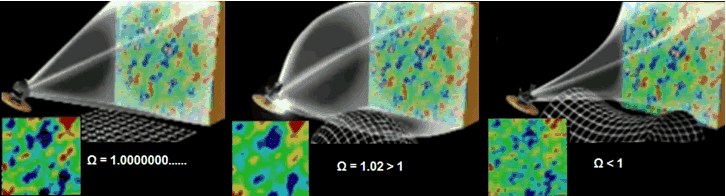
well that's mean that Boomrang result is around 1.07 so its must be sometuing like Ω = 1.07 ± ε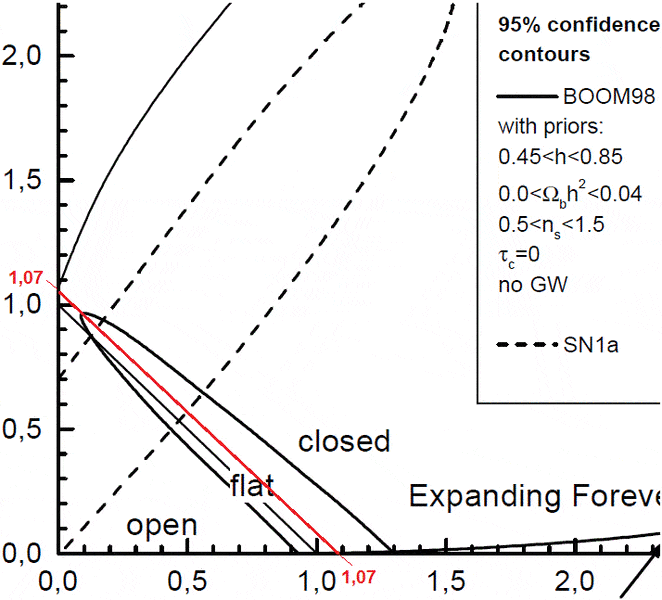
is this valid representation of Boomrang result or WMAP result?
It is very strange you using my surname, and only have only one post...el-fayoumi said:hello Mr ibrahim , some ppl who are following this topic understand well Arabic and know well what you said.
you have been asked: "can we say for sure and certain that the entire universe is flat or its only nearly flat locally?"
your answer was: "In fact the entire universe is flat, Radiation comes back since the beginning of the universe".
That's WRONG ! and I don't know how the age of the photon proved to you that wmap detected the shape of the entire universe?
it wasn't a misrepresentation of your saying, the question was: " is there a degree of precision, if reached, we can say for sure that we are living in an infinite euclidean space? " the answer is NO. this refute your original claim that the results prove that the entire universe is flat. and again I know that you changed your mind later thanks to the debate. but remember you were talking about null hypothesis. choosing one of several possibilities is not "null hypothesis".
best regards,
Hellohalifax12 said:the result of wmap is also freely available.
I guess an ideally flat universe must be infinite.
I quite agree, experiment can corroborate your hypotheses or falsify it...halifax12 said:the result of wmap is also freely available.
theories can predict, but the experiments have the last word.
Ok, the point of this figure was that, the actual angle of the spots are around 1 deg...halifax12 said:the result of wmap is also freely available.
I guess cepheid answered this question, you have 4 panels and you can place these zeroes in the lower left panel for an ideally flat universe that has nothing to do with the experiment result in the first panel.
The problem is:halifax12 said:the result of wmap is also freely available.
what I understand from this drawing that there is a difference between a nearly flat universe and an ideally flat one. in a debate what count is the idea you are trying to prove, you don't have to draw a perfect picture for a slightly positive curve. you just can't draw the real universe in a debate, and you don't have to measure the spots to get the idea.
The point I was trying to conceive that, The universe total energy was zero at the beginning and now.. do you agree with that?halifax12 said:the result of wmap is also freely available.
well that's mean that Boomrang result is around 1.07 so its must be sometuing like Ω = 1.07 ± ε
don't worry Mr.ibrahim no one will think that you are arguing with yourself or your surname.It is very strange you using my surname, and only have only one post...
flat universe means euclidean and by definition is an infinite space.I said that, as a classical appropriation, then Ω≈1, and it is known that with a theory that take quantum and general relativity together, will solve the infinite value of the universe.
The claim that we live in an infinite Euclidean space, was never done by me
as marcus said:Yes, but we cannot be certain that our universe is ideally flat or curved, the inflationary universe, predicts that the Ω should be very close to the critical value of 1, but if the universe began with flat universe, it should remains so...
so even if you are close to the critical value you still have the possibility of a closed universe.WMAP does NOT provide strong evidence that the observable universe is EXACTLY flat.
It provides wonderfully strong evidence that Omega is in the range
0.9916 < Omega < 1.0133 (talking about the universe as a whole, assuming uniformity)
And what that translates to, in the picture of a very large balloon that looks flat to creatures living on it
faithful in what sense? none of them is precisely accurate, its just explain the general idea how the spots change. NASA never claimed that you can get the value of Ω by measuring the spots of this cartoon style small figure.Ibrahim64 said:my understanding that, you claim that, this figure:
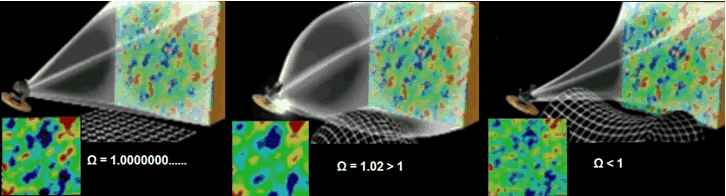
is a faithful representation of figure:
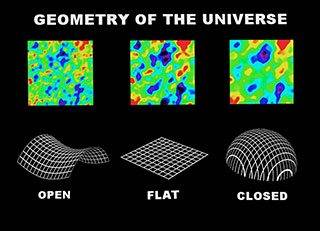
I guess you mean Ω=1.02±0.02 not Ω=1.00±0.02 . any way even if the figure never claimed values for different sizes of the spots, " Ω is supposed to be exactly 1 for the flat case " as Mr. cepheid said.The problem is:
WMAP according to the wiki, used to claim: Ω=1.00±0.02 so Mr jerusalem took the value in the middle and placed them in the graph with 8 zeroes for the flat universe, do you think this is proper way? The actual figure never claimed values for different sizes of the spots. Just to show that boomrang results, matches one of flat universe...
the data is also consistent with a slightly curved model.Also, I was using paper: http://arxiv.org/pdf/astro-ph/0011469v1.pdf, which states:
http://img717.imageshack.us/img717/2356/boomrang.png
...marcus said:The data is consistent (within uncertainty bounds) with the perfectly flat model. And also it is consistent with a overall slightly curved model.
if you are talking about the observable universe.so the experimental results agrees with a flat universe, or very close to it, and cannot distinguish from flat universe...
well I can not say that as a fact, but if the universe total energy is zero, you still need a non-null positive and negative energy in order to have the capacity to perform work.The point I was trying to conceive that, The universe total energy was zero at the begging and now.. do you agree with that?
if this is your measuring, how you know that you are comparing the same spots?http://img823.imageshack.us/img823/8872/spotsn.png
Hello halifax12halifax12 said:don't worry Mr.ibrahim no one will think that you are arguing
if you are talking about the observable universe.
well I can not say that as a fact, but if the universe total energy is zero, you still need a non-null positive and negative energy in order to have the capacity to perform work.
The point of this figure was that the area in the spot with the same density cannot make more than one degree, more than that, means that the ends never been in contact (they separated by speed more than the speed of light) and so it does not matter if they are the same spot... I think this figure makes it clear...halifax12 said:if this is your measuring, how you know that you are comparing the same spots?
best regards,
its my surname !Ibrahim64 said:It is very strange you using my surname, and only have only one post...
you said thatIbrahim64 said:I would like to also, clarify that, I did not say the whole universe is flat

