bob900
- 40
- 0
The vibration in a string is caused by the tension force on point masses inside the string :
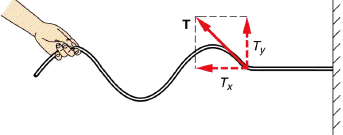
The tension force itself results from "the net electrostatic attraction between the particles in a solid when it is deformed so that the particles are further apart from each other than when at equilibrium" (source).
But a node in the string (when two waves cancel each other) is stationary. To transmit movement to string masses on either side of the node, shouldn't the node have to move (deform) to produce tension?
For example, in the following picture
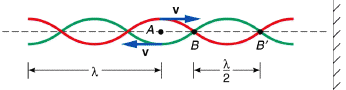
At node B, the red wave traveling to the right, has to create tension to transmit its upward to the string mass immediately to the right of B. Analogously, the green wave has to create tension to transmit its downward movement to the string mass on the left of B. But if the mass element at B itself does not move, how are these tension forces produced?
The tension force itself results from "the net electrostatic attraction between the particles in a solid when it is deformed so that the particles are further apart from each other than when at equilibrium" (source).
But a node in the string (when two waves cancel each other) is stationary. To transmit movement to string masses on either side of the node, shouldn't the node have to move (deform) to produce tension?
For example, in the following picture
At node B, the red wave traveling to the right, has to create tension to transmit its upward to the string mass immediately to the right of B. Analogously, the green wave has to create tension to transmit its downward movement to the string mass on the left of B. But if the mass element at B itself does not move, how are these tension forces produced?