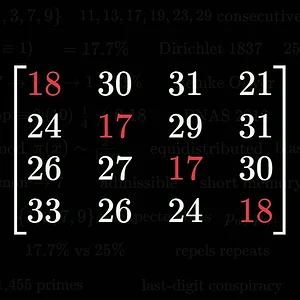
Every prime past five ends in a 1, a 3, a 7, or a 9 — and for two hundred years those endings were treated as pure noise. In 2016, two mathematicians at Stanford ran a count nobody had bothered with, and found the primes quietly breaking their own randomness: a prime ending in 1 is followed by another ending in 1 only about 17.7% of the time, not the 25% a fair die demands. Every digit avoids repeating itself. This is the story of the last-digit conspiracy — what it is, why the size of the gap to the next prime causes it, and why the bias fades so slowly it may as well be permanent.