-2.2.3 de y'+(\tan x)y=\sin {2x}; -\pi < x < \pi/2

  • Context: MHB 
  • Thread starter Thread starter karush
  • Start date Start date
Click For Summary

Discussion Overview

The discussion revolves around solving the first-order linear differential equation given by \(y' + (\tan x)y = \sin {2x}\) within the interval \(-\pi < x < \pi/2\). Participants explore various methods of finding the integrating factor and the solution to the equation, including steps involving integration and manipulation of the equation.

Discussion Character

  • Mathematical reasoning
  • Technical explanation
  • Homework-related

Main Points Raised

  • One participant proposes the integrating factor \(u(x) = -\cos x\) and questions if this step is correct.
  • Another participant suggests that the integrating factor should be \(\mu(x) = \sec(x)\), leading to a different approach in solving the equation.
  • There is a discussion about the distribution of the integrating factor and the resulting equation \((y \sec(x))' = \sec(x) \sin(2x)\).
  • Participants express uncertainty about the alignment of their results with the book's answer, indicating a potential discrepancy in the integration steps.
  • One participant mentions using Wolfram Alpha to verify their solution, which yields \(y(x) = c_1 \cos(x) - 2 \cos^2(x)\).
  • Another participant raises concerns about the length of the thread and the readability of posts, suggesting a need for better navigation features.
  • There is a side discussion regarding the usability of forums on mobile devices, with participants sharing their experiences with other platforms.

Areas of Agreement / Disagreement

Participants do not reach a consensus on the correct integrating factor or the final solution to the differential equation. Multiple competing views and methods are presented, and the discussion remains unresolved regarding the alignment with the textbook answer.

Contextual Notes

Some participants express confusion over the integration steps and the resulting forms of the solution, indicating that assumptions about the integrating factor and its application may not be universally accepted.

karush
Gold Member
MHB
Messages
3,240
Reaction score
5
$\tiny{2.2.3}$
1000
$\textsf{find the solution:}$
$$y^\prime+(\tan x)y=\sin {2x} \quad -\pi < x < \pi/2$$
$\textit{find u(x)}$
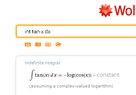
$$u(x)=\exp\int \tan x \, dx = -e^{\ln(\cos x)}=-\cos x$$ok just want to see if this first step is :cool:$\tiny{\color{blue}{From \, Text \, Book: \,Elementary \, Differential \, Equations \, and \, Boundary \, Value \, Problems \,
by: \, William \, Boyce \, and \, Richard \, C. \, DiPrima \,
Rensselaer \, Polytechnic \, Institute, \, 1969}}$
 
Last edited:
Physics news on Phys.org
$$\mu(x)=\exp\left(\int \tan(x)\,dx\right)=e^{\Large\ln(\sec(x))}=\sec(x)$$
 
MarkFL said:
$$\mu(x)=\exp\left(\int \tan(x)\,dx\right)=e^{\Large\ln(\sec(x))}=\sec(x)$$

something fishy?

View attachment 8223
 

Attachments

  • 223.png
    223.png
    3.3 KB · Views: 167
$$-\ln(\cos(x))=\ln\left((\cos(x))^{-1}\right)=\ln(\sec(x))$$
 
MarkFL said:
$$\mu(x)=\exp\left(\int \tan(x)\,dx\right)=e^{\Large\ln(\sec(x))}=\sec(x)$$

$\textit{So then distribute $u(x)$}$
$$(\sec x)(y^\prime+(\tan x)y)=(\sec x) \sin {2x}$$
$\textit{hence}$
$$(y \, sec(x))^\prime=(\sec x) \sin {2x}$$
$\textit{then}$
$\displaystyle y \, sec(x)
=\int (\sec x) \sin {2x} \, dx=-2\cos(x)+c_1$

ok don't see this heading toward the book answer
$$(c-2x \cos x+2\sin x)\cos x$$
W|A returned this
$$y(x)=c_1\cos(x)-2\cos^2(x)$$
 
Last edited:
karush said:
$\textit{So then distribute $u(x)$}$
$$(\sec x)(y^\prime+(\tan x)y)=(\sec x) \sin {2x}$$
$\textit{hence}$
$$(y \, sec(x))^\prime=(\sec x) \sin {2x}$$
$\textit{then}$
$\displaystyle y \, sec(x)
=\int (\sec x) \sin {2x} \, dx=-2\cos(x)+c_1$

ok don't see this heading toward the book answer
$$(c-2x \cos x+2\sin x)\cos x$$
W|A returned this
$$y(x)=c_1\cos(x)-2\cos^2(x)$$

When you multiply by $\mu(x)$, you get:

$$\sec(x)y'+\tan(x)\sex(x)y=\sec(x)\sin(2x)$$

This can be written as:

$$\frac{d}{dx}\left(\sec(x)y\right)=2\sin(x)$$

Integrate:

$$\sec(x)y=-2\cos(x)+c_1$$

Multiply through by $\cos(x)$:

$$y(x)=-2\cos^2(x)+c_1\cos(x)$$
 
Are you using Tapatalk by any chance? I have code in place to let me know when posts have been edited, so I don't miss added content (it's better to use a new post for new content), but Tapatalk lazily bypasses all my custom code and so I'm thinking that's why I didn't know you had added to your last post. Also, I restored one of the posts, because when it was deleted, then one of my posts didn't make much sense.
 
ok well I really don't like the long threads
when most of the posts are just a few lines and vast majority is irrelevant space
it would be better have a minimize or close out feature rather than delete the posts.
doing endless scrolling just to see the process gets old fast.

with that however i have tried other forums
but this is by far the most user freindly

I thot stack exchange was just a get lost fast jungle
yahoo very hard to read
most have no live view latex
 
I can't imagine trying to use the internet on a telephone. I'm sorry scrolling on a telephone is such a chore...they should fix that.
 

Similar threads

  • · Replies 3 ·
Replies
3
Views
1K
  • · Replies 2 ·
Replies
2
Views
2K
  • · Replies 2 ·
Replies
2
Views
2K
  • · Replies 5 ·
Replies
5
Views
2K
  • · Replies 3 ·
Replies
3
Views
2K
  • · Replies 4 ·
Replies
4
Views
2K
  • · Replies 1 ·
Replies
1
Views
1K
  • · Replies 2 ·
Replies
2
Views
2K
  • · Replies 6 ·
Replies
6
Views
2K
  • · Replies 4 ·
Replies
4
Views
1K