A debate about Mark Grayson slamming Conquest into the ground

  • Thread starter Thread starter Ax_xiom
  • Start date Start date
Join the discussion
Registration is free. Ask a follow-up in this thread, or start your own.
8 replies · 511 views
Ax_xiom
Messages
88
Reaction score
4
So in the comic Invincible, Mark Grayson (a character who can fly and has super strength) slams Conquest (another character with the same powers) into the ground while fighting him.
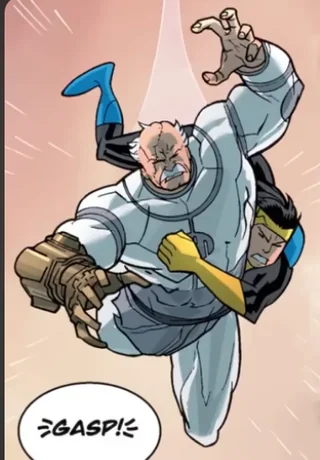
1788182989262.webp

And on impact they create a crater about this large. Conquest doesn't do anything while being slammed
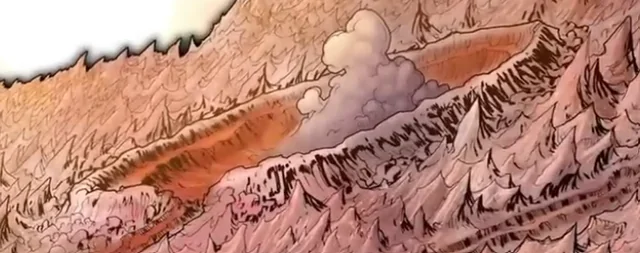
1788183028813.webp

So I had a debate with a friend about how much energy Mark would have needed to exert to do this. I said that due to conservation of energy, Mark has to input enough energy to generate the crater wether he is carrying Conquest or not. My friend said that due to Mark being very strong (He can lift over 400 tons), Conquest (who would be 500lbs or 227kg) wouldn't slow him down at all, so the amount of energy that he slams into the ground with would get multiplied because the velocity is the same with a higher mass

So who is correct?
 
Physics news on Phys.org
Ax_xiom said:
So in the comic Invincible, Mark Grayson (a character who can fly and has super strength) slams Conquest (another character with the same powers) into the ground while fighting him.

View attachment 373916
And on impact they create a crater about this large. Conquest doesn't do anything while being slammed
View attachment 373917
So I had a debate with a friend about how much energy Mark would have needed to exert to do this. I said that due to conservation of energy, Mark has to input enough energy to generate the crater wether he is carrying Conquest or not. My friend said that due to Mark being very strong (He can lift over 400 tons), Conquest (who would be 500lbs or 227kg) wouldn't slow him down at all, so the amount of energy that he slams into the ground with would get multiplied because the velocity is the same with a higher mass

So who is correct?
Does Mark smash Conquest into the ground by flying like Superman? Or does Mark lift Conquest whilst standing on the ground then slam him?

In case one the mass of Conquest decreases Mark's velocity while leaving the amount of kinetic energy the same. While both would be affected by the collision with the Earth, Mark would be mildly cushioned by Conquest's body so might come out ahead.

In the second case with the slam then Mark would be launched away from the Earth at high velocity, experiencing scorching from friction with the air. I expect Mark would reach a height where he would have difficulty breathing and might pass out. He either goes into orbit or falls again to Earth with an impact somewhat less than that suffered by Conquest as some of the energy has been dissipated by friction with the air.

In either case there would be a sonic boom shock wave that might knock down trees and buildings for miles around.
 
Hornbein said:
Does Mark smash Conquest into the ground by flying like Superman? Or does Mark lift Conquest whilst standing on the ground then slam him?
The former. Mark & Conquest were both flying before he gets slammed
Hornbein said:
In either case there would be a sonic boom shock wave that might knock down trees and buildings for miles around.
So how much energy does Mark need to output to do this and who is correct?
 
Ax_xiom said:
The former. Mark & Conquest were both flying before he gets slammed

So how much energy does Mark need to output to do this and who is correct?
The pair of Mark with struggling Conquest would be less aerodynamic than Mark flying all by himself, producing all sorts of drag. This reduces Mark's maximum velocity and Mark has to expend energy to overcome the drag. However it is true that the increased mass would increase momentum and kinetic energy. So less velocity but more mass. It's not obvious to me which would have more effect. A bit disappointing, yes?
 
Hornbein said:
The pair of Mark with struggling Conquest would be less aerodynamic than Mark flying all by himself, producing all sorts of drag. This reduces Mark's maximum velocity and Mark has to expend energy to overcome the drag. However it is true that the increased mass would increase momentum and kinetic energy. So less velocity but more mass. It's not obvious to me which would have more effect. A bit disappointing, yes?
True, didn't consider that. But what if we neglect aerodynamic drag? What is the case then?
 
Ax_xiom said:
True, didn't consider that. But what if we neglect aerodynamic drag? What is the case then?


So they are accelerating in a vacuum. Superman does it so why not. Mark is presumably accelerating as much as he is able. When entangled with Conquest there is more mass so acceleration is less. We'll assume there is a time limit on this : Mark can only control Conquest's struggles to free himself for so long. After a fixed time with the same thrust the two cases of Mark solo and Mark entangled with Conquest will have the same momentum. But solo Mark will have more velocity. Kinetic energy is momentum times velocity, so solo Mark makes more of an impact.
 
I think energy to create crator is
[tex]\sqrt{p^2c^2+m^2c^4}-mc^2[/tex]
where p is momentum of the villain in time of contact with the Earth in the Earth’s IFR and m is mass of the villain. How he got p does not matter in result.
 
Last edited:
I do not like superhero craters, they look like explosive craters. Since the superhero remains intact, one would expect rigid body craters; i.e., deep and narrow.
 
Hornbein said:
So they are accelerating in a vacuum. Superman does it so why not. Mark is presumably accelerating as much as he is able. When entangled with Conquest there is more mass so acceleration is less. We'll assume there is a time limit on this : Mark can only control Conquest's struggles to free himself for so long. After a fixed time with the same thrust the two cases of Mark solo and Mark entangled with Conquest will have the same momentum. But solo Mark will have more velocity. Kinetic energy is momentum times velocity, so solo Mark makes more of an impact.
The context here is that Mark continues to choke Conquest for several minutes after, so time shouldn't be much of an issue here. If Mark is providing a constant force over a constant distance, surely his kinetic energy in both cases is the same, right?