Absolute Value Function Challenge

Join the discussion
Ask a follow-up here, or get your own question answered by working scientists, mathematicians and engineers — people, not an autocomplete.
Real named experts · corrections over time · the nuance an AI answer skips
4 replies · 3K views
anemone
Gold Member
MHB
POTW Director
Messages
3,851
Reaction score
115
Solve $||||||| x^2 – x –1 |–3|–5|–7|–9| – 11|–13| = x^2 – 2x – 48$.
 
Mathematics news on Phys.org
My sol.
Since the LHS is greater than or equal to zero, this means $x^2-2x-48\ge 0$ so $x\le -6$ and $x \ge 8$. On this interval $x^2-x-1 >0$, $x^2-x-1-3 > 0$ and so on until $x^2-x-1-3-5-7-9-11 > $. Thus we are left with

$ |x^2 - x - 1- 3 - 5- 7 - 9- 11 -13| = x^2-2x-48$

or

$(x^2-x-49)^2 = (x^2-2x-48)^2$

which we can solve giving $x = 1$, $x = 7.754462862$ and $x = -6.254462862$. The third is the desired solution.
 
Thanks for participating, Jester and thanks also showing me this quick way to crack it!

I feel so dumb and silly now because for an hour that I spent today to work on this particular problem, I didn't see the "trick" that you used in your solution and cracked it using one stupidest way!(Angry)
 
Hi MHB,

I've "improved" the original problem to make it more "difficult" and I sure hope you enjoy solving this modified version of the problem.

Solve $||||||| x^2 – x –1 |–3|–5|–7|–9| – 11|–13| = (2x+9)(x-8)$.
 
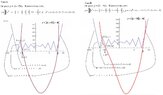
My solution to solve $||||||| x^2 – x –1 |–3|–5|–7|–9| – 11|–13| = (2x+9)(x-8)$ is shown below:

View attachment 1254

I first tried some simpler function and drew the graph of $y=|||| x^2 – x –1 |–3|–5|–7| $ on a paper and then I came to realize that there was a trick to find each formula of the function defined at specific intervals and next, I applied it to our case here and has labeled the formulas for the last three functions as shown in the diagram above.

We see that we've two cases to consider and to find the solution where $x<0$ for case A, we solve the equation $y=x^2 – x –1 –3–5–7–9– 11+13$ and $y=(2x+9)(x-8)$ simultaneously and get

$$x=3-\sqrt{58}\approx -4.616$$

and observe that $$-5.52<x=3-\sqrt{58}\approx -4.616<-4.52$$ and this is the solution that we're after.

Now, for case B, we solve the equation $y=-(x^2 – x –1 –3–5–7–9– 11-13)$ and $y=(2x+9)(x-8)$ simultaneously and get

$$x=\frac{4-\sqrt{379}}{3}\approx-5.515$$

and observe that $$-6.517<x=-5.515 \not<-5.52$$ and thus this answer can be discarded.

And to determine the $x$ value when $x>0$, we solve the equations $y=x^2 – x –1 –3–5–7–9– 11-13$ and $y=(2x+9)(x-8)$ simultaneously and get

$$x=3+4\sqrt{2}$$

Thus, the answers for solving $||||||| x^2 – x –1 |–3|–5|–7|–9| – 11|–13| = (2x+9)(x-8)$ are $$x=3-\sqrt{58}$$ and $$x=3+4\sqrt{2}$$.
 

Attachments

  • Absolute Value Function Challenge.JPG
    Absolute Value Function Challenge.JPG
    64.8 KB · Views: 107