Descartes’ Geometry of Square Roots

  • Context: Undergrad 
  • Thread starter Thread starter bob012345
  • Start date Start date
bob012345
Gold Member
Messages
2,382
Reaction score
1,098
TL;DR
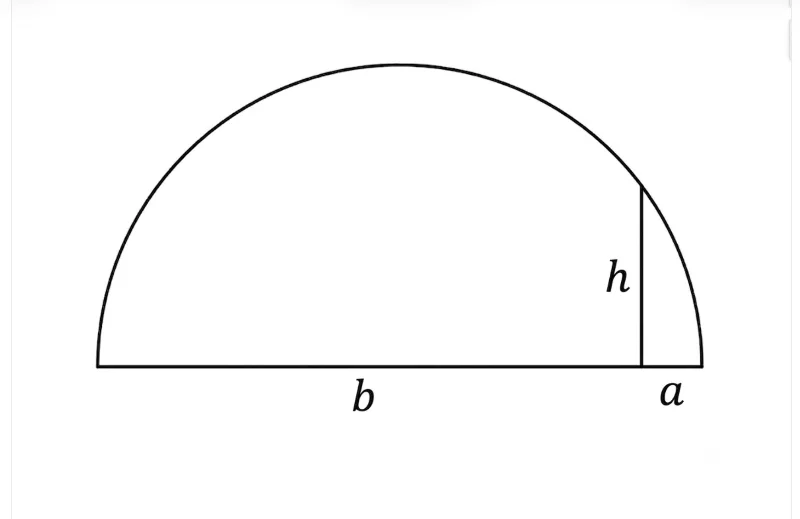
Here is an exercise for fun. It is a variation of a problem first worked out by Descartes. It is to show the length of the vertical segment is the square root of the product of the lengths of the horizontal segments.
In the figure below of a semi-circle, show that ##h=\sqrt{ab}##.

IMG_5810.webp

In the special case where ##a=1## unit length, then ##h=\sqrt{b}##. A complete discussion can be found in chapter 2 of the book An Imaginary Tale by Paul J. Nahin.
 
Last edited:
  • Like
Likes   Reactions: berkeman and Lnewqban
Mathematics news on Phys.org
1781390768657.webp

##r^{2}=h^{2}+\left(r-a\right)^{2}\Rightarrow h^{2}=2ar-a^{2}=a\left(2r-a\right)=ab\Rightarrow h=\sqrt{ab}\quad\blacksquare##
 
  • Like
Likes   Reactions: berkeman, Lnewqban and bob012345
Right Triangle.webp

Trigonometric proof
##\theta +\varphi=90^{\circ}##
Therefore
##\tan\theta=\cot\varphi\implies \tan\theta \tan\varphi=1.##
##1=\dfrac{b}{h}\cdot \dfrac{a}{h}\implies h^2=ab\implies h=\sqrt{ab}.##
 
  • Like
Likes   Reactions: berkeman, Lnewqban and bob012345
@kuruman's construction can also be solved using Pythagoras on the three right angled triangles:
$$\begin{eqnarray}
h_1^2&=&b^2+h^2\\
h_2^2&=&a^2+h^2\\
(a+b)^2&=&h_1^2+h_2^2
\end{eqnarray}$$Eliminate ##h_1## and ##h_2## and solve for ##h##.
 
  • Like
Likes   Reactions: Lnewqban and bob012345
Ibix said:
@kuruman's construction can also be solved using Pythagoras on the three right angled triangles:
$$\begin{eqnarray}
h_1^2&=&b^2+h^2\\
h_2^2&=&a^2+h^2\\
(a+b)^2&=&h_1^2+h_2^2
\end{eqnarray}$$Eliminate ##h_1## and ##h_2## and solve for ##h##.
Yes, I had that one also and that is why I labeled sides ##h_1## and ##h_2##. However, I dropped it after seeing @renormalize's, more elegant proof using Pythagoras. I remember seeing this proposition in high-school geometry (before trigonometry) but I cannot remember whether it was done with or without Pythagoras.
 
  • Like
Likes   Reactions: bob012345 and Ibix
Right Triangle 2.webp
Here is how it can be done without Pythagoras or trigonometry.

Right triangles ADC and CDB are similar. Therefore
##\dfrac{b}{h}=\dfrac{h}{a}\implies h^2=ab\implies h=\sqrt{ab}.##
I am pretty sure it was proven this way in my geometry class.

On edit.
Segment ##h## is the geometric mean of the segments into which it splits the diameter. Now I remember the bottom line of my geometry lesson! :oldsmile:

My question is, how did Descartes do it and what exactly did he do?
 
Last edited:
  • Like
Likes   Reactions: renormalize and Lnewqban
From the book I gather Descartes starts with line segment we call ##b## then extends it by ##a## which he takes as 1. His goal is to construct the square root of ##b##. He finds the midpoint and constructs the semi-circle then drops the perpendicular which we are calling ##h##. He then omits the details of the rest but the author assumes Descartes uses the Pythagorean theorem. Finally, he quotes Descartes giving his reason for omitting details “I hope that posterity will judge me kindly, not only as to the things which I have explained, but also to those which I have intentionally omitted so as to leave to others the pleasure of discovery.”
 
  • Like
Likes   Reactions: Lnewqban
bob012345 said:
... but the author assumes Descartes uses the Pythagorean theorem.
I would think that Descartes used similar triangles to finish this purely geometric that can be constructed with ruler and straight edge and zero algebra.
 
  • Like
Likes   Reactions: neilparker62 and bob012345
kuruman said:
I would think that Descartes used similar triangles to finish this purely geometric that can be constructed with ruler and straight edge and zero algebra.
I think inventing the geometric construction was the big accomplishment. We are left merely with the pleasure of showing that it works by various methods which it seems was by design.
 
  • Like
Likes   Reactions: neilparker62
  • #10
kuruman said:
View attachment 372547
Trigonometric proof
##\theta +\varphi=90^{\circ}##
Therefore
##\tan\theta=\cot\varphi\implies \tan\theta \tan\varphi=1.##
##1=\dfrac{b}{h}\cdot \dfrac{a}{h}\implies h^2=ab\implies h=\sqrt{ab}.##
Let D be the point where the perpendicular meets AB. Then: $$\triangle ADC \sim \triangle CDB \implies \frac{h}{b}=\frac{a}{h} $$
 
  • Like
Likes   Reactions: bob012345
  • #11
IMG_0016.webp

in polar coordinates a circle whose center is on the x-axis is given by the graph ##r=2R \cos \theta##

##r = 2R \cos \theta = 2\frac{b+a}{2} \cos \theta = (b+a) \cos \theta ##

the distance from the origin is ##\sqrt{h^2 + b^2}## and ##\cos \theta = \frac{b}{\sqrt{h^2 + b^2}}##

##\sqrt{h^2 + b^2} = \frac{(b+a)b}{\sqrt{h^2 + b^2}}##

##h^2 + b^2 = b^2 + ab##

##h^2 = ab##

##h = \sqrt{ab}##
 
  • Like
Likes   Reactions: bob012345
  • #12
bob012345 said:
From the book I gather Descartes starts with line segment we call ##b## then extends it by ##a## which he takes as 1. His goal is to construct the square root of ##b##. He finds the midpoint and constructs the semi-circle then drops the perpendicular which we are calling ##h##. He then omits the details of the rest but the author assumes Descartes uses the Pythagorean theorem. Finally, he quotes Descartes giving his reason for omitting details “I hope that posterity will judge me kindly, not only as to the things which I have explained, but also to those which I have intentionally omitted so as to leave to others the pleasure of discovery.”
Very tactfully put by Descartes! Nicolaus Copernicus in a header page of De Revolutionibus Orbium Coelestium writes somewhat more bluntly in Greek: "Let no one untrained in geometry enter here."
 
  • Like
Likes   Reactions: bob012345
  • #13
I had an overnight revelation about this. It should resonate with any person who has been sensitized to the importance of units. Here it is cast in modern terms. To avoid confusion I kept the labels defined in the original drawing.

Statement of the question
You are given an actual drawn segment that we will call ##b##. How would you draw another actual segment ##h## that is the square root of the given segment ##b##?

Preliminary analysis
The statement of the question is insufficient to answer the question and more information is needed. A person trained in physics will realize soon that drawing two line segments next to each other, one of which is purportedly the square root of the other, is like comparing apples and oranges - both are fruit and that's that. Even though both are line segments, their units are [L] and [L1/2].

However, note that any two segments can be in a square root relationship. All one has to do is find and draw a unit length segment ##a## that validates the relationship. Validation requires that one of the segments be the geometric mean of the unit segment ##a## and the other segment. Trivially, when the two segments are equal the unit length and the two segments are all the same. When the two segments are unequal, it doesn't matter which of the given unequal segments one calls the "geometric mean" ##h## and which the "other segment" ##b.## The key expression to be satisfied is $$\left(\frac{b}{h}\right)\times\left(\frac{a}{h}\right)=1.$$ Construction
GeoMean_A.webp
1. Draw segment ##b~## (black.) At its right end, point ##P##, draw vertical dashed line ##L## perpendicular to ##b.##
2. At point ##P## extend segment ##b## by adding ##a.##
3. Draw a circle of diameter ## b + a.##
4. Half the chord generated by ##L## is the square root of ## b## (magenta ##h.##)

Proof
The proof, using similar triangles, is shown in post #6 and will not be repeated here.

Illustrative example
Given two straight line segments, ##b = 1.96~##pu* and ##h=0.815~##pu, draw the unit length segment ##a## in pu such that one segment is the square root of the other.

GeoMean_B.webp
Construction
1. Draw given horizontal segment ##b## (black).
2, At its right end (point P), draw two vertical segments of length ##h## (blue) one up and the other down.
3. Draw a circle defined by three points, the one free end of segment ##b## and the two free ends of the two segments ##h##.
4. At point P, extend segment ##b## until it intersects the circle. The extension segment (red) is the required unit segment ##a.##

Numerical verification
The measured length of unit segment ##a## after construction is ##a=~##0.34 pu.
In this case ##b## is longer than the geometric mean ##h##, therefore ##h## is the square root. Its units are already pu and if I square it, its units will be pu2:
##h^2=(0.815~\text{pu})^2=0.664~\text{pu}^2.##
Now ##b## is given in pu units and needs to be converted to pu2 for comparison. This means multiply by "unit" vector ##a=0.34~##pu:
##b\times a=(1.96~\text{pu})\times(0.34~\text{pu})=0.666~\text{pu}^2.##
Close enough considering that the numerical value for ##a## is given to two sig-figs.


* pu = Powerpoint unit which is what I use for drawings.
 
  • Like
Likes   Reactions: neilparker62, Lnewqban, Ibix and 1 other person
  • #14
Presumably you can always construct ##\sqrt{b}## by drawing a circle with diameter b+1 and placing a perpendicular at b to intersect the circle. Eg diameter 6 / radius 3 for ##\sqrt{5}##. The right triangle with h as an altitude has hypotenuse ##r=\frac{b+1}{2}## drawn from the centre and base ##r-1=\frac{b-1}{2}## whence ##h=\sqrt{b}## by Pythagoras.
 
Last edited:
  • #15
neilparker62 said:
Presumably you can always construct ##\sqrt{b}## by drawing a circle with diameter b+1 ...
I don't think so. In what units would you draw "1" in this construction? Angstroms, centimeters, inches, feet, furlongs, light years, smoots? If you draw it as a fraction of ##b##, how would you choose that fraction?

If you choose to use a ruler with units to draw ##b## (as opposed to a straight edge without units), you might as well draw the square root segment directly in those units.

Once you draw the figure in post #1, you have defined the units ##a## in which ##h## is the square root of ##b##. Furthermore, the figure can be drawn if you are given (on a piece of paper) any two of the three segments involved and all you have is a compass and straightedge with no markings.
 
Last edited:
  • #16
Well here's the construction of ##\sqrt{5}## anyway. Courtesy of Google Gemini.

1781617580781.webp
 
  • #17
Gemini has solved the problem "Construct a segment DB that represents the square root of given segment AB when the unit segment is ##~{BC}=\frac{1}{5}{AB}.## The first construction in post #13 is the more general way of doing this.

The bottom line is that there three segments representing (1) a number, (2) the square root of this number and (3) a unit segment. If you are given segments representing any two of the three, you can construct the third. I note that (3), the unit segment, is necessary to make the conversion from "segment representation" to numerical representation.

This point is made clear if similar triangles are used in the Gemini problem. We have the basic relation $$\frac{AB}{DB}=\frac{DB}{BC}\implies AB\times BC=(DB)^2. $$ With ##AB=5BC##, $$5 BC^2=(DB)^2\implies \frac{DB}{BC}=\sqrt{5}.$$ This last expression says that "segment ##DB## expressed in terms of unit segment ##BC## is the dimensionless quantity ##\sqrt{5}.##"

Considering the obfuscatory numero-geometric solution proposed by Google Gemini, I would also add (sorry for gloating) that it also illustrates the superiority of human intelligence over the artificial variety.
 
  • #18
kuruman said:
I don't think so. In what units would you draw "1" in this construction? Angstroms, centimeters, inches, feet, furlongs, light years, smoots? If you draw it as a fraction of ##b##, how would you choose that fraction?

If you choose to use a ruler with units to draw ##b## (as opposed to a straight edge without units), you might as well draw the square root segment directly in those units.

Once you draw the figure in post #1, you have defined the units ##a## in which ##h## is the square root of ##b##. Furthermore, the figure can be drawn if you are given (on a piece of paper) any two of the three segments involved and all you have is a compass and straightedge with no markings.
I think we need to remember we are talking about geometric constructions here. We can define a line segment as 1 unit then construct another line segment ##b## referencing that. Then when we construct ##h## it will be the square root of ##b##. Or if we don’t define ##a=1##, we have ##h=\sqrt{ab}##.

The goal is to construct the square root geometrically, not calculate it or measure it.

EDIT: But I agree if one just draws an arbitrary segment ##b## one has a problem and must define what 1 is. We can always draw ##a## and define it as 1 or not with respect to ##b## and the relationship holds.
 
Last edited:
  • #19
kuruman said:
Considering the obfuscatory numero-geometric solution proposed by Google Gemini, I would also add (sorry for gloating) that it also illustrates the superiority of human intelligence over the artificial variety.
Alas - I will need to take responsibility for the above "solution" - the stated aim was to construct ##\sqrt{5}##. I don't necessarily get Gemini to find solutions - I just give it parameters for a diagram I want it to draw and it does that. Also on my instruction it drew and added in calculations for triangle MDB based on post #14.

1781630246501.webp
 
  • Informative
Likes   Reactions: kuruman
  • #20
bob012345 said:
I think we need to remember we are talking about geometric constructions here. We can define a line segment as 1 unit then construct another line segment ##b## referencing that.
I agree wholeheartedly, however one needs to be careful. Writing ##b+1## mixes apples and oranges. Having reached ##h^2=ab##, I would write the unit segment not as 1, but as a fraction ##f## of ##b##, i.e. ##~a=fb##. Then $$h^2=ab=\frac{1}{f}a^2\implies \frac{h}{a}=\sqrt{\frac{1}{f}}=\sqrt{\frac{b}{a}}.$$This says quite clearly that "line segment ##h## expressed as a fraction of unit segment ##a## is the same as the square root of segment ##b## expressed as a fraction of the same unit segment ##a##."
 
  • Like
Likes   Reactions: bob012345
  • #21
kuruman said:
I agree wholeheartedly, however one needs to be careful. Writing ##b+1## mixes apples and oranges. Having reached ##h^2=ab##, I would write the unit segment not as 1, but as a fraction ##f## of ##b##, i.e. ##~a=fb##. Then $$h^2=ab=\frac{1}{f}a^2\implies \frac{h}{a}=\sqrt{\frac{1}{f}}=\sqrt{\frac{b}{a}}.$$This says quite clearly that "line segment ##h## expressed as a fraction of unit segment ##a## is the same as the square root of segment ##b## expressed as a fraction of the same unit segment ##a##."
In my mind all these quantities are lengths representing pure numbers. We can say ##3=\sqrt{9}## without saying ##9## has different units than ##3##. I think geometric constructions are all about pure numbers represented by lengths. Relative scales are what matters and are implied by ##’1’##. At least that’s how I read Descartes. Here are his own words in translation;

IMG_5821.webp
 
  • #22
Note that Descartes is careful to define the unit segment before he proceeds to do anything else.
He begins the paragraph you marked with "For example, let AB be taken as unity ..." Two paragraphs down, he says "If the square root GH is desired, I add, along the same straight line, FG equal to unity ..." (emphasis mine.)

It looks like you missed the importance of defining the unit segment in post #1 and treated ##a## as if it were a number,
bob012345 said:
In the special case where ##a=1##, then ##h=b##. A complete discussion can be found in chapter 2 of the book An Imaginary Tale by Paul J. Nahin.
Remember that ##a##, as a line segment, is always unity, as per Descartes's construction, no matter how long you draw it in the diagram relative to ##b##. The special case is all three segments ##a##, ##b## and ##h## are equal.
 
  • #23
kuruman said:
Note that Descartes is careful to define the unit segment before he proceeds to do anything else.
He begins the paragraph you marked with "For example, let AB be taken as unity ..." Two paragraphs down, he says "If the square root GH is desired, I add, along the same straight line, FG equal to unity ..." (emphasis mine.)

It looks like you missed the importance of defining the unit segment in post #1 and treated ##a## as if it were a number,

Remember that ##a##, as a line segment, is always unity, as per Descartes's construction, no matter how long you draw it in the diagram relative to ##b##. The special case is all three segments ##a##, ##b## and ##h## are equal.
For Descartes, yes. In post #1 I mentioned this was a variation of Descartes’ original problem. His case is when ##a## is taken as unity. John Wallis actually did the case where ##a## is not taken as unity. When I say ##a=1## I mean it is a line segment of length of one unit in comparison to the length of the other segments.
 
  • #24
bob012345 said:
For Descartes, yes. In post #1 I mentioned this was a variation of Descartes’ original problem. His case is when ##a## is taken as unity. John Wallis actually did the case where ##a## is not taken as unity. When I say ##a=1## I mean it is a line segment of length of one unit in comparison to the length of the other segments.
Screenshot 2026-06-16 at 9.55.05 PM.webp
If you define segments ##b##, ##h## and ##a## using the drawing on the right, it has been shown here that ##~\dfrac{h}{a}=\sqrt{\dfrac{b}{a}}~## which says that segment ##~h~## is the square root of segment ##b~## but only if segment ##a## is taken as the unit segment. You can slide segment ##~h~## along the diameter as you please to change ##a##, ##b## and ##h##, but the square root relationship will hold. I think we both agree with that.

Can you post what John Wallis did in this context? I am not familiar with that.
 
  • Like
Likes   Reactions: bob012345
  • #25
Here is a construction to clarify why units are important for the construction. Suppose you are given a line segment on a piece of paper (black ##b## in the figure on the right) and someone asked you to produce segment ##h## on the paper such that it is the square root of ##b##. You know from what Descartes wrote that you must add a unit segment ##a## to the end of ##b## and then draw a circle of diameter ##d=a+b##.

GeoMean_C.webp
So you take out your transparent ruler and measure ##b## to be 2.54 cm. You add 1.0 cm to ##b## (blue segment), label it "a (cm)" and draw the blue circle according to the construction. You drop the blue perpendicular from the end of ##b## to the blue circle and call it "h (cm)." If you use the meter stick to measure the length of "h (cm)", you find that it is 1.6 cm. You then pull out your calculator and verify that 1.6 (without units) is the square root of 2.54 (also without units.)

Then you say to yourself, "Wait a minute, I know that 2.54 cm is 1 inch. What if I did the construction in inches? You add another inch to ##b## and get a circle of diameter 2 in. which is the construction in red. Note that the square root of ##b## labeled "h (in)" is (surprise, surprise!) equal to 1 in.

So you see, being given just a segment on a piece of paper is not enough to produce a second segment that is equal to the square root of the first because you get a different construction depending on the units you choose. Descartes teaches us that the length of the segment ##a## that we must add to the given segment ##b## doesn't matter as long as we understand that it is a unit segment.

In other words, Descartes says:
Given ##b##, add a segment having length ##a## of your choice to it, and proceed with the construction to find line segment ##h.## If you fashion a ruler with spacings equal to your chosen ##a## and measure ##b## and ##h## with it, you will find that ##h=\sqrt{b}.##
 
  • Like
Likes   Reactions: bob012345
  • #26
kuruman said:
Can you post what John Wallis did in this context? I am not familiar with that.
Wallis was a younger contemporary of Descartes whom he read and greatly admired. He used the figure below to construct the mean proportion ##BP=\sqrt{(AB)(BC)}## for any arbitrary placement of point ##B## between ##A## and ##C## using

$$(BP)^2+(AB)^2=(AP)^2$$ $$(BP)^2+(BC)^2=(PC)^2$$ $$(AP)^2+(PC)^2=(AC)^2$$

Note that triangle APC is always a right triangle.
IMG_5827.webp

This image is from the book referenced in post#1.
 
Last edited:
  • Informative
Likes   Reactions: kuruman
  • #27
Thanks, but how is that different from what we have been talking about?

In Wallis's expression, let ##BP=h~;~~AB=b~;~~BC=a~## to obtain ##h=\sqrt{ab}~## which has been shown in many different ways here.
 
  • #28
kuruman said:
Thanks, but how is that different from what we have been talking about?

In Wallis's expression, let ##BP=h~;~~AB=b~;~~BC=a~## to obtain ##h=\sqrt{ab}~## which has been shown in many different ways here.
It’s not. I just gave a little historical context to what we have been discussing in this thread.
 
  • Like
Likes   Reactions: kuruman
  • #29
Generalized version of post #16: Construction of ##\sqrt{b}##


1781728036916.webp
 
Last edited:
  • Like
Likes   Reactions: bob012345
  • #30
Worth noting that if ##b=n^2##, then BM, BD and MD form a Platonic sequence for generation of Pythagorean triplets: $$\frac{n^2-1}{2}\;;\;n\;;\;\frac{n^2+1}{2}.$$It's not quite clear why this bears the name of Plato who was a philosopher rather than a a mathematician but then again even the venerable Pythagoras theorem is relegated to a mere "Porism" in Copernican texts:

1781782343366.webp

1781782413670.webp

Corollary. Consequently it is clear that when the chord subtending any arc is given, the chord subtending the rest of the semicircle is also given. The angle inscribed in a semicircle is a right angle. Now in right triangles, the square on the diameter, that is, the side subtending the right angle, is equal to the squares on the sides forming the right angle.
 
  • Like
Likes   Reactions: bob012345

Similar threads

  • · Replies 59 ·
2
Replies
59
Views
232K
  • · Replies 2 ·
Replies
2
Views
3K
  • · Replies 16 ·
Replies
16
Views
4K
  • · Replies 33 ·
2
Replies
33
Views
4K
  • · Replies 3 ·
Replies
3
Views
2K
  • · Replies 1 ·
Replies
1
Views
2K
Replies
2
Views
2K
  • · Replies 3 ·
Replies
3
Views
2K
  • · Replies 40 ·
2
Replies
40
Views
6K
  • · Replies 78 ·
3
Replies
78
Views
7K