Discussion Overview
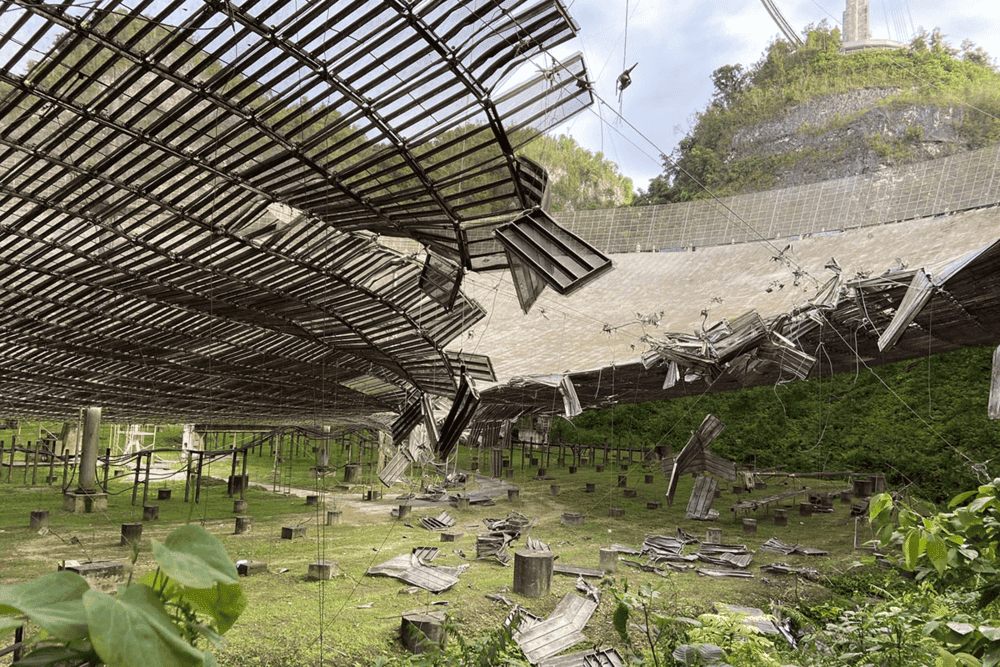
The discussion centers on the decommissioning and eventual collapse of the Arecibo Observatory, a significant radio telescope in Puerto Rico. Participants explore the implications of its closure, historical context, and the factors contributing to its structural failures, including maintenance issues and environmental challenges.
Discussion Character
- Debate/contested
- Historical
- Exploratory
Main Points Raised
- Some participants express sadness over the observatory's closure, reflecting on personal visits and its cultural significance.
- Others argue that the decommissioning is a natural outcome of the telescope's limited lifespan and that rebuilding may not be the best use of resources.
- A participant recounts the historical origins of the observatory, suggesting it was initially funded for military purposes but later adapted for astronomy.
- Concerns are raised about maintenance practices, with some attributing the collapse to environmental factors such as humidity and earthquakes rather than neglect.
- Another participant provides insights into the engineering challenges faced by the observatory, noting the failure of support cables and the risks involved in repairs.
- References to articles and historical documents are shared, highlighting the observatory's contributions to science and its unique capabilities in radar astronomy.
Areas of Agreement / Disagreement
Participants express a mix of sadness and acceptance regarding the observatory's fate, with no consensus on the causes of its decline or the appropriateness of potential rebuilding efforts. Multiple competing views on maintenance and environmental impacts are present.
Contextual Notes
Some discussions reference the observatory's history and its dual purpose, but there are unresolved questions about the extent of maintenance and the impact of environmental conditions on its longevity.
Who May Find This Useful
Readers interested in the history of scientific instruments, the impact of environmental factors on engineering, and the cultural significance of scientific facilities may find this discussion relevant.