Automata theory language constraints homework help

5 replies · 2K views · last reply
hamood_d10
Messages
4
Reaction score
0
Im currently studying Automata Theory and i have these questions that i want to answer
the problem I am not sure if i answer them currently
can anyone help me to solve them properly
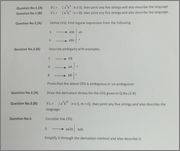
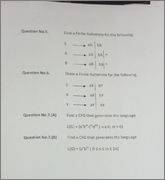
Photo of a printed homework sheet listing automata theory questions, including grammar and language problems such as Question No 2.(a) defining a regular expression and Question No 3 with a set-builder language definition.


Photo of a printed worksheet listing automata theory questions: Question No.5 asks for a finite automaton for the following languages, Question No.6 asks for a finite automaton for the following, Question 7 asks for a DFA, and Question 8 asks for a DFA for a regular language.
 
Last edited:
Mark44 said:
The images are tiny - too small to read.

sorry my bad i fix them
 
Q.NO1(A)
ab, aabb, aaabbb, aaaabbbb, aaaaaabbbbb.

Q.NO1(B)
aabb, aaabbb, aaaabbbb, aaaaaabbbbb, aaaaaaabbbbbb.

i don't know if they are right! also what it means by describe the language?

Q.NO7(A)
S → aSdd | A
A → bAc | bc

Q.NO7(B)
S → aSb | aSbb | λ

Im not sure about these or about the rest i really need help
 
Find a CFG that generates the language

Q1(A) - L(G) = { an bm | 0 ≤ n ≤ m ≤ 2n}
Q1(B) - L(G) = { an bm | 0 ≤ n, m}

WHATS THE DIFFERENCE BETWEEN THE Q1(A) AND Q1(B)?

ANSWER OF Q1(A) (IS IT RIGHT?)
S → aSb | aSbb | ^

ANSWER OF Q1(B)
??

Q2(A) - L(G) = { an bm cm d2n | n ≥ 0 , m > 0}
Q2(B) - L(G) = { an bm cm | n , m > 0}

WHATS THE DIFFERENCE BETWEEN THE Q2(A) AND Q2(B)?

ANSWER OF Q2(A) (IS IT RIGHT?)
S → aSdd | A
A → bAc | bc

ANSWER OF Q2(B)??

CAN YOU HELP ME ANSWER Q2(B) AND Q1(B) ?