Mellowed
- 1
- 0
Hi Guys,
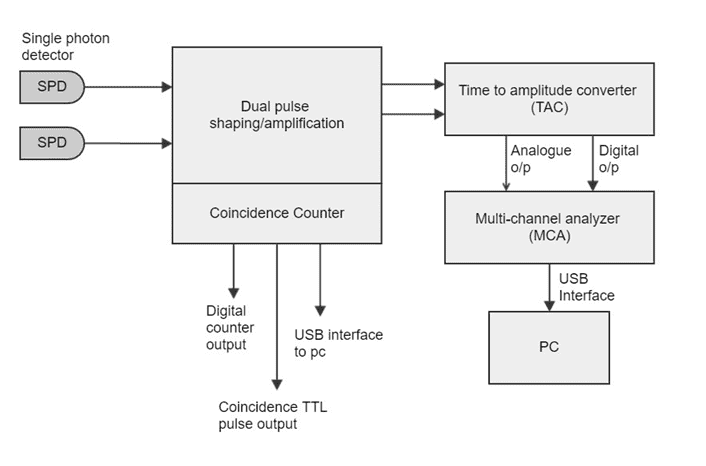
I was tasked with building a cheap Hanbury-Brown Twiss Interferometer >$50-100. Below is an image of my design requirements which i managed to implement within a 32bit micrcotronoller and i am able to measure time differences down to 100ps over a range of up to 1us-1ms at around 10mhz(i'm not using the clock cycle of the MCU for measurements). It sends the results to a PC and produces histographs etc and sends the data to labview aswell. It also counts the photons hitting each SPCM and has highspeed logic for simple highlow coincidence detection.
TLDR, device measures time difference between two Single photon detecotrs and some other stuff.
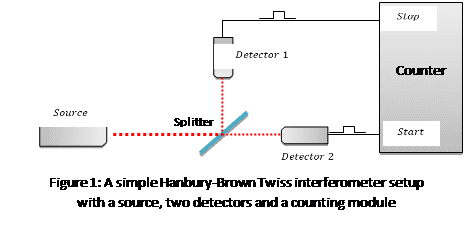
So I'm at the point where i need to explain the HBT experiment and I'm totally lost. Below is a basic setup example.
So the HBT can be used to calculate the second order coherence function given by
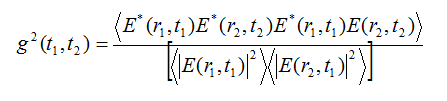
where (r1,t1) is the position and time of E electric fields? how would i get the (r1,t1), (r2,t1), (r2,t2) and how do they relate to the detections and measurements i make in the Figure1 above?
I studied electronics and no phyics (at all) and it has been a few years since i did maths so any help would be great.
Thanks!
I was tasked with building a cheap Hanbury-Brown Twiss Interferometer >$50-100. Below is an image of my design requirements which i managed to implement within a 32bit micrcotronoller and i am able to measure time differences down to 100ps over a range of up to 1us-1ms at around 10mhz(i'm not using the clock cycle of the MCU for measurements). It sends the results to a PC and produces histographs etc and sends the data to labview aswell. It also counts the photons hitting each SPCM and has highspeed logic for simple highlow coincidence detection.
TLDR, device measures time difference between two Single photon detecotrs and some other stuff.
So I'm at the point where i need to explain the HBT experiment and I'm totally lost. Below is a basic setup example.
So the HBT can be used to calculate the second order coherence function given by
where (r1,t1) is the position and time of E electric fields? how would i get the (r1,t1), (r2,t1), (r2,t2) and how do they relate to the detections and measurements i make in the Figure1 above?
I studied electronics and no phyics (at all) and it has been a few years since i did maths so any help would be great.
Thanks!