Math Amateur
Gold Member
MHB
- 3,920
- 48
- TL;DR
- I am reading Kristopher Tapp's book: Matrix Groups for Undergraduates.
I am currently focused on and studying Section 1 in Chapter2, namely:
"1. Complex Matrices as Real Matrices".
I need help in fully understanding how to prove an assertion related to Tapp's Proposition 2.4.
I am reading Kristopher Tapp's book: Matrix Groups for Undergraduates.
I am currently focused on and studying Section 1 in Chapter2, namely:
"1. Complex Matrices as Real Matrices".
I need help in fully understanding how to prove an assertion related to Tapp's Proposition 2.4.
Proposition 2.4 and some comments following it read as follows:
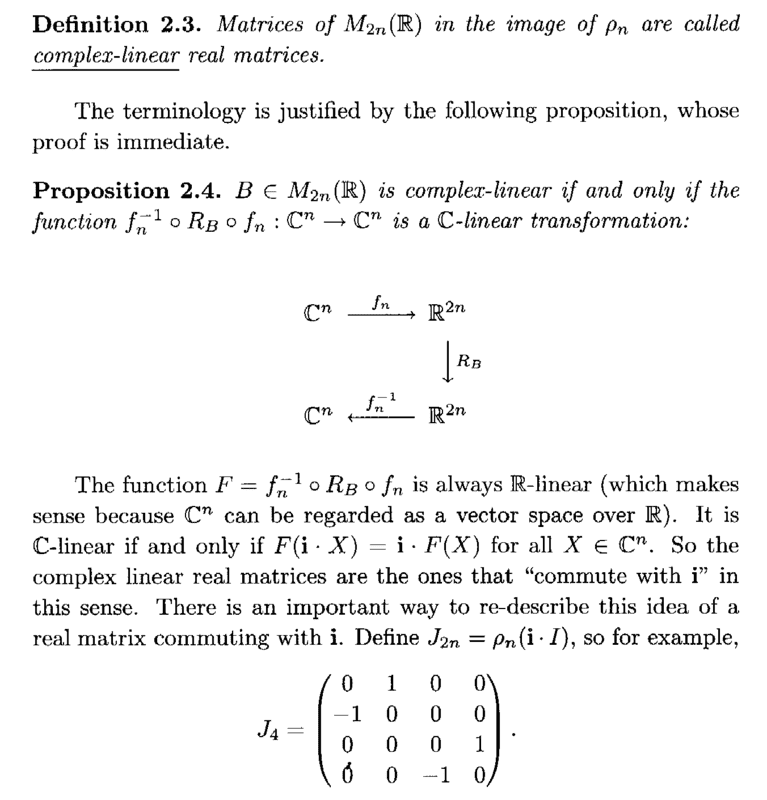
In the remarks following Proposition 2.4 we read the following:
" ... ... It (##F##) is ##\mathbb{C}##-linear if and only if ##F(i \cdot X) = i \cdot F(X)## for all ##X \in \mathbb{C}^n## ... "My question is as follows ... can someone please demonstrate a proof of the fact that ##F## is ##\mathbb(C)##-linear if and only if ##F(i \cdot X) = i \cdot F(X)## for all ##X \in \mathbb{C}^n## ...
Help will be much appreciated ...
Peter===================================================================================
*** EDIT ***
After a little reflection it appears that " ... ##F## is ##\mathbb{C}##-linear ##\Longrightarrow F(i \cdot X) = i \cdot F(X)## ... " is immediate as ...
... taking ##c = i## we have ...
##F(c \cdot X ) = c \cdot F(X) \Longrightarrow F(i \cdot X) = i \cdot F(X)## for ##c \in \mathbb{C}##Is that correct?
Peter
=======================================================================================
=======================================================================================
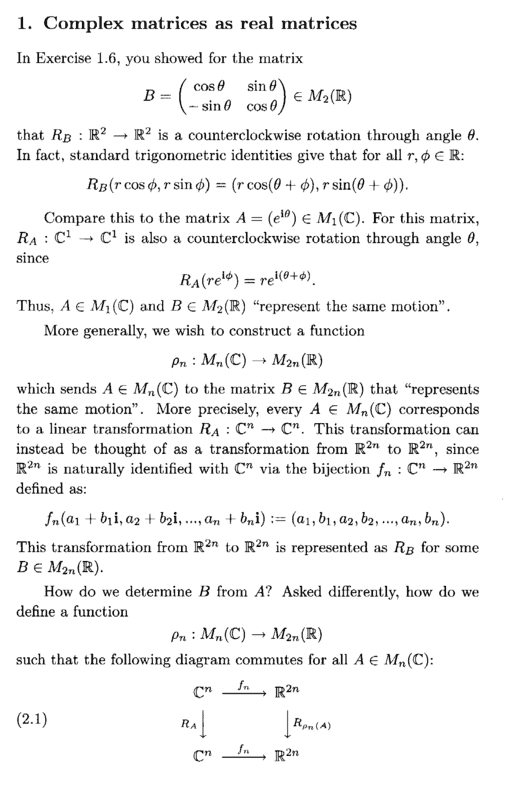
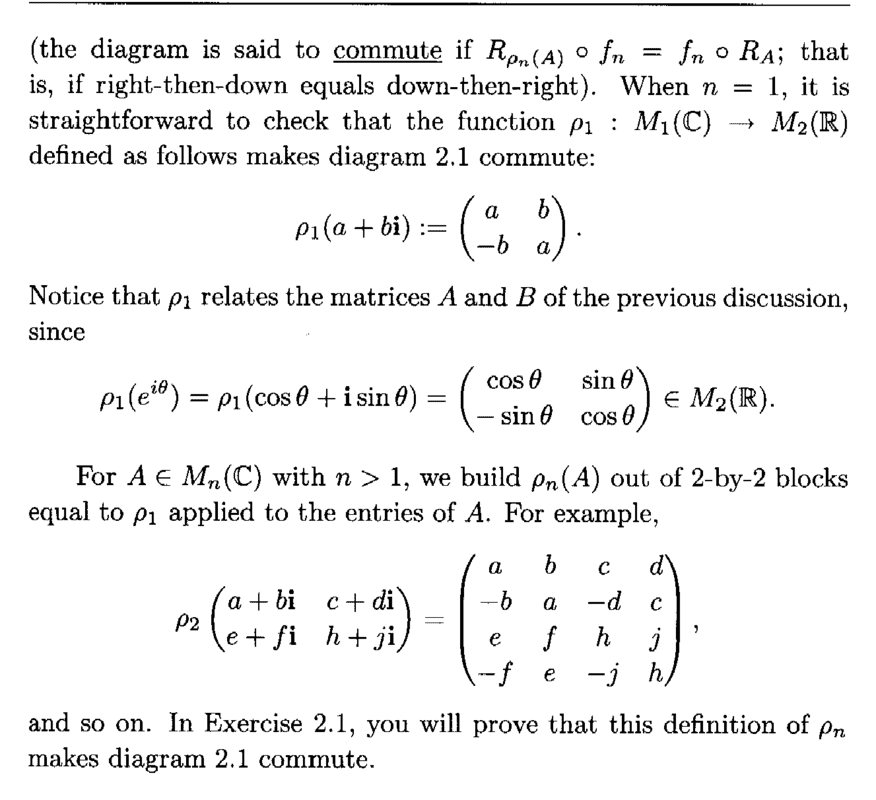
Note that Tapp defines##\rho_n## and ##f_n## in the following text ... ...
Also note that ##R_B## (actually ##R_A##) is defined in the following text ...
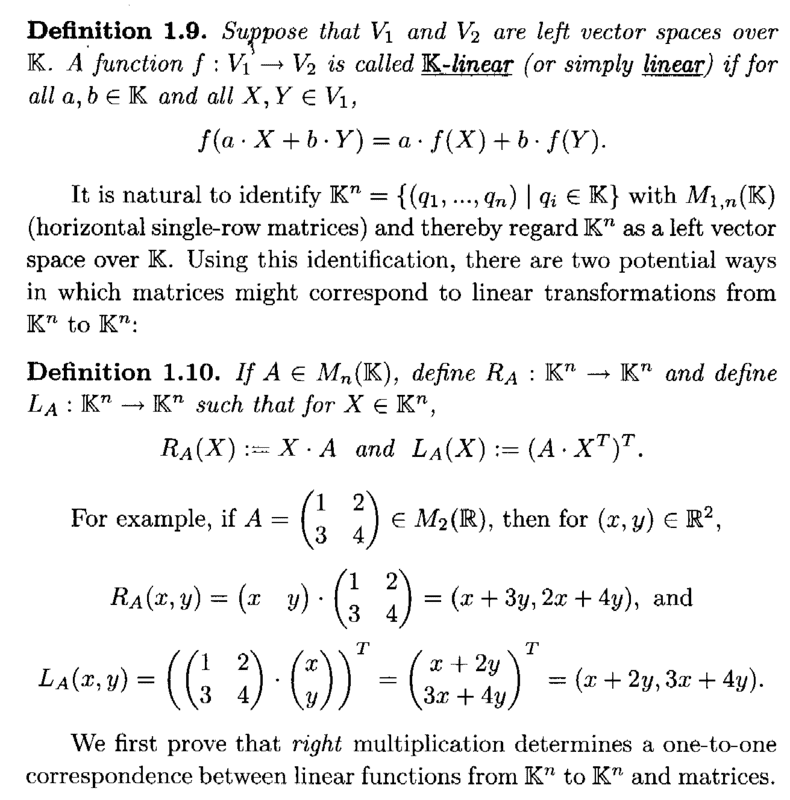 Hope the provision of the above text helps with definitions, notation and context ...
Peter
I am currently focused on and studying Section 1 in Chapter2, namely:
"1. Complex Matrices as Real Matrices".
I need help in fully understanding how to prove an assertion related to Tapp's Proposition 2.4.
Proposition 2.4 and some comments following it read as follows:
In the remarks following Proposition 2.4 we read the following:
" ... ... It (##F##) is ##\mathbb{C}##-linear if and only if ##F(i \cdot X) = i \cdot F(X)## for all ##X \in \mathbb{C}^n## ... "My question is as follows ... can someone please demonstrate a proof of the fact that ##F## is ##\mathbb(C)##-linear if and only if ##F(i \cdot X) = i \cdot F(X)## for all ##X \in \mathbb{C}^n## ...
Help will be much appreciated ...
Peter===================================================================================
*** EDIT ***
After a little reflection it appears that " ... ##F## is ##\mathbb{C}##-linear ##\Longrightarrow F(i \cdot X) = i \cdot F(X)## ... " is immediate as ...
... taking ##c = i## we have ...
##F(c \cdot X ) = c \cdot F(X) \Longrightarrow F(i \cdot X) = i \cdot F(X)## for ##c \in \mathbb{C}##Is that correct?
Peter
=======================================================================================
=======================================================================================
Note that Tapp defines##\rho_n## and ##f_n## in the following text ... ...
Also note that ##R_B## (actually ##R_A##) is defined in the following text ...
Peter