Concentric gas rings from nearly intersecting stellar orbits

  • Level: High School 
  • Thread starter Hornbein
  • Start date
  • Tags Tags
    Stars
6 replies · 2K views · last reply
Hornbein
Gold Member
Messages
4,343
Reaction score
3,463


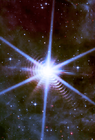
Two stars with orbits that almost intersect create concentric rings of gas.
 
  • Like
Likes   Reactions: vanhees71, Ibix and Drakkith
Are you sure? This looks a lot like diffraction to me.

Sometimes a red dwarf is just a sausage.
 
Vanadium 50 said:
Are you sure? This looks a lot like diffraction to me.

Sometimes a red dwarf is just a sausage.
Anton is a serious and reliable source.
 
Those rings still look a lot like diffraction to me.
 
https://arxiv.org/abs/astro-ph/0202315 (https://iopscience.iop.org/article/10.1086/340005)

WR140 is interesting to study because of this feature, it is not like they just randomally observed that star with JWST and saw something crazy and new. This was expected to be seen https://webbtelescope.org/contents/media/videos/2020/57/1297-Video?news=true (shows a cute animation)

Even more info about WR140: https://www.roe.ac.uk/~pmw/Wr140int.htm

The radial spikes however, are an artefact on JWST imaging
 
Last edited:
But that paper doesn't show the regulalrly spaced rings.
 
Vanadium 50 said:
But that paper doesn't show the regulalrly spaced rings.
The one from 2002? No because one did not have the equipment to take such images back then on WR140, but one understood its features. It is a well known phenomena, but rare (because WR stars are rare). When I took course "stellar physics" in 2007, the teacher had a seminar for grad students about WR stars which he invented us mere mortal undergrads to attend "just for fun". I think I was the only undergrad student who attendend.

Here is a paper about the WR104 star
https://www.researchgate.net/publication/230919834_The_Prototype_Colliding-Wind_Pinwheel_WR_104
Grid of ten contour-map panels of a rotating gas structure with spiral arms, each labelled by date from Apr98 to Sep04, axes marked from -100 to 100.

diagram:
Diagram of a spiral dust shell around a Wolf-Rayet star and an OB star, with labels for the shock front, dust formation zone, inner and outer walls of the first coil, bright first coil, faint second coil and eclipse on second coil.

image(s) from the Keck Observatory
https://stories.scienceinpublic.com.au/stories-of-astronomy-2012/keck-telescope/
http://www.physics.usyd.edu.au/~gekko/pinwheel.html
"The technique will be used on NASA’s successor to the Hubble Space Telescope: the James Webb Space Telescope"
False-colour image of a spiral pattern at the centre, with a bright red and yellow core curling into a blue and green arm, surrounded by concentric blue and purple rings on a black background.


Here is WR112
https://webarchive.gemini.edu/media/pr_images/final-wide-shot.jpg (by Gemini observatory)
its pattern is more compliacted because its motion is not perpendicular to our line of sight
https://scitechdaily.com/evolved-bi...of-dusty-embers-from-a-massive-stellar-forge/

Note that this is IR wavelength, in order to get pictures we can see we have to perform imageprocessing. This is a guy who has made such pic for WR140 using JWST data
Infrared space telescope image of a bright star with eight diffraction spikes radiating outward against a dense field of background stars, with concentric curved gas rings arcing around its center.
zoomed in:
Dark false-colour astronomical image with a diagonal edge, showing a series of curved, concentric arc-shaped rings and filaments in pink and blue, with scattered bright stars.

does not look like diffraction to me.
 
Last edited: