Continuous acetone production process design

6 replies · 7K views · last reply
gfd43tg
Gold Member
Messages
949
Reaction score
48
Hello,

I am working on a process design project and was wondering if I could get some help. While this is classwork material, I thought this is too big of a problem to post in the homework section, and would be more suitable in a forum such as this one which has much less traffic. For reference, here is the project description
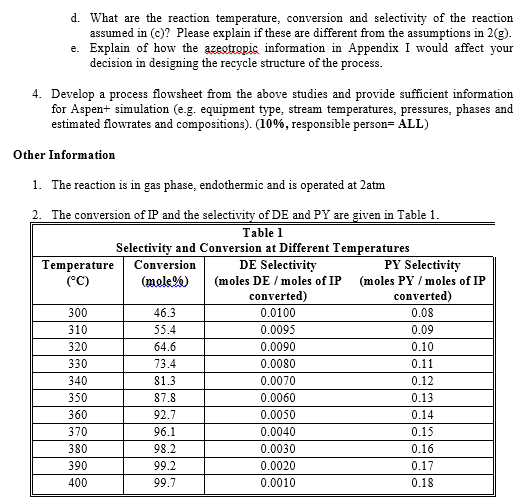
Assignment sheet titled Production of Acetone, Work Session #1, listing the objective, reactions 1 to 3 for dehydrogenation of isopropyl alcohol, assumptions, and assignment questions 1 and 2.

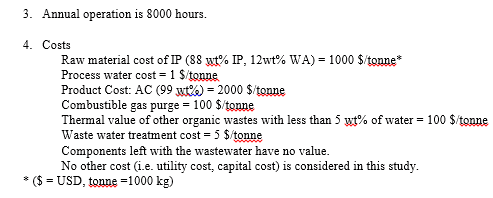
Printed exam-style questions 3a to 3c on recycle structure, asking about recycle streams, adiabatic reactor operation and the best economic potential of an acetone process.

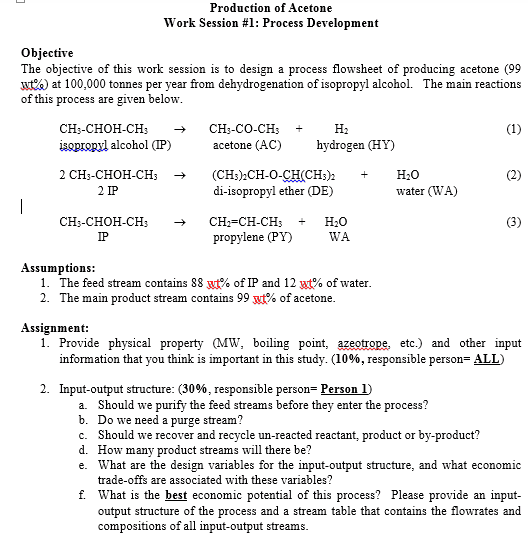
Screenshot of a project brief with a table titled Selectivity and Conversion at Different Temperatures, listing temperature in C, conversion in mol%, DE selectivity and PY selectivity for 300 to 400 C.

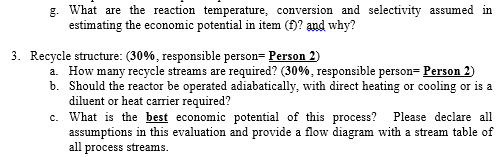
Project specification list: annual operation 8000 hours; costs: raw material IP 88 wt% IP and 12 wt% WA at 1000 $/tonne, process water 1 $/tonne, product AC 99 wt% at 2000 $/tonne, combustible gas purge 100 $/tonne, other organic wastes under 5 wt% water at 100 $/tonne, waste water treatment 5 $/tonne.


So with that said, we have 5 heuristic steps to dealing with planning a process

level 1: Batch vs. continuous
level 2: input-output structure
level 3: Recycle structure
level 4: Separation structure
level 5: Preliminary process flow sheet

1. So the production here is 100,000 tonnes/year, so it is clear this must be a continuous process (rule of thumb is > 1 million lbs/year should be continuous, we far exceed that amount)

2.
----------------------------------------------------------------------------------------------------------------------------------------------
To be continued
 
Attachments
  • Typed assignment page titled Production of Acetone, Work Session #1, listing three reactions: isopropyl alcohol to acetone and hydrogen, 2 isopropyl alcohol to di-isopropyl ether and water, and isopropyl alcohol to propylene and water, plus assumptions and assignment questions.
    upload_2015-3-11_23-47-50.png
    16.8 KB · Views: 1,069
  • Typed page excerpt listing design questions: item g asks about reaction temperature, conversion and selectivity; item 3 covers recycle structure, including how many recycle streams and whether the reactor is adiabatic.
    upload_2015-3-11_23-48-30.png
    8.3 KB · Views: 1,024
Here are some useful azeotropic information
Line graph of temperature against mole fraction for an isopropanol and water mixture at 1 atm, with two curves (bubble and dew) meeting at a minimum near 65 mol% IP, labelled as the azeotrope.

T-x-y diagram for acetone/water at 1 atm: temperature versus mole fraction, with a liquid curve and vapor curve, and an annotation pointing to where AC and water form an azeotrope at 92 mol% AC.

T-x-y phase diagram for acetone and water at 10 atm, with a blue bubble-point curve and green dew-point curve. The curves meet at a minimum-boiling azeotrope labelled AC-Water form azeotrope at 75 mol% of AC at 10 atm.


And my lovely onion diagram for process design
Onion diagram of nested rings labelled Reaction System, Separation System, Heat Recovery System and Utility System, with an arrow from the centre outward and the caption Problem: Optimum reaction --X--> optimum process.
 
Last edited:
This is a very rudimentary system I have come up with on paper so far. My thoughts are that of course I will need to react and get my products and by-products. I thought after the reactor it would be fairly easy to separate the hydrogen and propylene due to the large difference in boiling point, so I ran it at the boiling point of acetone to bring that as well. Since it will form a azeotrope with water, I know it won't be pure. After that I use another separator to easily purge off the gases.

From the bottom stream of the first separator, I want to recover and recycle my isopropyl alcohol (IP) because it is quite costly ($1000/tonne), so I need another separator. However it too forms a couple azeotropes, so I know I can't send it back to the reactor pure (at least for now). Any hints for how to deal with azeotropes?

Hand-drawn process flow diagram: reactor fed by IP and WA, feeding a separator, then a separator at 26 C with PY, HY and purge streams, and a second separator recycling WA, IP and DE, with IP and WA recycled back to the reactor.
 
Last edited:
Hand-drawn process flow diagram: reactor at 20 atm feeds a flash drum at 20 C, then a separator at 57 C, with recycle streams back to the reactor and labeled stream compositions (IP, AC, HY, DE, WA, PY).


Here is what myself and my partner have come up with so far. So basically, in this iteration we know hydrogen and propylene are light non-keys, and everything else is a heavy non-key, so they are most easily separated. Just running the flash drum at ambient temperature to minimize heating costs.

Now for the second separator, I want to separate the acetone (AC) from the diisopropyl ether (DE), and ultimately my goal is to recycle the isopropyl alcohol (IP) back into the reactor while purifying the acetone at 99 wt%. So I run this separator at 57 C, as at this temperature Acetone and water form an azeotrope. I figure the acetone and water will exit the top stream at its azeotropic composition, and DE is a heavy key, so there should be some in the distillate as well. The bottom stream has IP as a heavy non-key, and heavy keys of water and DE.

The next cascade of columns aims to purify the acetone and recycle the IP. So the bottom column separates the IP and AC, of which those are purged. Hopefully the AC is very low concentration in this stream. The top column (hopefully) will have very high AC concentration.

Obviously, there is a lot of information needed to be added, such as the fraction of each component in each stream, for which I need to use the T-xy diagram to determine. However, I am not experienced in azeotropic distillation, so this is proving to be a tough problem. Does there exist azeotropes of 3 or more components? Or do I just treat each one as a two component distillation. Designing a process has so many complications that it makes it hard to keep everything straight.
 
Attachments
  • Hand-drawn process flow diagram on lined paper: a reactor feeds a flash drum, then a distillation column at 57 C, then two further separation units at 68.5 and 2 atm, with stream labels AC, DE, IP, WA, HY and PY.
    ImageUploadedByPhysics Forums1426410486.022205.jpg
    23 KB · Views: 1,013
  • Hand-drawn process flow diagram on lined paper: feeds IP and WA enter a reactor at 2 MPa, then a flash drum at 25 C, then distillation columns at 57 C and 68.5, with labelled streams IP, WA, AC, DE, HY and PY.
    upload_2015-3-15_17-9-5.png
    46.4 KB · Views: 1,015
Last edited:
I'm working on a column in my design. I have managed to purge out most all of the hydrogen, and I have some propylene. Now, with this column I want to separate my acetone into a second column through the top, but for some reason I have a lot of difficulty getting this column to do ANY separation. It seems to just all go straight to the bottom, and the temperature of the top stream is less than -200 C, which makes no sense.

Aspen Plus flowsheet showing a valve feeding COLUMN1, a distillation column with a condenser at the top and reboiler at the bottom, with stream labels S1, T1 and B1 and error readout QC=-392 QR=1156.
Here is the stream profile
Table of stream properties for three streams S1, T1 and B1, listing temperature, pressure, vapor fraction, mole flow, mass flow, volume flow and enthalpy.

Table of mole flow in kmol/hr for six components (HY, PY, AC, DE, IP, WA) across three columns, with values such as AC 263.625 and 259.074, WA 424.089 and 426.732, and several entries listed as trace.


Here are my column specifications
Aspen Plus column setup dialog: Calculation type Equilibrium, 50 stages, Total condenser, Kettle reboiler, Vapor-Liquid phases, Standard convergence; reflux ratio 10 (mole), distillate to feed ratio 0.01 (mole).

Aspen Plus column feed and product streams table: feed stream S1 on stage 35 (On-Stage); product streams T1 on stage 1 and B1 on stage 50, both liquid, basis mole, units kmol/hr.


How the heck can I get this acetone to flow up? This is my error message. It seems that some stages are dry
Aspen Plus error message: severe error saying stages 2 to 15 dried up, followed by a note on flow limits and a mass balance error for BLOCK COLUMN1 with inlet and outlet flows and a relative difference.


It is difficult since I cannot upload my Aspen file onto PF, but if anyone has Aspen Plus I can certainly send my file
 
Last edited:
Hi Maylis.

Dealing with azeotropes can be pretty challenging, but I have four ideas (in rough order of priority).

The first is to have the reactor operate such that greater than 75% acetone is present in the outlet stream. This way, you can run the column/flash drum at 10 atm, and perform the separation from 75%->99% past the azeotrope. Try exploring pressures at above 10 atm also - the location of the azeotrope might go below 75% acetone.

The second is to consider running the column as a vacuum. There is an azeotrope at 92% acetone at 1 atm, but pressures below 1 atm might push the azeotrope to a higher percent (it might even go away). However, from a design standpoint, having a vacuum column is going to increase it's cost, so I would avoid vacuum columns if possible.

The third is pressure swing distillation. This would involve operating a first column at 1 atm, and pushing amount of acetone in the outlet stream past 75%. Then, that outlet stream can be fed into a second column at 10 atm. The second column won't have to deal with the second azeotrope, since the percent acetone is past 75%! This would likely be more expensive than either of the preceding options, since two columns would be needed.

The fourth (and what your professor might not like), is to incorporate some method other than distillation. Other methods would include using membranes or some absorbent material to scavenge the water. I wouldn't design my plant around it, but you could perhaps put it in your report/memo as an option which was considered, but not pursued.For your column, under operating specifications, I noticed you have "distillate to feed ratio" selected with a value of 0.01. That is pretty much why everything is going into the bottoms. You are basically forcing Aspen to put only 1% of the feed into the distillate. This is also probably why you have weird dang happening - everything might be turning into a vapor, and the heat of vaporization is lowering the temperature significantly. Actually, I don't even think that is thermodynamically possible. Then again, acetone is quite volatile, so maybe. That's one of the great things about Aspen, thermodynamically impossible stuff is allowed to happen in favor or attempting to satisfy a constraint (sarcasm). I feel your pain.

But yeah, get rid of the distillate to feed ratio constraint. Instead maybe specify 99% acetone in the distillate.

Oh and one more thing. Regarding the tradeoffs for running the reactor - increasing temperature leads to less undesired DE, but more undesired PY. In fact, you get more undesired PY than DE, so this would be a negative tradeoff. The benefit is an increased overall reaction rate. This is something I would optimize for AC production. Definitely have a recycle stream going into the reactor, because that will allow you to operate at a lower temperature. I also wouldn't worry about purifying the feed before it goes into the reactor. Although, you could have a separator before the reactor, where everything gets separated. You could try both having all of the reactions before and after separation, but if you don't have infinite time (which you don't) maybe just put the separators after the reactor. Also you need a purge stream to get rid of the DE and PE. They will not leave otherwise.

Hope this helps, and I am not too late!
 
  • Like
Likes   Reactions: gfd43tg
Well it is a little late, but I will check this out during the summer just for my own enrichment. I can email you my final aspen file to see what we ultimately ended up doing if you are interested.