Degeneracy removed when commuting observables are specified?

  • Context: Graduate 
  • Thread starter Thread starter Happiness
  • Start date Start date
  • Tags Tags
    Degeneracy observables
Click For Summary

Discussion Overview

The discussion revolves around the proof concerning two commuting operators, ##A## and ##B##, and their common eigenfunctions. Participants explore the implications of the proof on the concept of degeneracy in quantum mechanics, particularly whether the eigenvalues of these operators can completely specify simultaneous eigenfunctions and if degeneracy is fully removed when considering commuting observables.

Discussion Character

  • Debate/contested
  • Technical explanation
  • Conceptual clarification

Main Points Raised

  • Some participants question the claim that eigenvalues ##a_n## and ##b_n## completely specify a simultaneous eigenfunction ##\phi_n^{(k)}##, suggesting that multiple solutions may exist for an eigenvalue ##b_n^{(k)}##.
  • There is a suggestion that degeneracy may not be lifted unless the largest set of commuting observables is considered, indicating that the proof may not be sufficient as presented.
  • One participant references a source, Cohen-Tannoudji, Diu, and Laloë, to support the idea that a basis of common eigenvectors can be chosen without necessarily removing degeneracy.
  • Another participant emphasizes the need for ##A## and ##B## to be the only commuting operators in the system for degeneracy to be removed, raising a question about how to demonstrate that the roots in the proof are distinct under this condition.
  • There is acknowledgment of a misunderstanding regarding the completeness of the proof, with one participant noting they initially overlooked a critical aspect of the argument.

Areas of Agreement / Disagreement

Participants generally express disagreement regarding the completeness of the proof and the conditions under which degeneracy is removed. Multiple competing views remain about the necessity of additional commuting operators and the implications of the proof presented.

Contextual Notes

Participants highlight limitations in the proof, particularly regarding the assumptions about the distinctness of roots and the necessity of considering all commuting operators in the system.

Happiness
Messages
686
Reaction score
30
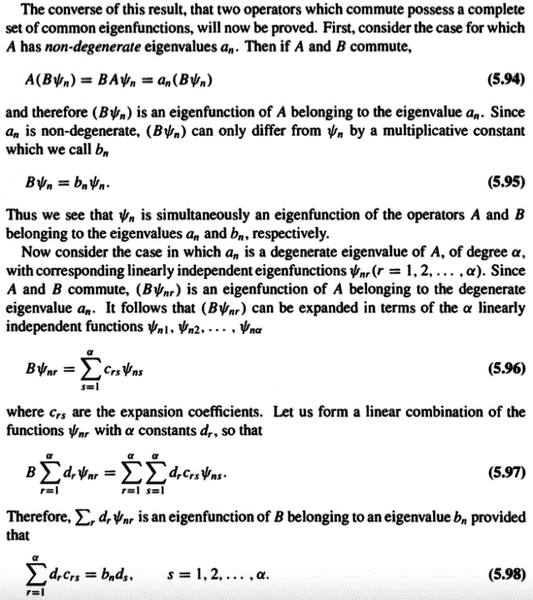
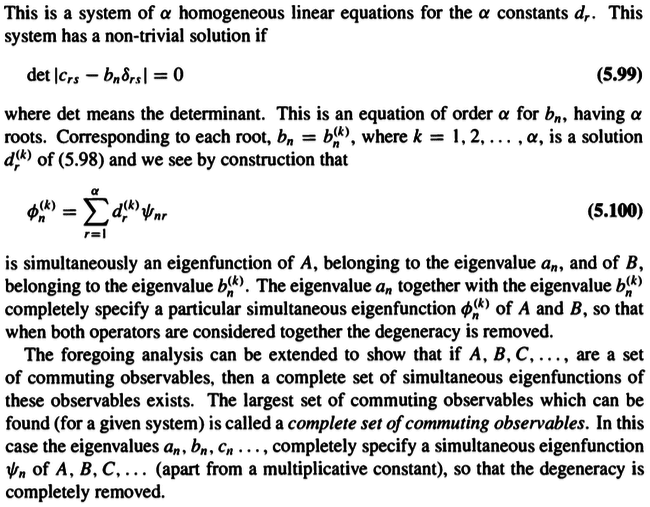
The following is a proof that two commuting operators ##A## and ##B## possesses a complete set of common eigenfunctions. The issue I have with the proof is the claim that the eigenvalue ##a_n## together with the eigenvalue ##b_n## completely specify a particular simultaneous eigenfunction ##\phi_n^{(k)}## of ##A## and ##B##, so that when both operators are considered together the degeneracy is completely removed.

(5.99) may not have ##\alpha## distinct roots. If so, ##a_n## together with ##b_n## do not completely specify a particular simultaneous eigenfunction, since an eigenvalue ##b_n^{(k)}## may have more than one solution ##d_r^{(k)}## corresponding to it.

Furthermore, the last paragraph mentions that the degeneracy is completely removed when the largest set of commuting observables are considered. This implies that if ##A## and ##B## do not form the largest set of commuting observables, the degeneracy may not be not completely removed. So I believe the claim is not proved.
Screen Shot 2015-12-22 at 4.26.44 am.png

Screen Shot 2015-12-22 at 4.27.02 am.png
 
Physics news on Phys.org
I agree with you. To quote Cohen-Tannoudji, Diu, and Laloë, when they do a similar proof:
What we have just shown is that it is always possible to choose, in every eigenspace of A, a basis of eigenvectors common to A and B.
That's it. It does not necessarily lift the degeneracy, and often does not, hence the need for additional operators to build a C.S.C.O.
 
  • Like
Likes   Reactions: Happiness
Happiness said:
The following is a proof that two commuting operators ##A## and ##B## possesses a complete set of common eigenfunctions. The issue I have with the proof is the claim that the eigenvalue ##a_n## together with the eigenvalue ##b_n## completely specify a particular simultaneous eigenfunction ##\phi_n^{(k)}## of ##A## and ##B##, so that when both operators are considered together the degeneracy is completely removed.

(5.99) may not have ##\alpha## distinct roots. If so, ##a_n## together with ##b_n## do not completely specify a particular simultaneous eigenfunction, since an eigenvalue ##b_n^{(k)}## may have more than one solution ##d_r^{(k)}## corresponding to it.

Furthermore, the last paragraph mentions that the degeneracy is completely removed when the largest set of commuting observables are considered. This implies that if ##A## and ##B## do not form the largest set of commuting observables, the degeneracy may not be not completely removed. So I believe the claim is not proved.

View attachment 93554
View attachment 93555
I guess the authors forgot to specify that ##A## and ##B## must be the only operators that commute within the system under consideration for the degeneracy that present in either of the two operators to be removed. Instead, they introduced the concept of CSCO when the discussion is almost over.
 
blue_leaf77 said:
I guess the authors forgot to specify that ##A## and ##B## must be the only operators that commute within the system under consideration for the degeneracy that present in either of the two operators to be removed. Instead, they introduced the concept of CSCO when the discussion is almost over.

How can we show that when ##A## and ##B## are the only operators that commute, the ##\alpha## roots in (5.99) are distinct in order for the degeneracy to be removed?
 
Ah I see your point. I didn't read the excerpt till the end so I thought that the proof that no further operator exist without destroying the commutativity between them was already given but not stated literally.
 

Similar threads

  • · Replies 4 ·
Replies
4
Views
3K
  • · Replies 11 ·
Replies
11
Views
3K
Replies
11
Views
3K
  • · Replies 9 ·
Replies
9
Views
2K
  • · Replies 19 ·
Replies
19
Views
3K
  • · Replies 5 ·
Replies
5
Views
2K
  • · Replies 6 ·
Replies
6
Views
2K
  • · Replies 25 ·
Replies
25
Views
18K
  • · Replies 11 ·
Replies
11
Views
3K
Replies
4
Views
2K