Derive a general expression for range when launch angle=0

7 replies · 4K views · last reply
aron silvester
1. The problem statement, all variables, and given/known data

Printed problem statement, item 7, in blue text: Derive a general expression for the range when the launch angle is zero. The expression should be in terms of v0, R, h, θ, and g.


Homework Equations


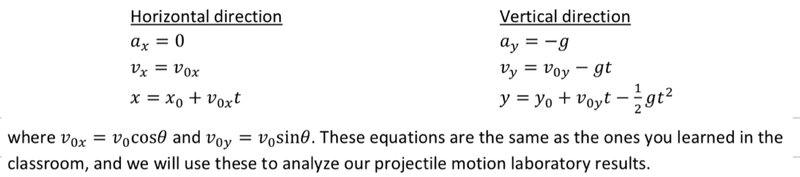
Two columns of projectile motion equations: horizontal direction with ax = 0, vx = v0x, x = x0 + v0x t; vertical direction with ay = -g, vy = v0y - gt, y = y0 + v0y t - (1/2) g t^2. Below, v0x = v0 cos θ and v0y = v0 sin θ.


The Attempt at a Solution


So basically I took vertical direction formula and I solved for "t". I then took the horizontal direction formula and solved for "x" or we can also call x the "Range" since that's what the problem is asking for. Is this right?
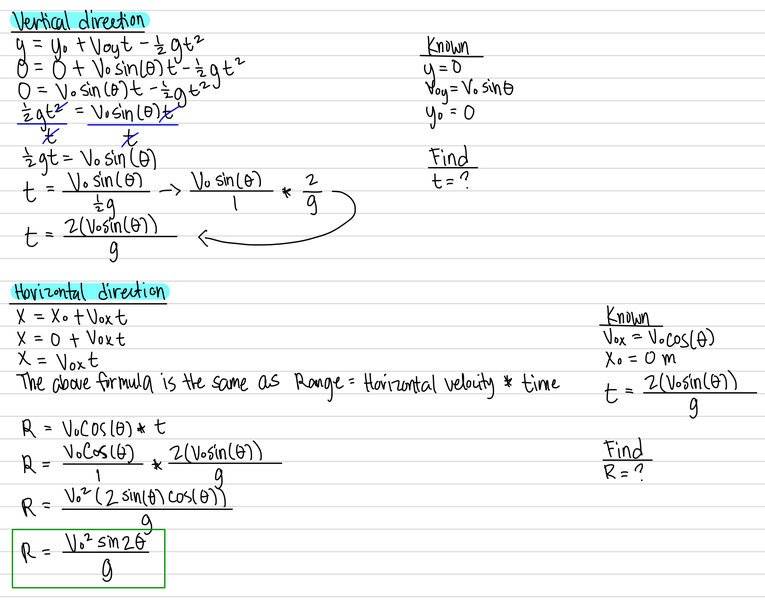
Handwritten derivation of projectile range: vertical motion gives t = 2(Vo sin θ)/g, horizontal motion gives R = Vo cos θ * t, leading to R = Vo² sin 2θ / g, boxed in green.
 
TSny said:
Correct. Good job!
Hey thanks, but my professor got this. The equation that I got is the same as the expression on the left side of the addition sign, and then he's adding an equation inside a square root. Why is that?
Handwritten whiteboard: Part II, with the system R = V0(cos θ)t and 0 = h + V0(sin θ)t - ½gt², followed by 'Solve for R.' and 'Derive this eq.: R = (V0² sinθcosθ)/g + √((V0⁴ sin²θcos²θ)/g² + (2hV0²cos²θ)/g)'.
 
I haven't looked at your professors solution but I think yours is wrong.

If the launch angle is zero then sin(θ) = 0 and the range will always be zero unless it's fired from some initial height y0. Yet you state y0=0.

The problem statement mentions "h" which I think meant to be the initial launch height eg it's fired from the top of a hill of height h.
 
  • Like
Likes   Reactions: TSny
i mean if you set up theta=0, you will not get the formula. then you get that formula, R=V0*t
= vo*√(2h/g)
 
Last edited:
aron silvester said:
Hey thanks, but my professor got this. The equation that I got is the same as the expression on the left side of the addition sign, and then he's adding an equation inside a square root. Why is that?
View attachment 212478
As @CWatters noted, you solved the problem for firing the projectile with a nonzero angle over level ground, so the projectile returns to the same height as it was fired from. But it looks like you were meant to solve a different problem where the projectile is fired horizontally (##\theta = 0##) off a cliff of height h. I apologize for not catching that earlier.
 
CWatters said:
I haven't looked at your professors solution but I think yours is wrong.

If the launch angle is zero then sin(θ) = 0 and the range will always be zero unless it's fired from some initial height y0. Yet you state y0=0.

The problem statement mentions "h" which I think meant to be the initial launch height eg it's fired from the top of a hill of height h.
TSny said:
As @CWatters noted, you solved the problem for firing the projectile with a nonzero angle over level ground, so the projectile returns to the same height as it was fired from. But it looks like you were meant to solve a different problem where the projectile is fired horizontally (##\theta = 0##) off a cliff of height h. I apologize for not catching that earlier.

I finally solved it, but I have a question. When I used the quadratic formula, why did I have to multiply the inside of the square root by (v^2cos^2(θ))/g^2 and again by (v^2cos^2(θ))/1 ?? The part where I do this is in pink ink.
Handwritten derivation of projectile range: horizontal and vertical motion equations, the quadratic formula applied to solve for R, and pink-ink algebra simplifying the square-root term to v0^4 sin^2(θ) cos^2(θ)/g^2 + 2hv0^2 cos^2(θ)/g.
 
aron silvester said:
I finally solved it, but I have a question. When I used the quadratic formula, why did I have to multiply the inside of the square root by (v^2cos^2(θ))/g^2 and again by (v^2cos^2(θ))/1 ?? The part where I do this is in pink ink.
View attachment 212534
Handwritten algebra with purple and orange annotations deriving projectile range; a circled term is moved inside a square root, with the resulting v0 and cos terms raised to the fourth power and the expression simplified.


When you bring something into the square root, you have to square it. The something here is ##\frac{v_0^2 \cos ^ 2\theta}{g}##. So, after bringing it into the square root, the ##v_0## and ##\cos{\theta}## are raised to the 4th power.