'Devil' comet visible tonight 21.04.24

  • Context: Stargazing 
  • Thread starter Thread starter pinball1970
  • Start date Start date
  • Tags Tags
    Comet
Click For Summary
SUMMARY

The 'Devil Comet', officially known as Comet 12P/Pons-Brooks, reached perihelion on April 21, 2024, at a distance of 0.78 AU from the sun. Observers in mid- to southern latitudes of North America are advised to look towards the Taurus constellation immediately after sunset, where the comet will be positioned just below it and to the left of Jupiter. However, visibility is severely hindered by twilight, atmospheric absorption, and the full Moon, making this period one of the worst times to observe the comet. Improved viewing conditions are expected in May as the comet moves away from the sun and into the night skies of the southern hemisphere.

PREREQUISITES
  • Understanding of celestial navigation and constellation identification
  • Familiarity with astronomical photography techniques
  • Knowledge of comet observation challenges, including light pollution and atmospheric conditions
  • Experience with telescopes, specifically the Seestar S50 smart telescope
NEXT STEPS
  • Research optimal viewing conditions for comets, focusing on light pollution and atmospheric effects
  • Learn advanced techniques for astrophotography using Canon 6DII and similar cameras
  • Study the orbital mechanics of comets, particularly perihelion effects on visibility
  • Explore the historical visibility patterns of Comet 12P/Pons-Brooks and similar comets
USEFUL FOR

Astronomy enthusiasts, amateur astrophotographers, and educators interested in comet observation and celestial events will benefit from this discussion.

pinball1970
Gold Member
2025 Award
Messages
3,662
Reaction score
5,797
TL;DR
Viewers in the mid- to southern latitudes of North America can look toward the Taurus constellation immediately after sunset to spot the comet. It will be just below the constellation, with the prominent 'V' shape of Taurus pointing down towards it. The comet will appear just to the left of Jupiter.
From the article:

"Viewers in the mid- to southern latitudes of North America can look toward the Taurus constellation immediately after sunset to spot the comet. It will be just below the constellation, with the prominent 'V' shape of Taurus pointing down towards it. The comet will appear just to the left of Jupiter, which will appear as a bright pale yellow orb.
Look for a circular, wispy patch of light with possibly a faint tail that stretches up and to the left of the bright central area, or coma, that surrounds the comet's nucleus."


https://www.space.com/devil-comet-pons-brooks-reaches-perihelion
 
  • Like
Likes   Reactions: Stavros Kiri
Astronomy news on Phys.org
I think that will be tricker than the article assumes. It is very low in the sky and close to the sun, twilight and atmospheric absorption will be serious problem.
 
  • Like
Likes   Reactions: davenn, Stavros Kiri and pinball1970
glappkaeft said:
I think that will be tricker than the article assumes. It is very low in the sky and close to the sun, twilight and atmospheric absorption will be serious problem.
Let's see if any of the pf beautiful universe guys get an image.
 
They can probably get something. It is just a pity that these kinds of articles always gets published for perihelion. If the comet is close to the sun in the sky it is much better to observe it, depending on the shape of its orbit, earlier (like in this case, it has been followed visually since November and was really nice a few weeks ago), or later like with C/2011 L4 Pan-STARRS in 2013 (impossible to spot when the massive press and TV news coverage said but very nice naked eye a few weeks after when only amateur astronomers still cared).
 
  • Informative
Likes   Reactions: pinball1970
It'll be back in the night sky in the Summer [for the Southern hemisphere]... (June, mostly, if I remember correctly, though even in May will start being ok to spot etc. ...). Now it's really the worst time to observe it or get photos ...
Quoting from Spacewether.com :
A) [April 22]
"THE 'DEVIL COMET' AT PERIHELION: Comet 12P/Pons-Brooks hasn't been this close to the sun for 71 years. On April 21st, the 'devil comet' reached perihelion at a distance of 0.78 AU. Solar heat brightened the comet, but sky watchers couldn't enjoy the show. This animation from Mike Olason of Tucson, Arizona, shows why:

devilcomet_strip_opt.gif

The comet is very close to the horizon when the sun sets. Bright twilight almost washes it out. Add in this week's full Moon and you have a very tricky observing problem.

"The comet is getting closer to the horizon each evening as twilight is getting brighter," says Olason. "By the end of the month 12P will no longer be observable from here in Tucson."

Now for the good news: In May, the comet will move away from the sun and into the night skies of the southern hemisphere. In fact, astronomer Michael Mattiazzo is already seeing it from Australia."

B) [April 21]
"THIS IS THE WORST TIME TO OBSERVE 'THE DEVIL COMET': If you get your science news from mainstream media, you might think this weekend is a great time to observe Comet 12P/Pons-Brooks, a.k.a. "The Devil Comet." In fact, the opposite is true. The comet--barely a naked eye object on the best of nights--is almost completely overwhelmed by a combination of evening twilight and full Moonlight.

To illustrate the problem, Mike Olason photographed the comet sinking into the haze near of Tucson, Arizona, on April 20th:

12p_at_twilight_strip.gif

"As one can see from the animation, the images were collected as twilight started to fade only to be replaced by moonshine from the 87% illuminated Moon," says Olason. "It also did not help that the comet was at an altitude below 6 degrees. Most of the tail and coma were washed out by light pollution, twilight, Moonlight and atmospheric interference."

The kernel of truth in mainstream reports is that Comet 12P is at perihelion on April 21st--its closest approach to the sun. Solar heat is indeed brightening the comet to its maximum luminosity. However, Earth and the comet are far apart on opposite sides of the sun, and we have to squint through the glare of the sun to see the comet.

It all adds up to poor visibility--for now. In May the comet will move away from the sun and into the night skies of the southern hemisphere. In fact, astronomer Michael Mattiazzo is already seing from Australia." (see above for the link ...)
 
Last edited:
yeah, still very close to the horizon here in Australia. I have seen/photo'ed it a couple of times but very difficult in the twilight
this was for the 22 April that I posted on social media .....

TONITE'S "BEST OF THE BUNCH" PHOTO OF COMET 12P/PONS-BROOKS

Canon 6DII, 200mm, f2.8, 10 sec, ISO160
unguided hence the star trailing, but a fuzz of a tail is visible
Area finder map as well
Comet was on the line at 10o'clock from that star just above the "h" of 20h
Shooting to the NW from West Ryde, across a major portion of the Wstrn/NW suburbs of the city. Would have been better from a dark site.
Wasn't visible in 7x50 binoculars

1714046477366.jpeg


1714046439879.jpeg
 
  • Like
Likes   Reactions: Stavros Kiri
davenn said:
yeah, still very close to the horizon here in Australia. I have seen/photo'ed it a couple of times but very difficult in the twilight
this was for the 22 April that I posted on social media .....

TONITE'S "BEST OF THE BUNCH" PHOTO OF COMET 12P/PONS-BROOKS

Canon 6DII, 200mm, f2.8, 10 sec, ISO160
unguided hence the star trailing, but a fuzz of a tail is visible
Area finder map as well
Comet was on the line at 10o'clock from that star just above the "h" of 20h
Shooting to the NW from West Ryde, across a major portion of the Wstrn/NW suburbs of the city. Would have been better from a dark site.
Wasn't visible in 7x50 binoculars

View attachment 344028


View attachment 344027
Thanks @davenn for this live observation update from the Southern Hemisphere ...
 
  • Love
Likes   Reactions: davenn
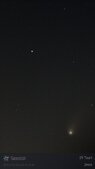
Another update from Southern Hemisphere (this time South Africa). Was very low on the horizon. I focused on 29 Tauri and moved just slightly off centre, as I didn't know if the tracking on Pons-Brook would be very accurate.

2 minute total exposure time, at 10sec exposure intervals, Seestar S50 smart telescope.
(Focal Length 250mm, Aperture 50mm, f/5; 1920x1080 pixels, pixel dimensions 2.9μm square, sensor diagonal 6.46mm, aspect ratio 1/2.8)
 

Attachments

  • photo_2024-04-25_21-19-43.jpg
    photo_2024-04-25_21-19-43.jpg
    8.4 KB · Views: 71
  • Like
Likes   Reactions: davenn and Stavros Kiri
Skywave said:
Another update from Southern Hemisphere (this time South Africa). Was very low on the horizon. I focused on 29 Tauri and moved just slightly off centre, as I didn't know if the tracking on Pons-Brook would be very accurate.

2 minute total exposure time, at 10sec exposure intervals, Seestar S50 smart telescope.
(Focal Length 250mm, Aperture 50mm, f/5; 1920x1080 pixels, pixel dimensions 2.9μm square, sensor diagonal 6.46mm, aspect ratio 1/2.8)
Wow! great!

pinball1970 said:
Let's see if any of the pf beautiful universe guys get an image.
Despite the status and issues ... doing great so far (see posts #8 & #6 above ...)
 

Similar threads

  • · Replies 1 ·
Replies
1
Views
5K