Discrete maths problem - tracing an algorithm

Click For Summary
SUMMARY

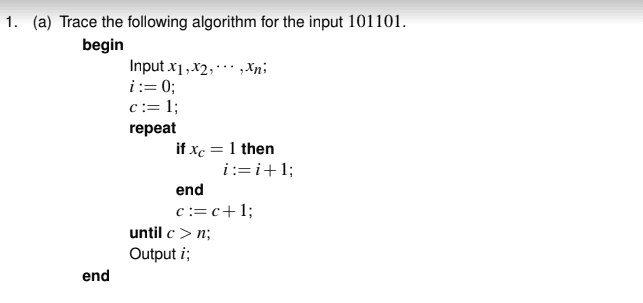
The discussion revolves around understanding the indexing mechanism in a discrete mathematics algorithm. The variable Xc represents the current index of the loop, which starts at 1 (C := 1) and increments with each iteration (C := C + 1). This allows the algorithm to access each value in the sequence of variables (x1, x2, ..., xn) sequentially. The participants confirm that the loop stops when C equals 7, and the variable i counts the occurrences of 1's in the input, which totals to 4 by the end of the algorithm.

PREREQUISITES
  • Understanding of discrete mathematics concepts
  • Familiarity with algorithmic indexing
  • Basic knowledge of loop structures in programming
  • Experience with variable assignment and incrementation
NEXT STEPS
  • Study discrete mathematics algorithms and their applications
  • Learn about loop constructs in programming languages
  • Explore variable scope and lifetime in algorithms
  • Investigate counting algorithms and their efficiency
USEFUL FOR

Students of discrete mathematics, computer science learners, and anyone interested in algorithm design and indexing techniques.

Sterling1
Messages
2
Reaction score
0
Hello,

I'm working on a discrete mathematics for computing paper and am stuck on what a symbol is trying to convey. Sorry if this seems like a stupid question (I feel stupid for not being able to work it out myself), I've just started this subject and am still getting used to it.

My question is what does the Xc mean in this algorithm (picture attached)? I understand that X1, X2 etc are the different variables, but does the Xc have something to do with the variable C := 1? If so, what does that symbol mean? I.e. what am I supposed to do with the variable in relation to C?

I hope this is clear enough and that once it's been explained to me I can crack on with the paper. Thank you very much in advance.
DM screen.PNG
 
Last edited by a moderator:
Physics news on Phys.org
It's indexing. So you have a bunch of values, $x_1, x_2, \dots,x_n,$ right? As you're looping through the repeat section, you're updating $c$. When you start, you have $c=1,$ so that $x_c=x_1.$ The next time you come through the loop, $c$ has been incremented by one, which is what the $c:=c+1$ line does. That means this time through the loop, $c=2,$ making $x_c=x_2.$ So essentially, the incrementing of $c$ allows you to examine each of the $x_1, x_2,\dots,x_n$ values one-by-one. Does that help?
 
Ackbach said:
It's indexing. So you have a bunch of values, $x_1, x_2, \dots,x_n,$ right? As you're looping through the repeat section, you're updating $c$. When you start, you have $c=1,$ so that $x_c=x_1.$ The next time you come through the loop, $c$ has been incremented by one, which is what the $c:=c+1$ line does. That means this time through the loop, $c=2,$ making $x_c=x_2.$ So essentially, the incrementing of $c$ allows you to examine each of the $x_1, x_2,\dots,x_n$ values one-by-one. Does that help?

Ah right, so essentially the i variable is counting how many 1's are in the input? I.e. in this algorithm i would equal 4 by the end? And the loop stops when C = 7? If I'm correct in that thinking then I've understood your explanation, and if I'm wrong then clearly I've missed something.

Thank you very much for your help, it makes sense to me (I think) now. It seems stupid to have not understood such a basic concept as indexing. Thank you.
 
Sterling said:
Ah right, so essentially the i variable is counting how many 1's are in the input?

Yep!

Sterling said:
I.e. in this algorithm i would equal 4 by the end?

Yes, I would agree.

Sterling said:
And the loop stops when C = 7?

Also correct.

Sterling said:
If I'm correct in that thinking then I've understood your explanation, and if I'm wrong then clearly I've missed something.

Thank you very much for your help, it makes sense to me (I think) now. It seems stupid to have not understood such a basic concept as indexing. Thank you.

You're very welcome!
 

Similar threads

Replies
86
Views
2K
  • · Replies 4 ·
Replies
4
Views
2K
  • · Replies 2 ·
Replies
2
Views
2K
  • · Replies 6 ·
Replies
6
Views
2K
  • · Replies 6 ·
Replies
6
Views
2K
  • · Replies 4 ·
Replies
4
Views
10K
  • · Replies 1 ·
Replies
1
Views
2K
  • · Replies 1 ·
Replies
1
Views
2K
  • · Replies 12 ·
Replies
12
Views
2K
  • · Replies 4 ·
Replies
4
Views
2K