sillycow
- 18
- 1
Reading about gravity waves got me back to thinking about relativity. And I am left with two questions to which I don't know the answer...
Question 1. Gravity waves ripple through the entire universe. They will not cause any macro scale effects because local changes to space-time are very small. However is there a scale at which these small space-time distortions become important?
For example:
Two subatomic particles which are very small, and very close to each-other.
Their binding/opposing forces/fields are at a very delicate equilibrium
Could the gravity waves distorting space time around them cause the equilibrium to break, and cause some interesting phenomenon to occur? (some type of nuclear decay?). If so, could something like that happening in many places at the same time lead to some macroscopic electromagnetic event?
Question 2. When examining the photon clock thought experiment: A pair of mirrors is moving at 0.5 the speed of light away from me. The clock's mirrors are aligned as such that the photon bouncing between them is moving parallel to the direction of the clock's movement. Since the speed of light is constant, then as seen by me, it would take the photon a different amount of time to move in one direction than it would to move the other.
Wouldn't the blue photon complete it's journey in less time then the red one?
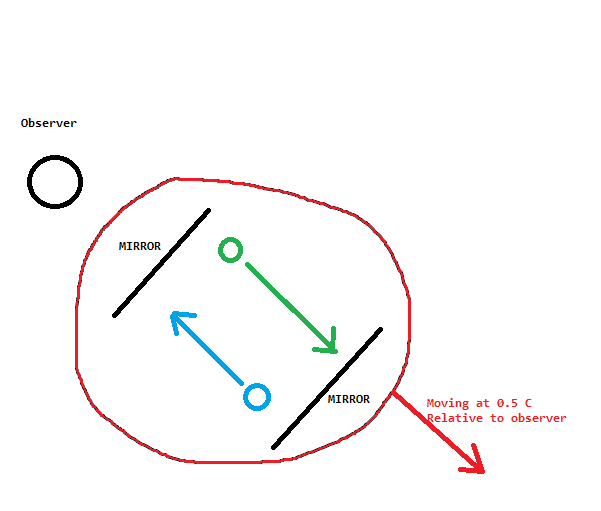
Since distances are defined in light-seconds/years/hours/whatever this observation would make it seem that the clock has two different sizes, depending on the direction that the photon is bouncing.
Would this not effect the way I would observe atoms? Namely: Electrons would seem orbit "faster" in one direction as opposed to the other. Making the atom's electron shells seem egg shaped instead of spherical. Wouldn't this cause me (the "stationary" observer) to detectsome electric/magentic field originating said atom's perceived assymetry?
Question 1. Gravity waves ripple through the entire universe. They will not cause any macro scale effects because local changes to space-time are very small. However is there a scale at which these small space-time distortions become important?
For example:
Two subatomic particles which are very small, and very close to each-other.
Their binding/opposing forces/fields are at a very delicate equilibrium
Could the gravity waves distorting space time around them cause the equilibrium to break, and cause some interesting phenomenon to occur? (some type of nuclear decay?). If so, could something like that happening in many places at the same time lead to some macroscopic electromagnetic event?
Question 2. When examining the photon clock thought experiment: A pair of mirrors is moving at 0.5 the speed of light away from me. The clock's mirrors are aligned as such that the photon bouncing between them is moving parallel to the direction of the clock's movement. Since the speed of light is constant, then as seen by me, it would take the photon a different amount of time to move in one direction than it would to move the other.
Wouldn't the blue photon complete it's journey in less time then the red one?
Since distances are defined in light-seconds/years/hours/whatever this observation would make it seem that the clock has two different sizes, depending on the direction that the photon is bouncing.
Would this not effect the way I would observe atoms? Namely: Electrons would seem orbit "faster" in one direction as opposed to the other. Making the atom's electron shells seem egg shaped instead of spherical. Wouldn't this cause me (the "stationary" observer) to detectsome electric/magentic field originating said atom's perceived assymetry?
Last edited: