Doubt about Jacobi's diagonalization method

Click For Summary
SUMMARY

The Jacobi diagonalization method is an iterative algorithm used for diagonalizing symmetric matrices. As the number of iterations increases, the absolute value of the largest off-diagonal element decreases, indicating convergence towards a diagonal matrix. However, the convergence rate is slow, requiring a number of iterations proportional to the matrix size (n), with the computational complexity being O(n^3) due to the interactions between off-diagonal elements. Understanding this behavior is crucial for effectively applying the Jacobi method in numerical linear algebra.

PREREQUISITES
  • Understanding of symmetric matrices
  • Familiarity with iterative algorithms
  • Knowledge of matrix operations and their complexities
  • Basic concepts of numerical linear algebra
NEXT STEPS
  • Study the convergence properties of iterative methods for matrix diagonalization
  • Learn about the QR algorithm for diagonalization of matrices
  • Explore the impact of matrix size on computational complexity in numerical methods
  • Investigate alternative methods for improving convergence rates in matrix diagonalization
USEFUL FOR

Mathematicians, numerical analysts, and computer scientists interested in matrix computations and optimization of algorithms for diagonalization of symmetric matrices.

Cloruro de potasio
Messages
30
Reaction score
1
TL;DR
Number of iterations required in the Jacobi symmetric matrix diagonalization method
Good Morning,

I am using the Jacobi diagonalization method for symmetric matrices and I have realized that as the number of iterations progresses, the speed with which the larger element (in absolute value) outside the diagonal of the diagonal becomes smaller Matrices are increasing (graphical attachment showing the logarithm of the value of the maximum element (in absolute value) of the matrix together depending on the number of iteration.

I don't understand very well why this happens, can someone help me?

Thank you very much in advance and greetings
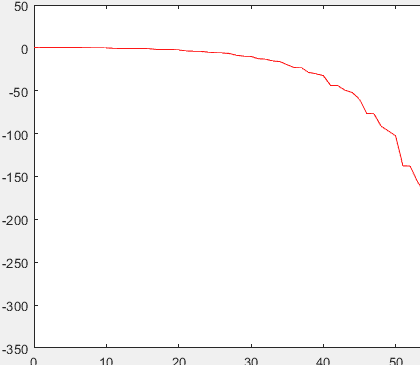
1574508818069.png
 
Physics news on Phys.org
The Jacobi method of matrix diagonalization has a slow convergence. The method is an iterative one and for reducing a ##n## - dimensional symmetric matrix to a diagonal one, it requires a number of iterations proportional to ##n##. Now, in each iteration, the number of off-diagonal elements to be annihilated is proportional to ##n^2## - i.e. we have an order of ##n^3## operations. The annihilation of one pair of off-diagonal elements affects the values of others in the same column and row. So, matrix elements that have been put to zero in some operation may become non-zero later on, when another pair is being reduced.
 
  • Informative
Likes   Reactions: Cloruro de potasio
Thank you very much,

I understand that the number of iterations is proportional to the size of the matrix to be diagonalized, but ... why does the rate of decrease of the largest element outside the diagonal increase as the number of iterations increases?
 
Cloruro de potasio said:
but ... why does the rate of decrease of the largest element outside the diagonal increase as the number of iterations increases?

Because it goes to convergence depending on the number of iterations but at a slow rate in general.
 
  • Informative
Likes   Reactions: Cloruro de potasio

Similar threads

  • · Replies 5 ·
Replies
5
Views
2K
  • · Replies 1 ·
Replies
1
Views
3K
  • · Replies 2 ·
Replies
2
Views
4K
  • · Replies 0 ·
Replies
0
Views
3K
  • · Replies 4 ·
Replies
4
Views
6K
  • · Replies 1 ·
Replies
1
Views
3K
  • · Replies 5 ·
Replies
5
Views
6K
  • Poll Poll
  • · Replies 3 ·
Replies
3
Views
7K
  • Poll Poll
  • · Replies 1 ·
Replies
1
Views
5K
Replies
1
Views
3K