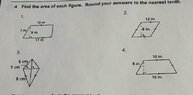
1.) The area for a trapezoid is given by:
$$A=\frac{h}{2}(B+b)$$
Plugging in the given values, we find:
$$A=\frac{6\text{ m}}{2}(11+10)\text{ m}=63\text{ m}^2\approx60\text{ m}^2\quad\checkmark$$
2.) The area for a parallelogram is given by:
$$A=bh$$
Plugging in the given values, we find:
$$A=(12\text{ in})(8\text{ in})=96\text{ in}^2\approx100\text{ in}^2\quad\checkmark$$
3.) The area for a kite can be found from the product of its diagonals. We can see one is 10 cm in length, and we can use Pythagoras to get the other:
$$\sqrt{6^2-5^2}+\sqrt{8^2-5^2}=\sqrt{6}+\sqrt{39}$$
And so the area is:
$$A=(10\text{ cm})((\sqrt{6}+\sqrt{39})\text{ cm})=10(\sqrt{6}+\sqrt{39})\text{ cm}^2\approx90\text{ cm}^2$$
4.) We have a trapezoid, and we know the big base \(B\) and the little base \(b\), but we don't know the height \(h\). But, we can find it using Pythagoras. Consider the right triangle making up the left part of the diagram. We are given the hypotenuse, and the smaller leg must be half the difference between the big base and the little base. Can you continue to find the height?