Finding minimum value of function with two variable

Click For Summary
SUMMARY

The discussion focuses on finding the minimum value of a cost function involving two variables, x and y. The user successfully computed the first partial derivatives with respect to both variables and set them to zero to find critical points. The optimal solution is confirmed by evaluating the second derivative test using the Hessian matrix determinant. Additionally, the user seeks to determine the valid range for x and y values that yield a solution, indicating a need for further clarification on the constraints of the problem.

PREREQUISITES
  • Understanding of partial derivatives and critical points
  • Knowledge of the second derivative test and Hessian matrix
  • Familiarity with optimization techniques in multivariable calculus
  • Ability to interpret graphical representations of mathematical problems
NEXT STEPS
  • Learn about the second derivative test for functions of multiple variables
  • Study the properties and applications of the Hessian matrix in optimization
  • Explore methods for determining feasible regions in optimization problems
  • Investigate graphical techniques for visualizing multivariable functions and their constraints
USEFUL FOR

Students and professionals in mathematics, engineering, and economics who are involved in optimization problems, particularly those dealing with multivariable functions and cost calculations.

gevni
Messages
25
Reaction score
0
I have a formula for cost calculation that contain x and y two variable. I have to find the value of (x,y) where that formula will gives minimum value as cost should not be equal to zero, it has some minimum value.
I took 1st partial derivative with respect to x and then with y and found the value of x and y where function will give minimum value. My question is how to combine both to get one answer as optimal (x,y) where function has minimum cost?
 
Last edited:
Physics news on Phys.org
Please type out your function and your work so far.
 
gevni said:
I have a formula for cost calculation that contain x and y two variable. I have to find the value of (x,y) where that formula will gives minimum value as cost should not be equal to zero, it has some minimum value.
I took 1st partial derivative with respect to x and then with y and found the value of x and y where function will give minimum value. My question is how to combine both to get one answer as optimal (x,y) where function has minimum cost?
I assume you set the partial derivatives to 0 and solved the two resulting equations for x and y. Now what do mean by "combine both to get one answer? The one point, (x, y) IS the point where f(x, y) is minimum (or maximum- you need to check which). For example if $f(x,y)= (x-3)^2+(y- 4)^2$ then setting the partial derivatives equal to 0 gives $2(x- 3)= 0$ and $2(y- 4)= 0$ so x= 3 and y= 4. The "critical point" is (3, 4) where the value of the function is f(3, 4)= 0, a minimum.
 
Country Boy said:
I assume you set the partial derivatives to 0 and solved the two resulting equations for x and y. Now what do mean by "combine both to get one answer? The one point, (x, y) IS the point where f(x, y) is minimum (or maximum- you need to check which). For example if $f(x,y)= (x-3)^2+(y- 4)^2$ then setting the partial derivatives equal to 0 gives $2(x- 3)= 0$ and $2(y- 4)= 0$ so x= 3 and y= 4. The "critical point" is (3, 4) where the value of the function is f(3, 4)= 0, a minimum.
Thank you! yes after getting partial derivatives with x and y I set the resulting equations to 0 for getting values of x and y and got the formula for x= ...and y=...
Just want to confirm that now I have to replace x and y in original cost equation with these formulas (x= and y=) and it will results in minimum cost for that cost equation right?.
One more question how do I know that these values of x and y are for minimum?
 
One way is to compare the value at that point to values close by. Another is to use the "second derivative test": if $(f_{xx})(f_{yy})-(f_{xy})^2$ is positive at the given point, then it is either a maximum or a minimum. If it is negative then the point is a "saddle point".

(This is the determinant of the "Hessian matrix", $\begin{bmatrix} f_{xx} & f_{xy} \\ f_{xy} & f_{yy}\end{bmatrix}$. It is actually the product of the two eigenvalues. Each eigenvalue tells you if the graph curves up (if the eigenvalue is positive) or down (if negative) in the x or y directions. The determinant is positive if they have the same sign, both positive or both negative, negative if they have different signs.)
 
Last edited:
Country Boy said:
One way is to compare the value at that point to values close by. Another is to use the "second derivative test": if $(f_{xx})(f_{yy})-(f_{xy})^2$ is positive at the given point, then it is either a maximum or a minimum. If it is negative then the point is a "saddle point".

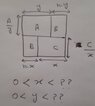
Thank you I compared points closed by and get to know the minimum. Now there is one more thing, I have to provide the range of x and y within which if their values fall then there is a solution else there will be no solution. Can you please look into the attached figure it is n*n square divided into A,B and C area, can you please help me finding the upper range for both variables (x,y)?

0<x< ?
0<y<?
 

Attachments

  • 110461264_1177808379226535_2654335419636091325_n.jpg
    110461264_1177808379226535_2654335419636091325_n.jpg
    38.5 KB · Views: 109
That picture is very hard to understand. You have region labeled "A", "B", "C", and "A" and are apparently using those letters to represent the areas of those regions but don't say that. In addition you have an "h" (or is it "n"?) but do not define it. Is h the length of a side of the square? Finally, what in the world does this picture have to do with the original problem, a "cost calculation"?
 
Country Boy said:
That picture is very hard to understand.
I think I batter had to ask it as a separate question (with detail) as it is a different problem. Many thanks for your help :)
 

Similar threads

  • · Replies 5 ·
Replies
5
Views
2K
  • · Replies 1 ·
Replies
1
Views
1K
Replies
3
Views
2K
  • · Replies 4 ·
Replies
4
Views
4K
  • · Replies 3 ·
Replies
3
Views
2K
  • · Replies 1 ·
Replies
1
Views
1K
  • · Replies 2 ·
Replies
2
Views
1K
  • · Replies 2 ·
Replies
2
Views
1K
  • · Replies 1 ·
Replies
1
Views
2K
  • · Replies 3 ·
Replies
3
Views
3K