Finding when a system has infinite, no, or single solutions for different k values

Join the discussion
Registration is free. Ask a follow-up in this thread, or start your own.
5 replies · 3K views
Yankel
Messages
390
Reaction score
0
Hello

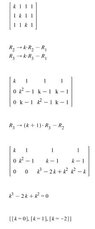
I have been trying to solve this system of equations, I need to find for which values of k the system has infinite number of solutions, no solution and a single solution.

I did some work, and found that for k=0 and k=1 there are infinite number of solutions and for k=-2 there is no solution.

However, for k=0 I ran this system on Maple and it found a single solution. What did I do wrong here ?

View attachment 308

thank you !
 

Attachments

  • eq.JPG
    eq.JPG
    9.2 KB · Views: 130
Physics news on Phys.org
Yankel said:
Hello

I have been trying to solve this system of equations, I need to find for which values of k the system has infinite number of solutions, no solution and a single solution.

I did some work, and found that for k=0 and k=1 there are infinite number of solutions and for k=-2 there is no solution.

However, for k=0 I ran this system on Maple and it found a single solution. What did I do wrong here ?

View attachment 308

thank you !

You cannot set \(k^2+k-2=0\) since you then need an implicit division by zero to get a solution which is wrong since the last equation is \(0 \times x_3=0\) when \(k=0\)

CB
 
if I solve k^2+k−2=0 I get k=1,-2

where is the division by zero comes in ?

what is the solution then ?
 
Yankel said:
if I solve k^2+k−2=0 I get k=1,-2

where is the division by zero comes in ?

what is the solution then ?

Because you have already divided by 0.

You started out with a system of simultaneous equations \( {\bf{A}} (k) {\bf{x}} ={\bf{c}}\) to which you applies Gaussian elimination to the augmented system and that gave a last equation: \( (k^3+k^2-2k)x_3=k^2-k\) which leaves \(x_3\) undetermined when \(k=0\).

What you get when you set \(k^3+k^2-2k=0\) are the values of \(k\) for which either no solution exists or there are an infinity of solutions, if \(k^3+k^2-2k=0\) and \(k^2-k=0\) you have an infinity of solutions, if \(k^3+k^2-2k=0\) and \(k^2-k\ne 0\) you have no solutions.

Please look at your original post and clarify what question you think you are asking.

CB
 
Last edited:
Hello, Yankel!

I've been trying to solve this system of equations: .][tex]\left|\begin{array}{ccc|c} k&1&1 & 1 \\ 1&k&1 & 1 \\ 1&1&k & 1 \end{array}\right|[/tex]

I need to find values of [tex]k[/tex] for which the system has
an infinite number of solutions, no solution, and a single solution.
The system has no solution if the determinent is zero.

[tex]D \;=\;\begin{vmatrix}k&1&1 \\ 1&k&1 \\ 1&1&k\end{vmatrix} \;=\;k\begin{vmatrix}k&1\\1&k\end{vmatrix} - 1\begin{vmatrix}1&1\\1&k\end{vmatrix} + 1\begin{vmatrix}1&k \\ 1&1\end{vmatrix} \;=\;0[/tex]

. . [tex]k(k^2-1) - (k-1) + (1-k) \:=\:0 \quad\Rightarrow\quad k^3 - k - k + 1 + 1 - k \:=\:0[/tex]

. . [tex]k^3 - 3k + 2 \:=\:0 \quad\Rightarrow\quad (k-1)^2(k+2) \:=\:0 \quad\Rightarrow\quad k \:=\: 1,\:\text{-}2[/tex]

The system has no solutions if [tex]k = 1[/tex] or [tex]k = \text{-}2.[/tex]~ ~ ~ ~ ~ ~ ~ ~ ~ ~ ~ ~ ~ ~ ~ ~ ~ ~ ~ ~ ~ ~ ~ ~ ~ ~ ~ ~ ~ ~Solve the system.

[tex]\text{We have: }\:\left|\begin{array}{ccc|c} k&1&1&1 \\ 1&k&1&1 \\ 1&1&k&1\end{array}\right|[/tex]

[tex]\begin{array}{c}\text{Switch} \\ R_1 \& R_2 \\ \end{array}\:\left|\begin{array}{ccc|c} 1&k&1&1 \\ k&1&1&1 \\ 1&1&k&1 \end{array}\right|[/tex]

[tex]\begin{array}{c} \\ \\ R_2-kR_1 \\ R_3-R_1 \end{array}\:\left|\begin{array}{ccc|c}1&k&1&1 \\ 0&1-k^2 & 1-k & 1-k \\ 0 & 1-k & k-1 & 0 \end{array}\right|[/tex]

[tex]\begin{array}{c} \\ \\ \\ \tfrac{1}{1-k^2}R_2 \\ \tfrac{1}{1-k}R_3 \end{array}\:\left|\begin{array}{ccc|c} 1&k&1 \\ 0&1&\tfrac{1}{k+1} & \tfrac{1}{k+1} \\ 0 & 1 & \text{-}1 & 0 \end{array}\right|[/tex]

[tex]\begin{array}{c}R_1 - kR_2 \\ \\ \\ \\ R_3-R_2 \end{array}\:\left|\begin{array}{ccc|c}1 & 0 & \tfrac{1}{k+1} & \tfrac{1}{k+1} \\ 0 & 1 & \tfrac{1}{k+1} & \tfrac{1}{k+1} \\ 0 & 0 & \text{-}\tfrac{k+2}{k+1} & \text{-}\tfrac{1}{k+1} \end{array}\right|[/tex]

[tex]\begin{array}{c}\\ \\ \\ \\ \\ \\ \text{-}\tfrac{k+1}{k+2}R_3 \end{array}\:\left|\begin{array}{ccc|c} 1 & 0 & \tfrac{1}{k+1} & \tfrac{1}{k+1} \\ 0&1&\tfrac{1}{k+1} & \tfrac{1}{k+1} \\ 0&0&1& \tfrac{1}{k+2} \end{array}\right|[/tex]

[tex]\begin{array}{c}R_1 - \tfrac{1}{k+1}R_3 \\ R_2 - \tfrac{1}{k+1}R_3 \\ \\ \\ \end{array}\:\left|\begin{array}{ccc|c}1&0&0 & \tfrac{1}{k+2} \\ 0&1&0 & \tfrac{1}{k+2} \\ 0&0&1 & \tfrac{1}{k+2} \end{array}\right|[/tex]

The system has a solution for any [tex]k \ne \text{-}2[/tex]That's strange!
If [tex]k =1[/tex], a solution is: .[tex]\left|\begin{array}{ccc|c}1&0&0 & \tfrac{1}{3} \\ 0&1&0 & \tfrac{1}{3} \\ 0&0&1 & \tfrac{1}{3} \end{array}\right|[/tex]

Yet in the first stage, we saw that [tex]k = 1[/tex] makes the determinant zero.
Can anyone explain this?
 
Yankel said:
I have been trying to solve this system of equations, I need to find for which values of k the system has infinite number of solutions, no solution and a single solution.

I did some work, and found that for k=0 and k=1 there are infinite number of solutions and for k=-2 there is no solution.

However, for k=0 I ran this system on Maple and it found a single solution. What did I do wrong here ?

View attachment 308
The unwanted "$k=0$" came in when you multiplied a row of the matrix by $k$, as for example in the row operation $R_2\to kR_2 - R_1.$ The row operation that is allowed in the Gaussian reduction process is to add a multiple of one row to another row. In this case that would allow the operation $R_2\to R_2-\frac1k R_1$, but not $R_2\to kR_2 - R_1.$ However, that goes wrong when $k=0$ because of the fraction $\frac1k.$ So you need to investigate the case $k=0$ separately to see whether or not the solution is unique in that case.

soroban said:
The system has no solution if the determinent is zero.
That is not quite right. If you have a system of $n$ linear equations in $n$ variables, then it has a unique solution if the determinant (of the coefficients in the equations) is nonzero. If the determinant is zero then the system has either no solution or infinitely many solutions.