xaz
- 1
- 0
Recently for a project I have been trying to figure out the correct time to launch a spaceship and have it successfully reach Mars. This is what I've managed so far
Because of Earth's orbit around the sun a ship would have a transfer orbit that looks like this
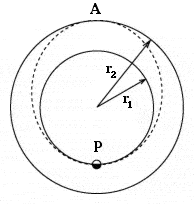
Distance from starting point to ending point= 1+1.523 =2.523 AU (addition of orbits)
Semi major axis of transit orbit= 2.523/2=1.261
Kepler's third law [T]^{2} = [a]^{3}[/itex], therefore T= \sqrt{1.261^{3}} = 1.417454 years
This is a time for a fall orbit so time for a trip=1.417454/2= 0.70873 years
location of Mars at time of launch= 360* (0.70873/1.88)= 135.555^{o}, so something like this
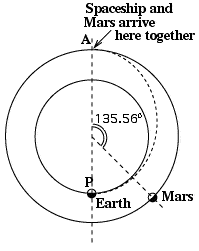
Now the angle between Earth Sun and Mars = 180-135.6= 44.4^{o}
To find when this angle occurs I was thinking of using c^{2}=a^{2}+b^{2}-2ab CosC, where a is the distance from Earth to the sun, b is the distance from Mars to the Sun, c is the distance between the two planets and C is the Earth Sun Mars angle. For a and b I used r=periapsis*{1+e}/{1+e cos(theta)} , I know this equation isn't perfect as it assumes Mars and Earth orbit at the same velocity and start at the same point but I'm going to adjust it later. Now my problem is I've been having trouble getting an equation for c, can anyone help me with that, or alternately does anyone know how I could find when this particular Earth Sun Mars angle is going to occur.
Thanks for any help in advance
Because of Earth's orbit around the sun a ship would have a transfer orbit that looks like this
Distance from starting point to ending point= 1+1.523 =2.523 AU (addition of orbits)
Semi major axis of transit orbit= 2.523/2=1.261
Kepler's third law [T]^{2} = [a]^{3}[/itex], therefore T= \sqrt{1.261^{3}} = 1.417454 years
This is a time for a fall orbit so time for a trip=1.417454/2= 0.70873 years
location of Mars at time of launch= 360* (0.70873/1.88)= 135.555^{o}, so something like this
Now the angle between Earth Sun and Mars = 180-135.6= 44.4^{o}
To find when this angle occurs I was thinking of using c^{2}=a^{2}+b^{2}-2ab CosC, where a is the distance from Earth to the sun, b is the distance from Mars to the Sun, c is the distance between the two planets and C is the Earth Sun Mars angle. For a and b I used r=periapsis*{1+e}/{1+e cos(theta)} , I know this equation isn't perfect as it assumes Mars and Earth orbit at the same velocity and start at the same point but I'm going to adjust it later. Now my problem is I've been having trouble getting an equation for c, can anyone help me with that, or alternately does anyone know how I could find when this particular Earth Sun Mars angle is going to occur.
Thanks for any help in advance