MarcelComsol
- 3
- 2
Hi there,
I'm failing in simulating the fresnel equations in 2D with Comsol.
As you can see in the model added to this post, the reflectance and transmission in the global plots both for TE-waves ("Port, senkrecht polarisiert", Plot "Reflektion und Transimission, senkrecht") and TM-waves ("Port, parallel poralisiert", Plot "Reflektion und Transmission, paralell") seems to be correct for small angles of alpha. But for bigger angles of alpha, the simulated values differ strongly from the analytical solutions. I suspect that the wave from the upper port is also entering from the sides of the dielectrica (side 1 and 6), since we have also an electrical field in the dielectrica for alpha equals 90 degrees(see picture below). How can I avoid the electromagnetic wave entering from the sides 1 and 6 (i chose floquet periodic boundary conditions)?
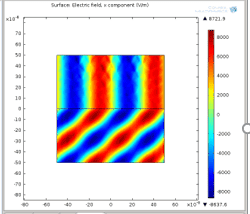
Picture above: TM waves, alpha=90 degrees, but still a wave is entering my dielectrica(the lower half)
I would be very happy about every help in this problem!
Best wishes
model: https://drive.google.com/open?id=107LINBOhmZtR_uzkJhYKgNb8POFVLMX6
I'm failing in simulating the fresnel equations in 2D with Comsol.
As you can see in the model added to this post, the reflectance and transmission in the global plots both for TE-waves ("Port, senkrecht polarisiert", Plot "Reflektion und Transimission, senkrecht") and TM-waves ("Port, parallel poralisiert", Plot "Reflektion und Transmission, paralell") seems to be correct for small angles of alpha. But for bigger angles of alpha, the simulated values differ strongly from the analytical solutions. I suspect that the wave from the upper port is also entering from the sides of the dielectrica (side 1 and 6), since we have also an electrical field in the dielectrica for alpha equals 90 degrees(see picture below). How can I avoid the electromagnetic wave entering from the sides 1 and 6 (i chose floquet periodic boundary conditions)?
Picture above: TM waves, alpha=90 degrees, but still a wave is entering my dielectrica(the lower half)
I would be very happy about every help in this problem!
Best wishes
model: https://drive.google.com/open?id=107LINBOhmZtR_uzkJhYKgNb8POFVLMX6
Attachments
