Help with a question (Bernoulli General solution)

Click For Summary
SUMMARY

The discussion focuses on solving the Bernoulli differential equation of the form (dy/dt) + a(t)y = b(t)y^n, as presented in Martin Braun's "Differential Equations and Their Applications." Participants clarify that multiplying the equation by y^{-n} leads to a separable form, allowing for the identification of an integrating factor. The conversation reveals that the equation can be transformed into a more manageable format, and highlights the importance of correctly applying calculus principles to achieve an exact equation.

PREREQUISITES
  • Understanding of Bernoulli differential equations
  • Familiarity with integrating factors in differential equations
  • Knowledge of calculus, specifically the chain rule
  • Experience with separable equations and exact equations
NEXT STEPS
  • Study the concept of Bernoulli differential equations in detail
  • Learn how to derive and apply integrating factors in differential equations
  • Explore the chain rule and its applications in solving differential equations
  • Review resources on exact and separable equations for deeper understanding
USEFUL FOR

Mathematics students, educators, and anyone interested in mastering differential equations, particularly those focusing on Bernoulli equations and their applications in applied mathematics.

Ultra
Messages
6
Reaction score
0
Hello guys I hope you all are doing well. :)

I found below question in a book by Martin Braun "Differential Equations and Their Applications An Introduction to Applied Mathematics (Fourth Edition)"

The question :
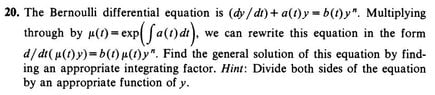
The Bernoulli differential equation is (dy/dt)+a(t)y=b(t)y^n. Multiplying through by µ(t)=exp(Integral of a(t).dt), we can rewrite this equation in the form
d/dt(µ(t)y)=b(t)µ(t)y^n. Find the general solution of this equation by finding an appropriate integrating factor. Hint: Divide both sides of the equation
by an appropriate function of y.

I have problems solving this question. because this question is located in section (1.9) of the book which talks about exact equations and my problem is that
I cannot turn "d/dt(µ(t)y)=b(t)µ(t)y^n" to an exact equation form. I'd appreciate any help. :)
 

Attachments

  • Question_20 (section 1.9) .jpg
    Question_20 (section 1.9) .jpg
    28.9 KB · Views: 160
Physics news on Phys.org
Welcome, Ultra!

Multiply both sides of the Bernoulli equation by $y^{-n}$ to obtain $y^{-n} dy/dt + a(t)y^{1-n} = b(t)$. By the chain rule, $d/dt(y^{1-n}) = (1-n)y^{-n} dy/dt$. So the equation can be written $d/dt(y^{1-n}) + (1-n)a(t)y^{1-n} = (1-n) b(t)$. If $u = y^{1-n}$, then $du/dt + (1-n)a(t)u = (1-n)b(t)$. In this form, you can now find an appropriate integrating factor and solve the equation.
 
Hello Euge,

Thanks for your reply. However, I think the question asks for something else!
Would u please read the attached PDF?
 

Attachments

If $z = \mu y$, then $y = z/\mu$ and $d/dt(\mu(t)y) = b(t)\mu(t)y^n$ becomes $$\frac{dz}{dt} = \frac{b}{\mu^{n-1}} z^n$$ Alternatively, $$\frac{dz}{z^n} - \frac{b(t)}{\mu(t)^{n-1}}\, dt = 0$$ This equation is already exact, in fact, separable. So there is no integrating factor to be found.
 
Hello Euge,

And thank you for your reply. So, the attached PDF is totally wrong?
 

Attachments

Ultra said:
Hello Euge,

And thank you for your reply. So, the attached PDF is totally wrong?
Everything up to the point where you say "And" is correct. But pretty much everything below the statement "Now could we say below" is not. When you take your partial with respect to t you will not get the RHS. I'm not sure how you calculated it, but it's wrong.

-Dan
 
topsquark said:
Everything up to the point where you say "And" is correct. But pretty much everything below the statement "Now could we say below" is not. When you take your partial with respect to t you will not get the RHS. I'm not sure how you calculated it, but it's wrong.

-Dan
Hello Dan,

And thank you.
 
topsquark said:
Everything up to the point where you say "And" is correct. But pretty much everything below the statement "Now could we say below" is not. When you take your partial with respect to t you will not get the RHS. I'm not sure how you calculated it, but it's wrong.

-Dan
Dan what book u suggest for someone who wants bone up his understanding of partials? (after all these years I still think I haven't known them by heart!)
 
Ultra said:
Dan what book u suggest for someone who wants bone up his understanding of partials? (after all these years I still think I haven't known them by heart!)
Any Calculus level text (you are looking for something like Calc III) should do the trick. I'm not certain that you are going to find a source on just partials but there ought to be any number of videos and examples online.

-Dan
 

Similar threads

  • · Replies 6 ·
Replies
6
Views
3K
  • · Replies 2 ·
Replies
2
Views
2K
  • · Replies 7 ·
Replies
7
Views
3K
  • · Replies 5 ·
Replies
5
Views
2K
  • · Replies 2 ·
Replies
2
Views
2K
  • · Replies 3 ·
Replies
3
Views
4K
  • · Replies 16 ·
Replies
16
Views
3K
  • · Replies 1 ·
Replies
1
Views
3K
  • · Replies 2 ·
Replies
2
Views
1K
  • · Replies 4 ·
Replies
4
Views
4K