ApPhysicsStudent
- 4
- 0
So currently i am working on a robot, and i have gone to my physics teacher on how to help me achieve what i want out of it but she was not detailed with her explanation. It is only her second year teaching physics so i don't blame her but this seemed like a good place to put it.
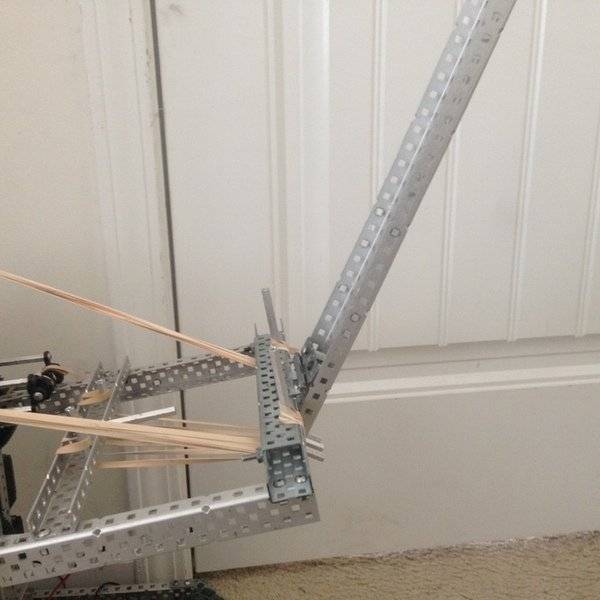
So this is for a competition called VEX robotics, i figured that could matter to any who wants to understand why i am asking but since it is a physics question i cam here. So currently my machine throws about 4 feet high but only 2 feet across. I just want to know is the physics behind designing a catapult so that i can figure out what can be accomplished to get more horizontal distance and a little less vertical distance. My Physics teacher said to look at the angle on the piece where the object sits, is this true and what should i look at? Please include any formulas because i do not understand where the angle comes into play. here is a picture when the machine is in the thrown position for reference, when it is down the outstretched c channel is parallel to the ground.
So this is for a competition called VEX robotics, i figured that could matter to any who wants to understand why i am asking but since it is a physics question i cam here. So currently my machine throws about 4 feet high but only 2 feet across. I just want to know is the physics behind designing a catapult so that i can figure out what can be accomplished to get more horizontal distance and a little less vertical distance. My Physics teacher said to look at the angle on the piece where the object sits, is this true and what should i look at? Please include any formulas because i do not understand where the angle comes into play. here is a picture when the machine is in the thrown position for reference, when it is down the outstretched c channel is parallel to the ground.