Help with the physics of a Catapult

  • Thread starter Thread starter ApPhysicsStudent
  • Start date Start date
  • Tags Tags
    Catapult Physics
Click For Summary

Discussion Overview

The discussion revolves around the physics of designing a catapult for a robotics competition, specifically focusing on how to optimize the launch angle and velocity to achieve greater horizontal distance while managing vertical height. Participants explore concepts related to projectile motion and the mechanics of catapult design.

Discussion Character

  • Exploratory
  • Technical explanation
  • Mathematical reasoning

Main Points Raised

  • One participant seeks guidance on the physics behind catapult design to improve the horizontal distance of their robot's projectile.
  • Another participant suggests studying projectile motion, indicating that the launch angle and velocity are critical factors that affect range.
  • There is a discussion about achieving a 45-degree launch angle for maximum range, with questions about which angle to adjust: the angle of the projectile at launch or the stop angle of the arm.
  • A participant advises that adjustments may be needed to ensure the projectile launches at 45 degrees, emphasizing the importance of the arm's stop angle and the potential impact of centrifugal force on the projectile's trajectory.
  • Equations related to projectile motion are mentioned, with clarification that the initial angle refers to the angle at which the projectile leaves the catapult, typically when the arm stops moving.

Areas of Agreement / Disagreement

Participants generally agree on the importance of the launch angle in projectile motion, particularly the 45-degree angle for maximum range. However, there is some uncertainty regarding which specific angle adjustments are necessary for optimal performance, indicating that the discussion remains unresolved.

Contextual Notes

Participants mention factors such as the potential for the projectile to slide on the catapult, which could affect the launch angle and overall trajectory. There are also references to the need for further calculations involving sliding velocity and net velocity, suggesting that some mathematical steps remain unresolved.

ApPhysicsStudent
Messages
4
Reaction score
0
So currently i am working on a robot, and i have gone to my physics teacher on how to help me achieve what i want out of it but she was not detailed with her explanation. It is only her second year teaching physics so i don't blame her but this seemed like a good place to put it.

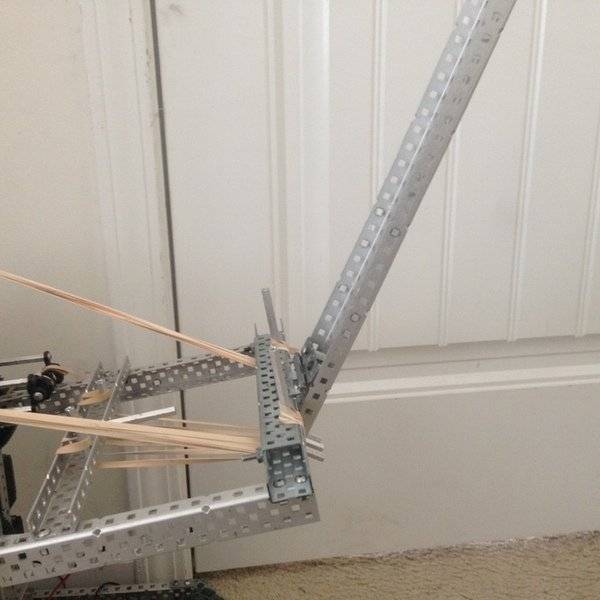
So this is for a competition called VEX robotics, i figured that could matter to any who wants to understand why i am asking but since it is a physics question i cam here. So currently my machine throws about 4 feet high but only 2 feet across. I just want to know is the physics behind designing a catapult so that i can figure out what can be accomplished to get more horizontal distance and a little less vertical distance. My Physics teacher said to look at the angle on the piece where the object sits, is this true and what should i look at? Please include any formulas because i do not understand where the angle comes into play. here is a picture when the machine is in the thrown position for reference, when it is down the outstretched c channel is parallel to the ground.
jhrl39.jpg
 
Engineering news on Phys.org
Read up on projectile motion. The launch angle and velocity alter the range. Max range is typically achieved at a 45 degree launch angle if the launch point and target area are at the same height.
 
CWatters said:
Read up on projectile motion. The launch angle and velocity alter the range. Max range is typically achieved at a 45 degree launch angle if the launch point and target area are at the same height.
Ok thank you! But which angle should i be working to achieve 45? should it be the one that the object will be thrown on or the stop angle of the arm?
 
Change whatsoever you need so that the actual projectile launches at 45 degrees. You may need to change both of the angles you mention but I would start with the angle at which the arm stops.

Check that centrifugal force can't cause the projectile to slip out early as that will send it up at a steeper angle. Eg use a cup or similar on the arm to hold the projectile.
 
The equations: Projectile motion

The initial angle is the one when the projectile will leave the cup of your catapult, so usually when the arm will stop. As @CWatters said, this is assuming the projectile doesn't slide on the catapult as it moves up. In that case, you have to add the sliding velocity (as a vector) to the arm velocity to find the net velocity of the projectile and its true angle.
 

Similar threads

  • · Replies 3 ·
Replies
3
Views
1K
Replies
4
Views
4K
  • · Replies 18 ·
Replies
18
Views
2K
  • · Replies 14 ·
Replies
14
Views
5K
Replies
3
Views
3K
  • · Replies 1 ·
Replies
1
Views
2K
  • · Replies 10 ·
Replies
10
Views
3K
Replies
2
Views
2K
  • · Replies 5 ·
Replies
5
Views
1K
  • · Replies 2 ·
Replies
2
Views
2K