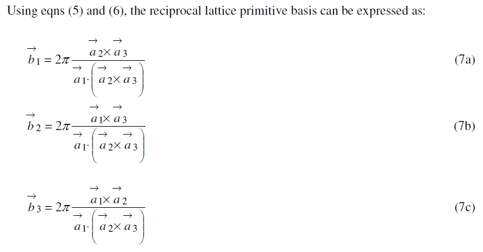
How are equations 7a, 7b, 7c derived from equations 5 and 6?

4 replies · 3K views · last reply
sam45
Messages
3
Reaction score
0
TL;DR
I am trying to understand how to determine the reciprocal lattice basis from the lattice basis vectors
may someone explain to me or show me the steps of how equations 7a, 7b, 7c were determined from equations 5 and 6
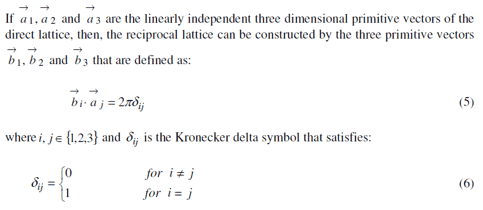
Printed text defining reciprocal lattice vectors b1, b2, b3 from primitive direct lattice vectors a1, a2, a3 via b_i · a_j = 2π δ_ij (eq. 5), with the Kronecker delta defined as 0 for i ≠ j and 1 for i = j (eq. 6).

Three equations labelled 7a, 7b and 7c giving reciprocal lattice primitive vectors b1, b2, b3 as 2π times cross products of the direct vectors a2 and a3, a3 and a1, a1 and a2, divided by a1 dot (a2 cross a3).
 
You can check directly that those formulas for the ##b_i## satisfy the equations that you want. For example, ##b_1\cdot a_1=2\pi\frac{a_1\cdot (a_2\times a_3)}{a_1\cdot (a_2\times a_3)}=2\pi##.

Since the vectors ##a_i## are linearly independent, the equations ##b_i\cdot a_j=2\pi\delta_{ij}## can be uniquely solved for the ##b_i##, and hence the above are the unique solutions.

If you wanted to figure out these formulas from scratch, you could argue like this: since ##b_1## is orthogonal to both ##a_2## and ##a_3##, you know that ##b_1=c_1 (a_2\times a_3)## for some constant ##c_1##. Then the equation ##a_1\cdot b_1=2\pi## let's you solve for ##c_1##, etc.
 
hello,

thank you. yes, but my question is how are they solved for bi i.e. what are the steps to find b1 for example

thank you
 
See the last paragraph of my post
Infrared said:
If you wanted to figure out these formulas from scratch, you could argue like this: since ##b_1## is orthogonal to both ##a_2## and ##a_3##, you know that ##b_1=c_1 (a_2\times a_3)## for some constant ##c_1##. Then the equation ##a_1\cdot b_1=2\pi## let's you solve for ##c_1##, etc.
 
  • Like
Likes   Reactions: sam45