member 664596
- TL;DR
- The presence of a stripe of artifact on the final MRI image would logically entail multiple points of frequency information on the actual (Fourier space) data acquisition; however, a zipper artifact is the result of a systematic corruption of a specific frequency. Why wouldn't it, then, manifest itself throughout the entire final image, as opposed to a single vertical stripe?
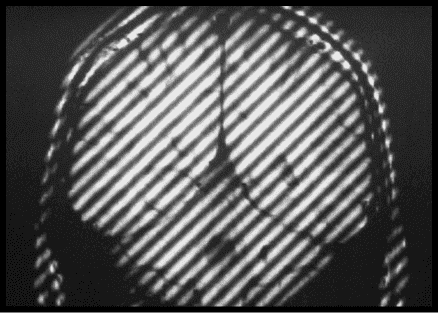
he so-called [herringbone or spike MRI artifact][1] on a given example could be traced to a specific point(s) in Fourier space ("k-space").
The idea is that during the acquisition of the image, a certain RF wave emitted by the patient (providing the info about diseased or normal anatomy) had become distorted by some extraneous RF interference, and sampled as such through a DFT process into Fourier space (k space). After producing the reverse FFT, that dot of artifact affected the whole image in a striped pattern:
There is another RF-interference artifact in MRI, called [zipper-artifact][3], manifested on the clinical images is as a thin stripe up and down:
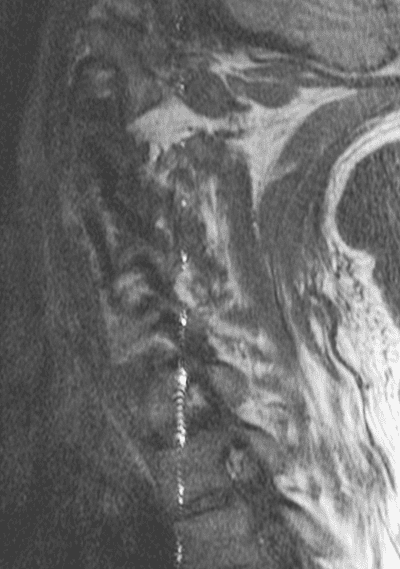
In the case of the zipper artifact there is a corruption of the signal sent back to the RF antenna from the patient being scanned, affecting a particular, specific frequency, which logically matches the polluting source. This frequency-specific phenomenon would affect each signal collected in the process of filling in k space. In contradistinction, a zipper artifact occurs at a single point in time, showing a dot in k-space.
The question is:
If every point of information in k-space (Fourier space) in MRI affects the entire reconstructed image after performing a reverse FFT, how can a frequency-specific problem in Fourier space produce a single vertical stripe on image space - as opposed to affecting the whole image as in the herringbone artifact above?
The idea is that during the acquisition of the image, a certain RF wave emitted by the patient (providing the info about diseased or normal anatomy) had become distorted by some extraneous RF interference, and sampled as such through a DFT process into Fourier space (k space). After producing the reverse FFT, that dot of artifact affected the whole image in a striped pattern:
There is another RF-interference artifact in MRI, called [zipper-artifact][3], manifested on the clinical images is as a thin stripe up and down:
In the case of the zipper artifact there is a corruption of the signal sent back to the RF antenna from the patient being scanned, affecting a particular, specific frequency, which logically matches the polluting source. This frequency-specific phenomenon would affect each signal collected in the process of filling in k space. In contradistinction, a zipper artifact occurs at a single point in time, showing a dot in k-space.
The question is:
If every point of information in k-space (Fourier space) in MRI affects the entire reconstructed image after performing a reverse FFT, how can a frequency-specific problem in Fourier space produce a single vertical stripe on image space - as opposed to affecting the whole image as in the herringbone artifact above?
Last edited by a moderator: