How can I cancel out vibration and noise coming from my upstairs neighbors?

  • Thread starter Thread starter NGC3034
  • Start date Start date
  • Tags Tags
    noise vibration
Click For Summary

Discussion Overview

The discussion revolves around methods to mitigate vibration and noise from upstairs neighbors in a concrete building. Participants explore various theoretical and practical approaches to soundproofing, including the use of materials and structural modifications.

Discussion Character

  • Exploratory
  • Technical explanation
  • Debate/contested
  • Experimental/applied

Main Points Raised

  • One participant suggests using a Tuned Mass Damper to address continuous vibrations but notes its limitations for single-cycle impacts.
  • Another participant proposes filling the concrete slab's cylindrical spaces with a heavy substance, such as tar or sand, to absorb impact energy and reduce vibrations.
  • There is a suggestion that increasing the mass or rigidity of the barrier is essential for low frequencies, while sealing air gaps is crucial for higher frequencies.
  • A participant recommends constructing a false ceiling isolated from the existing concrete to enhance soundproofing, using high-mass materials like plasterboard and sound-absorbent insulation.
  • Some participants discuss the potential effectiveness of using sand to fill cavities, noting its ability to dampen vibrations and prevent oscillations.
  • Questions arise regarding the impact of adding materials to the hollow voids, with concerns that it may not significantly improve sound transmission and could potentially worsen the situation.
  • There is a discussion about the nature of sounds produced by impacts on the slab, with references to the Q factor and its implications for sound damping.
  • One participant expresses skepticism about the practicality of injecting materials into the slabs, leaning towards the idea of using carpets and false ceilings instead.

Areas of Agreement / Disagreement

Participants express a range of views on the effectiveness of different soundproofing methods. While some agree on the potential benefits of false ceilings and heavy materials, others remain skeptical about filling the slab's voids and emphasize the importance of isolation from the existing structure. No consensus is reached on the best approach.

Contextual Notes

Participants acknowledge various limitations, including the challenges of estimating the Q factor for vibrations and the potential complications of sound transmission through solid structures versus hollow spaces. The discussion reflects a variety of assumptions and conditions that may affect the proposed solutions.

NGC3034
Messages
4
Reaction score
0
Hello gentlemen!
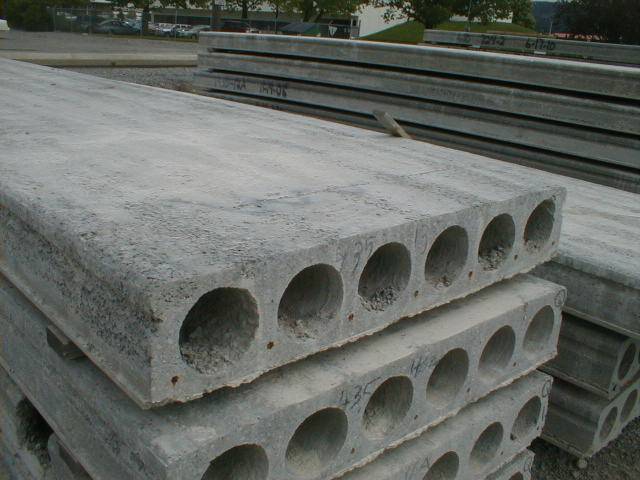
So I have a situation. Concrete floor (ceiling actually) slabs like these
8%20inch%20Hollow%20Core.JPG

has many cylindrical spaces in it. And noisy neighbors on top! The slab receives shocks / impacts and human shouts.
First I found Tuned Mass Damper. It is good for continuous vibration but not for first cycles after vibration applied. I mean shock is sort of "1-cycle vibration".
May be if I pump some kind of oil or solution of calculated density inside that slab it could absorb impact energy and convert it to waves or something...
Frequency range to be muted is about 10Hz - 3400Hz I think (it would be great to cover even short part of it).
I would like to hear your advice what you think could be done here?
 
Engineering news on Phys.org
NGC3034 said:
Hello gentlemen!
So I have a situation. Concrete floor (ceiling actually) slabs like these
8%20inch%20Hollow%20Core.JPG

has many cylindrical spaces in it. And noisy neighbors on top! The slab receives shocks / impacts and human shouts.
First I found Tuned Mass Damper. It is good for continuous vibration but not for first cycles after vibration applied. I mean shock is sort of "1-cycle vibration".
May be if I pump some kind of oil or solution of calculated density inside that slab it could absorb impact energy and convert it to waves or something...
Frequency range to be muted is about 10Hz - 3400Hz I think (it would be great to cover even short part of it).
I would like to hear your advice what you think could be done here?
I believe that for low frequencies the only way is to increase the mass or rigidity of the barrier. For higher frequencies, the slightest air gap will allow the sound through, so it must be totally sealed. Obviously a soft covering is going to help as well by absorbing impacts and higher frequency sounds.
 
tech99 said:
I believe that for low frequencies the only way is to increase the mass or rigidity of the barrier. For higher frequencies, the slightest air gap will allow the sound through, so it must be totally sealed. Obviously a soft covering is going to help as well by absorbing impacts and higher frequency sounds.
So the substance to be put in spaces must be as heavy as possible (tar/flux, may be something more realistic?) and putty all cracks carefully.
Surely soft covering could help but I'm afraid giving carpets as present would cost me a lot :sorry:
 
I think your best bet is to build a false ceiling that is isolated from (eg not fixed to) the existing concrete. The false ceiling should have a high mass (perhaps use several layers of plasterboard/dry wall). Should also be sound absorbent mineral wool or similar between the new false ceiling and the concrete.
 
  • Like
Likes   Reactions: russ_watters and NGC3034
NGC3034 said:
May be if I pump some kind of oil or solution of calculated density inside that slab it could absorb impact energy and convert it to waves or something...
Maybe partly fill the cavities with bedding sand that flows easily. It will be very lossy and so prevent oscillations following an impact.
 
  • Like
Likes   Reactions: NGC3034
256bits said:
Filling the concrete cavities with another substance besides air - speculative AFAIK
Speculation is good. Machine tool vibrations can be greatly reduced by partly filling some of the structure, or a bore in a tool holder, with free flowing sand or shot. Sand is cheap, garnet used for grit blasting might work well. The particles are thrown around by any vibration, so it dampens vibration and can prevent build up of oscillation or tool chatter.

With a heavy concrete beam you should estimate the Q of the oscillation resulting from an impact. A high Q resonance will need less added free mass and so be easier to dampen than a low Q resonance. But the low Q resonance is not so much of a problem as it lasts less time.
 
Thanks guys for your answers!
CWatters, 256bits,
There are services around building second ceilings. Just wanted to save height of the room. I'll pick heaviest from their options if I'll choose to use them.
Baluncore,
I like idea about sand. Is there a simple way to estimate the Q and subsequently mass of sand?
Speculation is good indeed :)
 
Does a hammer impact to the slab make it ring like a bell or does it sound like a short dull thud.
Loading with a sand should quickly turn the ring of a bell into a thud.
Any “thud” will be hard to stop. What is the most annoying sound?
What is the dominant frequency or musical note? How long does it ring for?
https://en.wikipedia.org/wiki/Q_factor#Physical_interpretation
 
  • #10
It won't make any significant difference putting stuff in the hollow voids and could make things worse. The sound is being transmitted by the solid parts not the hollow. That's why any solution involving a false ceiling should be isolated from the existing ceiling (eg the false ceiling should ideally be supported by the walls NOT the existing ceiling). There are things called "resilient bars" and "isolated/acoustic hangers" intended to allow plasterboard to be fixed to the existing ceiling. These can be effective but totally isolated is better.

If you really don't have the height for a false ceiling (may only take 4") then I think the only alternative that will be effective is to give the folks above carpet with sound reducing underlay.

Any penetration between floors for services or walls can bypass sound insulation making it less effective.

Here in the UK new houses have to meet Part E of the Building Regulations that covers sound transmission both between rooms and independent dwellings. This can be done by using proven floor and wall designs called "Robust Details". Some are free, others not. Typically companies that make hollow concrete floors and or sound insulation will have a drawing that shows how to use their products to make a floor that complies with UK regulations. Using one of these detail drawings can avoid the need for a sound test. Here is one example...

http://www.knaufinsulation.co.uk/sites/knaufuk/files/downloadfile/4_3-separating-floors_1.pdf

They seem to recommend a combination of underlay and resilient bars for new floors. For upgrading an existing floor they suggest an isolated/false ceiling as I suggested.
 
  • #11
Those are primarily dull thuds. Slabs don't really oscillate. And voices - another half of the problem. So considering also possible procedure to inject stuff inside slabs would be a challenge and CWatters scepticism I should go with carpets and false ceilings. Will keep in mind all details CWatters provided (Now I want to move to UK :smile: )
I was just imagining jelly inside a slab and how it absorbs energy. But if this so easy someone would already had invented appropriate technology.