How Can One 2nd Order ODE Have Different Solutions?

Click For Summary
SUMMARY

The discussion focuses on the solutions of the second-order ordinary differential equation (ODE) represented as \(\frac{d^2y}{dx^2}=ky\). It establishes that for \(k = -1\), the solution is \(y = \sin x\), while for \(k = 1\), the solution is \(y = e^x\). The use of Laplace transforms is highlighted as an effective method for deriving these solutions, leading to the general solution form \(y(x)=c_1e^{\sqrt{k}x}+c_2e^{-\sqrt{k}x}\). The relationship between sine and exponential functions is also noted, emphasizing the versatility of solutions based on the parameter \(k\).

PREREQUISITES
  • Understanding of second-order ordinary differential equations (ODEs)
  • Familiarity with Laplace transforms
  • Basic knowledge of exponential and trigonometric functions
  • Ability to manipulate complex numbers in mathematical expressions
NEXT STEPS
  • Study the application of Laplace transforms in solving differential equations
  • Explore the characteristics of solutions for different values of \(k\) in second-order ODEs
  • Investigate the relationship between trigonometric and exponential functions
  • Learn about initial value problems and their solutions in the context of ODEs
USEFUL FOR

Mathematicians, engineering students, and anyone interested in advanced calculus or differential equations will benefit from this discussion, particularly those looking to deepen their understanding of ODE solutions and methods.

tade
Messages
720
Reaction score
26
2nd Order ODE "Contradiction"?

To solve a 2nd order ODE, we can follow the steps as shown below. (Image 2 is a continuation from Image 1, apologies for the size difference.) :rolleyes:
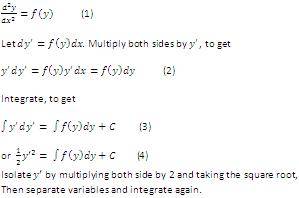
Fig.6_876.JPG

The method to obtain the solution is straightforward.

Let's say

\frac{d^2y}{dx^2}=ky

If k = -1, a possible solution is y = sin x. If k = 1, a possible solution is y = e^x.How do we obtain these two different solutions from one straightforward method?
 
Last edited by a moderator:
Physics news on Phys.org
tade said:
Let's say

\frac{d^2y}{dx^2}=ky

If k = -1, a possible solution is y = sin x. If k = 1, a possible solution is y = e^x.


How do we obtain these two different solutions from one straightforward method?
I think Laplace transforms look good for this.

$$\frac{d^2y}{dx^2}=ky\implies\mathcal{L}\{\frac{d^2y}{dx^2}\}(s)=k \mathcal{L}\{y\}(s)\\ s^2\mathcal{L}\{y\}(s)-\left.\frac{dy}{dx}\right|_0-sy(0)=k\mathcal{L}\{y\}(s) \\ \mathcal{L}\{y\}(s)=\frac{\frac{dy}{dx}|_0+sy(0)}{s^2-k}\\y(x)=\mathcal{L}^{-1}\left\{\frac{\frac{dy}{dx}|_0+sy(0)}{s^2-k}\right\}(x).$$
With a bit of simplifying, this comes down to ##y(x)=c_1e^{\sqrt{k}x}+c_2e^{-\sqrt{k}x}##.

Note that ##\sin{x}=\frac{e^{ix}-e^{-ix}}{2i}##. :wink:
 
Mandelbroth said:
With a bit of simplifying, this comes down to ##y(x)=c_1e^{\sqrt{k}x}+c_2e^{-\sqrt{k}x}##.

Note that ##\sin{x}=\frac{e^{ix}-e^{-ix}}{2i}##. :wink:

That's pretty neat.
 

Similar threads

  • · Replies 5 ·
Replies
5
Views
2K
  • · Replies 14 ·
Replies
14
Views
3K
  • · Replies 9 ·
Replies
9
Views
3K
  • · Replies 1 ·
Replies
1
Views
2K
  • · Replies 1 ·
Replies
1
Views
2K
  • · Replies 2 ·
Replies
2
Views
3K
  • · Replies 1 ·
Replies
1
Views
2K
Replies
3
Views
3K
  • · Replies 7 ·
Replies
7
Views
2K
  • · Replies 6 ·
Replies
6
Views
2K