How can we measure a galaxy's velocity via a star?

Click For Summary
SUMMARY

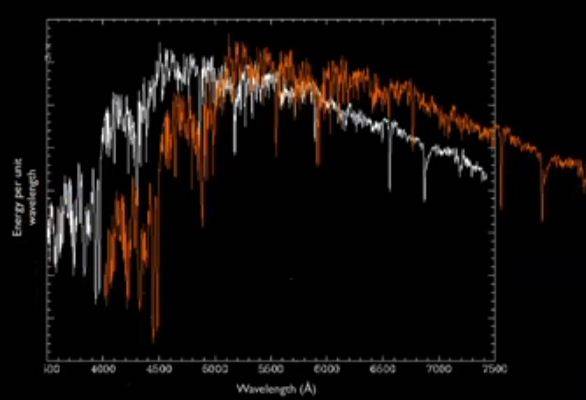
This discussion clarifies the method of measuring a galaxy's velocity through the spectrum of a star. The key point is that the star used for comparison is located within our galaxy, serving as a reference point or "laboratory" for spectral analysis. To determine redshift or blueshift, one must compare the absorption lines of the galaxy's spectrum to those obtained from laboratory measurements, rather than to the spectrum of the nearby star. This distinction is crucial for accurate velocity measurements of distant galaxies.

PREREQUISITES
  • Understanding of spectral analysis techniques
  • Familiarity with redshift and blueshift concepts
  • Knowledge of absorption lines in spectroscopy
  • Basic principles of astrophysics and galaxy dynamics
NEXT STEPS
  • Research the process of spectral analysis in astrophysics
  • Learn about redshift and blueshift calculations in cosmology
  • Study the significance of absorption lines in stellar spectroscopy
  • Explore laboratory methods for measuring spectral lines
USEFUL FOR

Astronomers, astrophysics students, and anyone interested in the methods of measuring cosmic velocities and understanding spectral data analysis.

Phys12
Messages
351
Reaction score
42
In this video (), we first took the spectrum of a star and then of a galaxy which look like the following:
Capture.jpg

However, what I don't get is: if we take the spectrum of a star and then of the galaxy the star is in, shouldn't it give me the same spectrum as they're moving in the same speed? And if we want to determine the redshift/blueshift, shouldn't we look at the absorption lines and compare them to the ones we get in our laboratories rather than a star itself?

Thanks!
 
Astronomy news on Phys.org
The star is in our galaxy, not in the galaxy whose redshift you are measuring. So the star is nearby and is basically "the laboratory".
 
  • Like
Likes   Reactions: Phys12
phyzguy said:
The star is in our galaxy, not in the galaxy whose redshift you are measuring. So the star is nearby and is basically "the laboratory".
Oh, got it, thanks! :)
 

Similar threads

  • · Replies 3 ·
Replies
3
Views
2K
  • · Replies 3 ·
Replies
3
Views
2K
  • · Replies 26 ·
Replies
26
Views
6K
  • · Replies 2 ·
Replies
2
Views
3K
  • · Replies 4 ·
Replies
4
Views
2K
  • · Replies 12 ·
Replies
12
Views
3K
  • · Replies 48 ·
2
Replies
48
Views
6K
  • · Replies 3 ·
Replies
3
Views
2K
  • · Replies 11 ·
Replies
11
Views
5K
  • · Replies 5 ·
Replies
5
Views
3K