Taz.
- 20
- 0
My teacher said there isn't a special kind of formula, you just derive it from f=ma.
This is the diagram:
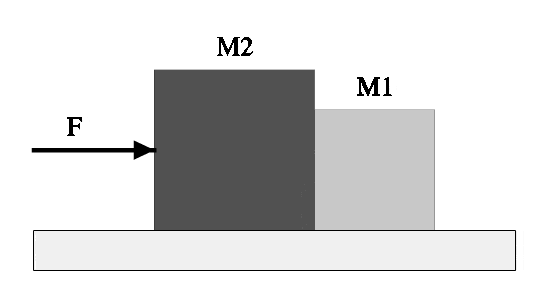
This is the diagram:
Doc Al said:I assume you want the contact force between those two masses. Your teacher is right. Just apply Newton's 2nd law.
Hint: First find the acceleration of the system.
Right.Taz. said:To find the the answer in N ?
So-> F= m1 * acceleration that I found for the whole system ?
That's Newton's 3rd law. Whenever two objects interact, they exert equal and opposite forces on each other.Ok, I found the answer. But scientifically, I don't understand how.
My teacher said that the contact force for both blocks is the same. How is that possible ?
Definitely.So if a bee flying at 10 km/h hits a car moving at 30 km/h the forces between both bodies is the same.
When applying Newton's 2nd law to m1, use the mass of m1.Taz. said:Why would you use the mass of m1 and not m2 ?
Right.Taz. said:My acceleration is: 1.32 m/s^2
That's correct.And then I just multiplied 1.32 m/s^2 by 1.39 m/s^2.
The contact force is not the only force acting on m2. To apply Newton's 2nd law to m2, you must use the net force: ƩF = m2*a.If I do 1.32 m/s^2 *3.46 m/s^2 I don't get the same answer...
Doc Al said:Sure. First identify the forces acting on each block. What forces act on m2? On m1?
I don't quite understand what you are doing here. You want:Taz. said:but just a last question-> for m2 is it 6.20 + F = 2.82 *1.18 OR -6.20 + F = 2.82 *1.18