For the following graph, find the number of walks of length $n$ from any vertex to any other vertex. Use of technology is allowed (but explain what you did and how you did it).
Remember to read the http://www.mathhelpboards.com/showthread.php?772-Problem-of-the-Week-%28POTW%29-Procedure-and-Guidelines to find out how to http://www.mathhelpboards.com/forms.php?do=form&fid=2!
No one solved this week's University POTW. Here is my solution.
First, you start with the adjacency matrix, where the $i,j$th entry in the matrix represents the number of paths from vertex $i$ to vertex $j$. Using Mathematica (really Wolfram Programming Cloud), I assigned this as follows:
produced $A$ back at me. Note that I introduced decimals to force Wolfram Programming Cloud to recognize the need for numerical computations. Unfortunately, the symbolic approach was far too unwieldy, as finding the eigenvalues involved solving a sixth-order polynomial - not even possible in principle.
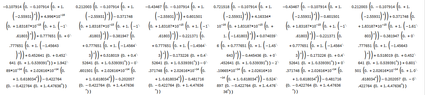
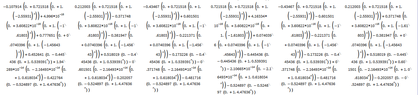
Now for the crux of the matter. It can be shown that the $i,j$th entry of $A^n$ gives the number of walks of length $n$ from vertex $i$ to vertex $j$. Hence, this diagonalization is precisely what is needed to compute the $n$th power of $A$. If $D$ is the diagonal matrix similar to $A$ - that is, $A=P^{-1}DP$ for some invertible $P$ - then $A^n=P^{-1}D^n P$, and $D^n$ turns out to be exceptionally easy to compute. All we have to do is exponentiate the main diagonals, and then perform the matrix multiplication indicated to get $A^n$. The result was quite a challenge to display. First the code:
I had to take six screenshots, one for each row, to get the full results to show up here on MHB. There is far too much text for a single post otherwise. Here they are: