How to derive Schrodinger's equation?

Click For Summary
SUMMARY

The discussion centers on the derivation of Schrödinger's equation, emphasizing its status as a foundational principle in quantum mechanics rather than a derivation from first principles. Participants highlight that while the equation can be approached through various formulations, such as Lagrangian mechanics and the path integral formalism, it is often treated as an empirical starting point. Richard Feynman's insights are referenced, noting that Schrödinger's equation emerged from experimental observations rather than theoretical derivation. The conversation also points to resources like "Modern Quantum Mechanics" by JJ Sakurai for a more structured derivation.

PREREQUISITES
  • Understanding of quantum mechanics fundamentals
  • Familiarity with Lagrangian mechanics and the principle of least action
  • Knowledge of wave-particle duality and de Broglie's hypothesis
  • Basic concepts of Hamiltonian mechanics
NEXT STEPS
  • Study the derivation of Schrödinger's equation from the path integral formalism
  • Explore "Modern Quantum Mechanics" by JJ Sakurai for a structured approach to quantum principles
  • Investigate Richard Feynman's doctoral thesis for insights on quantum mechanics derivations
  • Learn about the relationship between momentum and energy in quantum mechanics through de Broglie's wave function
USEFUL FOR

Students of quantum mechanics, physicists interested in foundational principles, and educators seeking to explain the derivation of Schrödinger's equation in a comprehensive manner.

Astrocyte
Messages
15
Reaction score
4
Homework Statement:: Derive Schrödinger equation
Relevant Equations:: Schrödinger Equation

I want to find the derivation of Schrödinger Equation.
Actually, I learned quantum mechanics already, but I think the proof that begins from the plane wave solution is quit ambiguous.
Because I feel that the derivation of physical equations from "the solution" is not a right approach.
Is there any more elegant derivation that starts from the fundamental principle like conservation of energy and constraint condition?
 
Last edited:
Physics news on Phys.org
That's not really how physics work as it is an empirical science. You can typically start from the Schrödinger equation, which (on the more general form) will give you quantum mechanics. Then you can go out and do experiments to verify the predictions of quantum mechanics.

The way you arrive at things is typically educated guesswork rather than derivations from first principles. In some sense, the Schrödinger equation can be taken as the first principle.

Now, that being said, there are other equivalent formulations of quantum mechanics that rely upon other first principles where you can start from those and derive the Schrödinger equation. However, by the nature of equivalence, you could also have done it the other way around. (Cf. Newtonian mechanics vs Lagrange mechanics.)
 
  • Like
Likes   Reactions: Astrocyte
If I remember correctly one can derive the the Schrödinger equation from the path integral formalism starting from the classical Lagrangian ##L = \frac{m}{2}\dot{x}^2- V(x)##.
 
  • Like
Likes   Reactions: Astrocyte
Astrocyte said:
I want to find the derivation of Schrödinger Equation.
Richard Feynman (in “Feynman lectures Vol. III”, Chapter 16) puts it in the following way:

Where did we get that [Schrödinger’s equation] from? Nowhere. It’s not possible to derive it from anything you know. It came out of the mind of Schrödinger, invented in his struggle to find an understanding of the experimental observations of the real world. You can perhaps get some clue of why it should be that way by thinking of our derivation of Eq. (16.12) which came from looking at the propagation of an electron in a crystal.
 
  • Like
Likes   Reactions: malawi_glenn, vharihar, Hamiltonian and 1 other person
Orodruin said:
That's not really how physics work as it is an empirical science. You can typically start from the Schrödinger equation, which (on the more general form) will give you quantum mechanics. Then you can go out and do experiments to verify the predictions of quantum mechanics.

The way you arrive at things is typically educated guesswork rather than derivations from first principles. In some sense, the Schrödinger equation can be taken as the first principle.

Now, that being said, there are other equivalent formulations of quantum mechanics that rely upon other first principles where you can start from those and derive the Schrödinger equation. However, by the nature of equivalence, you could also have done it the other way around. (Cf. Newtonian mechanics vs Lagrange mechanics.)
Thank you for the answer.

The elements of Schrödinger equation are quit familiar one to me. The equation includes hamiltonian and energy.
So, I thought it can be derived from Lagrange mechanics(or Hamilton mechanics), which has basic principle called "principle of least action", or Lagrange multiplier (that is used to derive canonical ensemble). But I could not find it.
As you said, It maybe become the first principle of quantum mechanics like Newton's second law in classical physics. Then, the plane wave solution could be an example of the first principle like free fall motion in Newton mechanics.
 
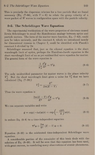
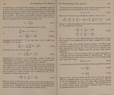
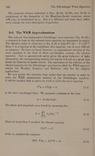
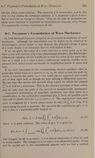
I don't think it is what you are looking for, but back in the day, I liked this discussion

Schodinger_1.pngSchrodinger_2.pngSchrodinger_3.png

Feynmann_1.pngFeynmann_2.png

from Borowitz Fundamentals of Quantum Mechanics (1967)
 
  • Like
  • Informative
Likes   Reactions: Hamiltonian, jtbell and Astrocyte
Astrocyte said:
So, I thought it can be derived from Lagrange mechanics(or Hamilton mechanics), which has basic principle called "principle of least action", or Lagrange multiplier (that is used to derive canonical ensemble).
Richard Feynman's doctoral thesis is exactly such a derivation. Not bad for a human. I'm not sure he extracts Sschrodinger per se.
 
  • Like
Likes   Reactions: Astrocyte
Before Schrödinger there was de Broglie, who had the idea that a wave of the form ##\psi(x,t) = e^{i kx - \omega t}## was associated with a particle. Then ##\hbar k## would be associated with the momentum of the particle, and ##\hbar \omega## would be associated with the energy. Assuming that the Newtonian relationship between momentum and energy held, so that ##p^2/2m = E##, this implies ##\hbar^2 k^2/2m = \hbar \omega##.

Clearly, ##\psi## would then satisfy ##- \frac{\hbar^2}{2m} \frac{d^2 \psi}{dx^2} = i \hbar \frac{d \psi}{dt}##. (It also satisfies ##|\dfrac{(\frac{d \psi}{dx})^2}{2m}| = |\dfrac{d\psi}{dt}|##, but that's an ugly, nonlinear equation. Nature wouldn't be so cruel...)
 
  • Like
Likes   Reactions: jbagley72, Delta2 and Astrocyte
  • Like
Likes   Reactions: jbergman and vanhees71
  • #10
There is an elegant, well-motivated derivation of the Schrödinger equation in Modern Quantum Mechanics by JJ Sakurai. It is based on the expected properties of the time evolution operator.
 
  • Like
Likes   Reactions: jbagley72, LittleSchwinger, hutchphd and 3 others

Similar threads

  • · Replies 39 ·
2
Replies
39
Views
2K
  • · Replies 2 ·
Replies
2
Views
1K
  • · Replies 17 ·
Replies
17
Views
3K
  • · Replies 3 ·
Replies
3
Views
652
  • · Replies 32 ·
2
Replies
32
Views
2K
  • · Replies 3 ·
Replies
3
Views
2K
  • · Replies 12 ·
Replies
12
Views
2K
  • · Replies 3 ·
Replies
3
Views
2K
  • · Replies 3 ·
Replies
3
Views
3K
  • · Replies 1 ·
Replies
1
Views
1K