Identifying which region in the conductor experiences a greater force

  • Thread starter Thread starter ellieee
  • Start date Start date
  • Tags Tags
    Conductor Force
Join the discussion
Registration is free. Ask a follow-up in this thread, or start your own.
3 replies · 1K views
ellieee
Messages
78
Reaction score
6
Homework Statement
using newton's third law of motion, suggest whether region K,L,M, or N has a greater magnetic force
Relevant Equations
nil
I feel that its M because as the conductor moves upwards, towards K, an equal but opposite force will be produced at M to pull the conductor downwards, but answer is K.
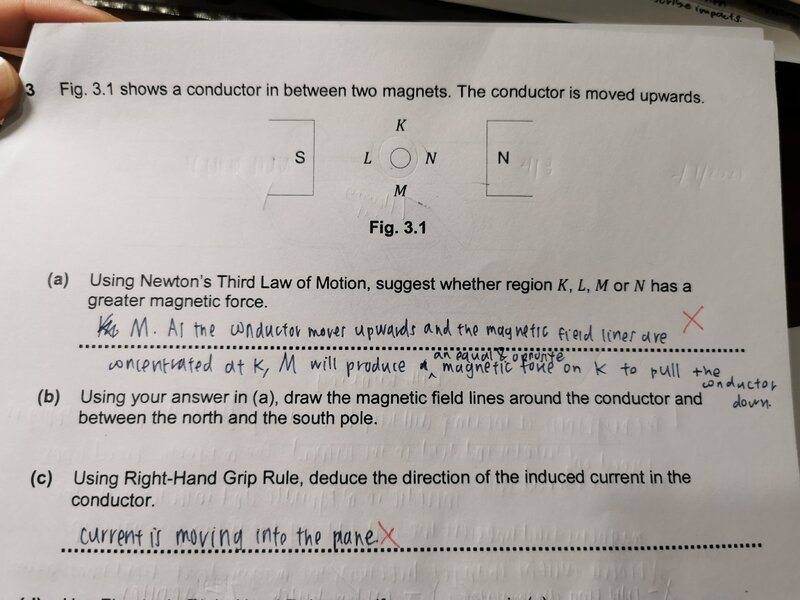
16253204730866744315348350721633.jpg
 
Last edited by a moderator:
Physics news on Phys.org
We are told that the conductor is moving up. According to Lenz's law, the induced current would be directed in such a way as to oppose the motion. For part (a) we don't need to know the direction of the motion but we do know that the force will be directed down, opposite to the motion.

Now imagine that the conductor is moving up with constant velocity being pushed by a hand. When that happens, the hand force is up, the field force is down and the two have equal magnitudes and opposite directions according to the 3rd law.

It looks like you missed the Lenz's law justification for the direction of the induced force on the conductor. This is a case of magnetic braking. If the current flowed in the opposite direction and assisted the motion of the conductor, then it would accelerate forever and have a source of abundant cheap energy.
 
Out of curiosity, can I ask where these questions are from? The language in them seems a bit odd.
To use "has" a force rather than exerts or experiences a force seems unusual. Also, in the one about the bulb and the coil the expression "State and explain your observations" sounds strange given that you're not actually observing anything; more normal would be to be "what you would observe" or "what you would expect to observe".

In style and content, they look very much like A-level type questions but the wording leads me to believe they're not really.
 
rsk said:
Out of curiosity, can I ask where these questions are from? The language in them seems a bit odd.
To use "has" a force rather than exerts or experiences a force seems unusual. Also, in the one about the bulb and the coil the expression "State and explain your observations" sounds strange given that you're not actually observing anything; more normal would be to be "what you would observe" or "what you would expect to observe".

In style and content, they look very much like A-level type questions but the wording leads me to believe they're not really.
they are olevel questions