David Neves
- 61
- 23
What do you think of the following paper about QED?
https://journals.aps.org/prd/pdf/10.1103/PhysRevD.96.085002
Infrared divergences in QED revisited
Daniel Kapec, Malcolm Perry, Ana-Maria Raclariu, and Andrew Strominger
Phys. Rev. D 96, 085002 (2017) – Published 10 October 2017
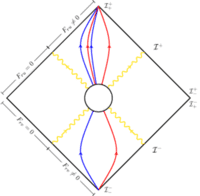
It has been found recently that the vacuum state of quantum electrodynamics (QED) is infinitely degenerate. The authors exploit this fact and show that any non-trivial scattering process in QED is necessarily accompanied by a transition among the degenerate vacua, making the scattering amplitude finite at low energy scales (infrared finite).
Recently, it has been shown that the vacuum state in QED is infinitely degenerate. Moreover, a transition among the degenerate vacua is induced in any nontrivial scattering process and determined from the associated soft factor. Conventional computations of scattering amplitudes in QED do not account for this vacuum degeneracy and therefore always give zero. This vanishing of all conventional QED amplitudes is usually attributed to infrared divergences. Here, we show that if these vacuum transitions are properly accounted for, the resulting amplitudes are nonzero and infrared finite. Our construction of finite amplitudes is mathematically equivalent to, and amounts to a physical reinterpretation of, the 1970 construction of Faddeev and Kulish.
https://journals.aps.org/prd/pdf/10.1103/PhysRevD.96.085002
Infrared divergences in QED revisited
Daniel Kapec, Malcolm Perry, Ana-Maria Raclariu, and Andrew Strominger
Phys. Rev. D 96, 085002 (2017) – Published 10 October 2017
It has been found recently that the vacuum state of quantum electrodynamics (QED) is infinitely degenerate. The authors exploit this fact and show that any non-trivial scattering process in QED is necessarily accompanied by a transition among the degenerate vacua, making the scattering amplitude finite at low energy scales (infrared finite).
Recently, it has been shown that the vacuum state in QED is infinitely degenerate. Moreover, a transition among the degenerate vacua is induced in any nontrivial scattering process and determined from the associated soft factor. Conventional computations of scattering amplitudes in QED do not account for this vacuum degeneracy and therefore always give zero. This vanishing of all conventional QED amplitudes is usually attributed to infrared divergences. Here, we show that if these vacuum transitions are properly accounted for, the resulting amplitudes are nonzero and infrared finite. Our construction of finite amplitudes is mathematically equivalent to, and amounts to a physical reinterpretation of, the 1970 construction of Faddeev and Kulish.