Inscribed Quadrilateral Perpendicular Bisectors Convergence Theorem

  • Context: High School 
  • Thread starter Thread starter anemone
  • Start date Start date
Click For Summary
SUMMARY

The Inscribed Quadrilateral Perpendicular Bisectors Convergence Theorem states that for an inscribed quadrilateral ABCD, if P, Q, and R are the feet of the perpendiculars from point D to lines BC, CA, and AB respectively, then the condition PQ = QR holds true if and only if the angle bisectors of angles ABC and ADC intersect on line AC. This theorem provides a geometric relationship between the perpendiculars and angle bisectors in cyclic quadrilaterals.

PREREQUISITES
  • Understanding of cyclic quadrilaterals
  • Knowledge of angle bisectors in geometry
  • Familiarity with perpendicular lines and their properties
  • Basic concepts of geometric proofs
NEXT STEPS
  • Study the properties of cyclic quadrilaterals in-depth
  • Learn about the construction and application of angle bisectors
  • Explore geometric proof techniques related to perpendicular bisectors
  • Investigate other theorems related to inscribed angles and their properties
USEFUL FOR

Mathematicians, geometry enthusiasts, and educators looking to deepen their understanding of cyclic quadrilaterals and their properties, particularly in relation to perpendicular bisectors and angle bisectors.

anemone
Gold Member
MHB
POTW Director
Messages
3,851
Reaction score
115
Here is this week's POTW:

-----

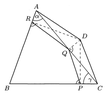
Let $ABCD$ be an inscribed quadrilateral. Let $P$, $Q$ and $R$ be the feet of the perpendiculars from $D$ to the lines $BC$, $CA$ and $AB$ respectively. Show that $PQ = QR$ if and only if the bisectors of $\angle ABC$ and $\angle ADC$ meet on $AC.$

-----

Remember to read the https://mathhelpboards.com/showthread.php?772-Problem-of-the-Week-%28POTW%29-Procedure-and-Guidelines to find out how to https://mathhelpboards.com/forms.php?do=form&fid=2!
 
Physics news on Phys.org
No one answered last week's POTW. (Sadface) You can refer to the suggested solution as shown below.

View attachment 9265

Denote in the triangle $ABC$ the angles at $A$ and $C$ by $\alpha$ and $\gamma$ respectively. $P$ and $Q$ are incident to the Thales circle of $CD$ and $\sin \angle PCQ=\sin \gamma$ or $PQ=CD\sin \gamma$.

Similarly, $QR=AD\sin \alpha$. By condition

$PQ=CD \sin \gamma=AD\sin \alpha=QR$

Rearranging and applying the sine rule for the triangle $ABC$ yields

$\dfrac{CD}{AD}=\dfrac{\sin \alpha}{\sin \gamma}=\dfrac{CB}{AB}$

By the angle bisector theorem, this holds if and only if the bisectors of $\angle ABC$ and $\angle ADC$ meet the segment $AC$ at the very same point.
 

Attachments

  • potw 382.png
    potw 382.png
    6.2 KB · Views: 117

Similar threads

  • · Replies 1 ·
Replies
1
Views
2K
  • · Replies 1 ·
Replies
1
Views
1K
  • · Replies 1 ·
Replies
1
Views
2K
  • · Replies 1 ·
Replies
1
Views
2K
  • · Replies 1 ·
Replies
1
Views
1K
  • · Replies 1 ·
Replies
1
Views
1K
  • · Replies 1 ·
Replies
1
Views
1K
  • · Replies 2 ·
Replies
2
Views
2K
  • · Replies 1 ·
Replies
1
Views
2K
  • · Replies 1 ·
Replies
1
Views
1K