Interesting DOF Result: No Matter Focal Length, Ratio is Constant

  • Thread starter Thread starter Borek
  • Start date Start date
  • Tags Tags
    Dof Interesting
Click For Summary

Discussion Overview

The discussion revolves around the relationship between focal length, depth of field (DOF), and the size of the object being photographed. Participants explore mathematical formulations and assumptions related to DOF, particularly in the context of photography, with a focus on how these factors interact under various conditions.

Discussion Character

  • Exploratory
  • Technical explanation
  • Mathematical reasoning
  • Debate/contested

Main Points Raised

  • One participant notes that the ratio of DOF to object size remains constant regardless of focal length, suggesting that focal length has a minimal effect on this ratio for small objects.
  • Another participant questions the availability of mathematical proof for the claims made, expressing uncertainty about the role of focal distance in DOF calculations.
  • A participant shares a resource for DOF calculations, indicating reliance on established equations.
  • One participant presents a detailed mathematical derivation of DOF, highlighting assumptions made in existing formulas and suggesting that the relationship between focal length and DOF may not be straightforward due to lens asymmetry.
  • The same participant emphasizes the importance of maintaining a constant magnification ratio when varying focal lengths, leading to a simplified formula for DOF that appears independent of focal length under certain conditions.
  • Concerns are raised about the validity of common assumptions in online calculators regarding focal lengths, with references to specific lens types and their characteristics.
  • There is an expressed desire to develop a simple scaling law for DOF, but challenges are noted due to the complexity of the mathematical relationships involved.

Areas of Agreement / Disagreement

Participants express differing views on the implications of focal length on DOF, with some supporting the idea that it has minimal impact while others challenge this notion through mathematical exploration. The discussion remains unresolved regarding the validity of certain assumptions and the sensitivity of DOF calculations to variations in focal length.

Contextual Notes

Participants acknowledge limitations in existing formulas, particularly regarding the assumption that focal lengths are equal, and the implications of lens design on DOF calculations. There is also mention of the complexity involved in deriving a simple relationship for DOF.

Borek
Mentor
Messages
29,204
Reaction score
4,626
Perhaps it is known to you, it was something new to me.

After Andy confirmed that reasonable circle of confusion for my camera should be about 0.02mm, I did some calculations - and I was surprised by the result.

Say you have an object that you want to take a picture of (be it flower, book, chair - something like that). Say its size is x cm and you want it to fit whole frame. What focal length lens should you use to get the largest DOF (assuming f-number of 8, as it usually gives best results)?

The answer is... it doesn't matter! Well, almost doesn't matter:
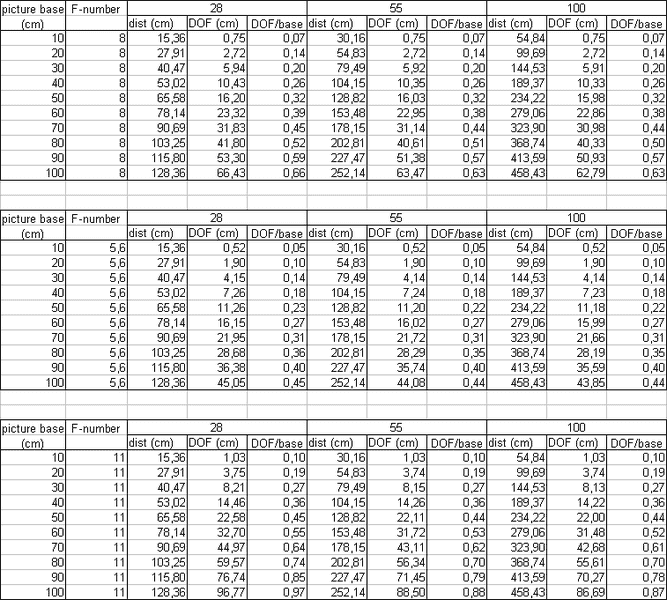
DOF_vs_focal.png


Note how for a given size of the object DOF/base ratio is always the same, no matter what focal length you use. For example - 30 cm object, f-number of 8, DOF/object size is always 0.20.

Picture base is a width of the object, dist is a distance between object and the sensor (for obvious reasons it changes with the focal length), DOF/base is the ratio between DOF and object size - and it turns out this ratio almost doesn't depend on the focal length. At least as long as we are talking about relatively small objects up to 1 meter. Shorter focal lengths give marginally larger DOF - that's what I expected, but I expected the difference to be much larger. Turns out short focal length means you have to get close to the object, and DOF gets smaller - so there is no gain.
 
Physics news on Phys.org
Is the math available somewhere? I know, it's common assumption, that DOF is supposed to be only a function of magnification, aperture and CoC. However, when I did the math some eons ago, I ended up being unable to eliminate the focal distance. It appears that larger f's decreases DOF very slightly, even with the same magnification and CoC.

I guess I have to redo that math. :-p
 
Last edited:
Borek said:
Perhaps it is known to you, it was something new to me.

This was a very nice result and a very clever piece of work. I hacked at this problem for a while, and although I made some progress, I don't think I completely solved it.

The wiki page (http://en.wikipedia.org/wiki/Depth_of_field) has a lot of useful information, but there's an assumption made very early in the derivation (as does all the other DOF sites I found) that is not always valid. I'm not sure there's value in presenting the detailed work, but I'll present the main results.

Start with Gauss's formula for a thin lens: f/s + f'/s' =1, where f and f' are the front and rear focal lengths, s is the object distance and s' the image distance. Recall that photographic lens focal length specifications are f'. The initial result is (pardon the text formatting):

DOF = 2s/[f/Nc(ff'/(f^2-f's))-Nc/f((f^2-f's)/ff')].

Where N is the f-number, c the CoC, etc. etc.

The problem with the online formulas I found is that the assumption f = f' is made too early. If f = f' then the usual formula is recovered from the above (and using m = f'/(f-s) = f/(f-s)). The issue is determining if f = f' is a valid assumption.

Photographic lenses are not symmetric because s != s', and in order to get good aberration correction, the lenses become asymmetric. My suspicion is that for 'normal' lenses (meaning say 35mm-85mm) f ~ f' because they are generally based on a double-Gauss configuration, but I know that telephoto lenses and microscope objectives have significantly different f and f'.

The key insight was to keep the magnification 'm' constant, or more specifically to keep the ratio s/s' constant as f' is varied. Keeping the approximation f = f' and rearranging the simplified formula gives the result:

DOF = 2Nc(m+1)/(m^2-(Nc/f)^2),

which clearly shows that as the f-number N increases the DOF increases. Now if we make another assumption, that s<<H (the hyperfocal distance) which is usually valid, then the DOF formula further simplifies to

DOF = 2Nc(m+1)/m^2,

which is independent of lens focal length, as Borek found (and is mentioned on the wiki page).

AFAICT, online calculators make use of the assumption that f = f', so the relevant question is the sensitivity of the full result when letting f/f' vary from 1. As a practical matter, since lens manufacturers don't provide data on f, I would have to measure it and that's too time consuming right now. I looked up a few telephoto lens prescriptions and found f/f' can be 3 or larger. My microscope objectives (including the luminars) have f/f' ratios that vary from about 1/1.6 (the 100mm luminar) down to 1/100 (100x objectives).

I had been hoping to generate some sort of simple scaling law for the DOF (DOF/Ns is dimensionless) but I couldn't get very far due to the complicated denominator. Maybe someone else will have better luck.
 

Similar threads

Replies
3
Views
3K
  • · Replies 79 ·
3
Replies
79
Views
14K
  • · Replies 6 ·
Replies
6
Views
3K
  • · Replies 9 ·
Replies
9
Views
9K
  • · Replies 7 ·
Replies
7
Views
7K
Replies
1
Views
4K
Replies
5
Views
2K
  • · Replies 3 ·
Replies
3
Views
3K
  • · Replies 2 ·
Replies
2
Views
2K
  • · Replies 7 ·
Replies
7
Views
14K